Waterjet Cutting, Inlays & Shaped Parts
For stone inlays, floor medallions, shaped parts and through-cut openings.
- Materials
- Stone, ceramic, sintered stone, glass and metals where qualified on the selected waterjet.
- Process
- Cut contours, openings and specified angled faces. Dry-fit inlay pieces before any pressing.

Recommended setup
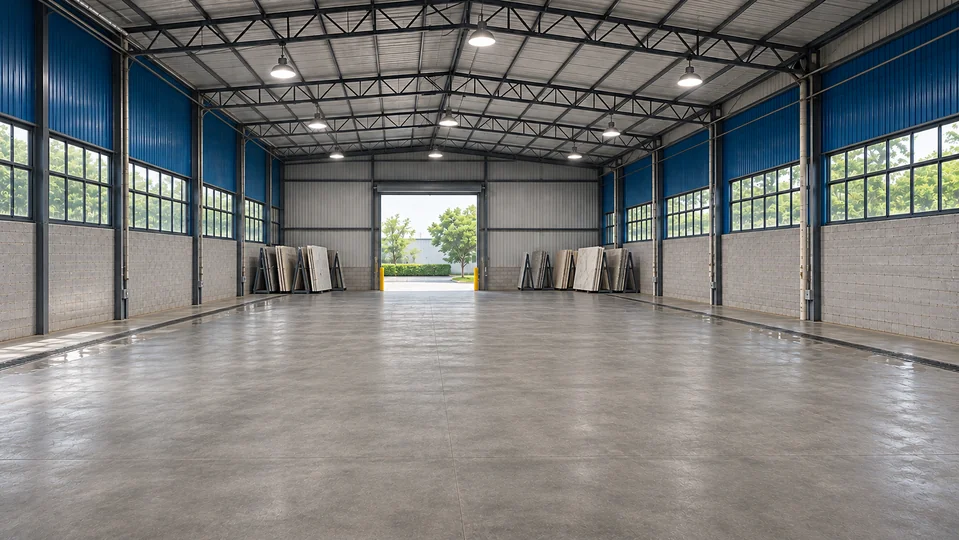
Setup 01 matches the workshop image above. Compare other setups for different parts or processes.
Setup 01
2060 five-axis waterjet + hydraulic inlay press
Cut shaped parts and inlay segments on the 2060. Press a bonded inlay only when the backing and adhesive method call for it.
Workflow
- Waterjet-cut and sort marked pieces
- Dry-fit the pattern and check both cut faces
- Press compatible inlays when specified
-
2060 Five-Axis Waterjet
Cut long contours and nested stone parts. Qualify angled faces where required.
- Output
- Long or nested parts for inspection and assembly.
- Overall size
- 7000 × 2800 × 2015 mm
-
1200 Hydraulic Inlay Press
Press compatible inlay assemblies using the nominated backing and adhesive.
- Output
- Pressed assemblies ready for the specified cure and inspection.
- Overall size
- 2700 × 1600 × 1700 mm
Compare other setups
Setup 02
Three-axis waterjet + matched pressure system
For flat parts and patterns with vertical cut faces.
Workflow
- Nest and support the blank
- Through-cut the shapes
- Check fit and cut-face quality
-
Three-Axis Abrasive Waterjet
Through-cut flat profiles with a vertical jet.
- Output
- Flat shapes and inlay segments.
-
Waterjet High-Pressure Intensifier Cabinet
Supply high-pressure water to a compatible waterjet.
- Output
- Pressurized water for the cutting head.
Setup 03
Five-axis waterjet + matched pressure system
For jobs with angled cut faces. Qualify the top and bottom dimensions on a sample.
Workflow
- Set face and angle references
- Cut the trial profile
- Check both faces and mating fit
-
Five-Axis Waterjet
Cut contours and angled faces on supported workpieces.
- Output
- Shaped parts with the specified through-cut face.
-
Waterjet High-Pressure Intensifier Cabinet
Supply high-pressure water to a compatible waterjet.
- Output
- Pressurized water for the cutting head.
Finished parts in use
Compare flat inlays, curved mating pieces and fixture openings. Inspect the cut faces before bonding or assembly. Applications are shown for illustration.
Floor inlays and repeated motifs
-

Dry-laid inlay Dry-fit the full pattern and check both cut faces. Press only if the backing and adhesive specification calls for it. -

Installed floor medallion Check joint consistency, pattern alignment and flush transitions. -

Repeating fan inlay Dry-lay adjacent repeats to check that the curves, spacing and end points line up along the run. -
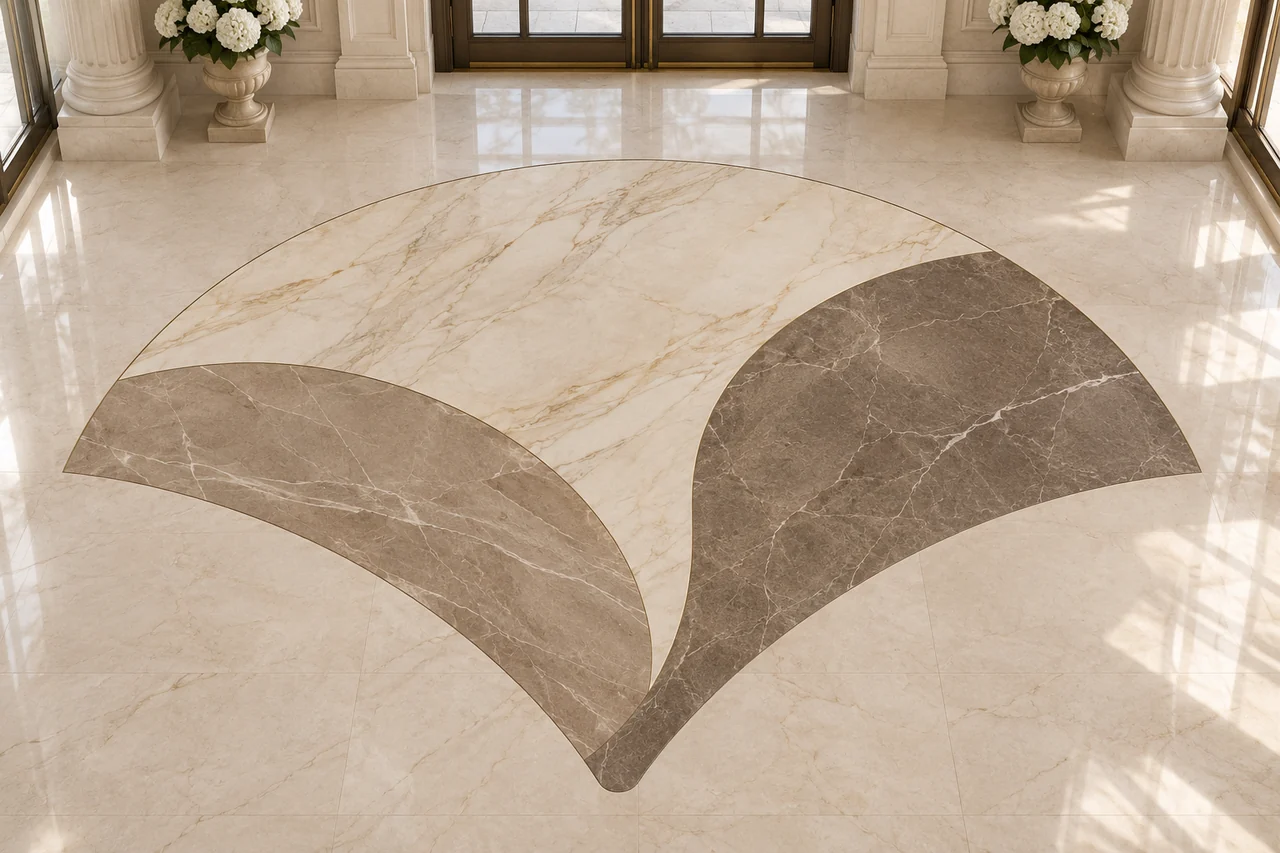
Leaf-shaped floor inlay Check the narrow tips and curved joints on a full motif before cutting the remaining pieces.
Service openings and curved joints
-

Through-cut service opening Measure the opening at both faces and check the ends for taper or chipping. -

Fitted service opening Trial-fit the hardware or insert and check that the finished edge clears the part. -

Curved mating pieces Check the angle and gap at both faces of a dry-fitted pair. -

Fitted curved joint Check that the curve meets the adjacent panel at the specified position and face level.
Check the fit for your workshop
Check your drawings against machine limits, then plan how slabs and finished parts will move through the workshop.
Part requirements
Provide the closed contours, face orientation, required cut angle and the template for mating pieces. Identify the backing and which assemblies require pressing.
Cut face
State whether each edge is vertical or angled, and define the measuring face.
Minimum features
Mark small bridges, opposing curves and tight internal details on the drawing.
Inlay assembly
Confirm pattern breaks, backing, adhesive and intended cure process.
Single-machine operations and model details
 Machine details
2060 Five-Axis Waterjet
- Functions
- Cut long contours and nested stone parts. Qualify angled faces where required.
- Core configuration
- Five-axis cutting head with a 2000 × 6000 mm effective cutting stroke. The 7000 × 2800 mm planning footprint covers the cutter itself. Allow separate space for the pressure package.
 Machine details
1200 Hydraulic Inlay Press
- Functions
- Press compatible inlay assemblies using the nominated backing and adhesive.
- Core configuration
- Hydraulic press with a 1200 × 1200 mm working area. Confirm the backing, pressure method and cure sequence.
 Machine details
Three-Axis Abrasive Waterjet
- Functions
- Through-cut flat profiles with a vertical jet.
- Core configuration
- Three-axis motion with abrasive waterjet cutting. Trial material, thickness and the lower cut face.
 Machine details
Waterjet High-Pressure Intensifier Cabinet
- Functions
- Supply high-pressure water to a compatible waterjet.
- Core configuration
- High-pressure intensifier system. Match the pressure source, cooling and utilities to the selected cutting configuration.
 Machine details
Five-Axis Waterjet
- Functions
- Cut contours and angled faces on supported workpieces.
- Core configuration
- Five-axis cutting head. Verify the required cut angle, thickness and top and bottom geometry on a sample.
Workshop layout and handling
The estimate adds the footprints of the machines in Setup 01. Allow extra room for loading, aisles, servicing and auxiliary equipment. Confirm the installed layout for your site.
- Waterjet utilities
- Plan space and access for the matched pressure system, water treatment and abrasive supply.
- Safe blank support
- Allow room to load the largest blank and retrieve small pieces from the cutting bed.
- Pattern assembly
- Keep a dry sorting and lay-up bench near the packing area.
Technical answers
Before you order
Review machine fit and sample checks, then see what to send for an equipment quote.
Discuss your setupWhen does an inlay need the press?
Use the press when the backing and adhesive method call for it and the dry-laid assembly fits the 1200 × 1200 mm working area. Cut-only parts go to inspection after cutting.
Which size limits apply to the 2060?
The effective cutting stroke is 2000 × 6000 mm. Check support for the actual workpiece and reserve separate space for the pressure package and abrasive supply.
What should I record from the trial?
Check the top and bottom fit of the tightest contour and dry-lay the full inlay. Record joint widths, fit to adjoining pieces and the press or cure conditions if used. See the finished-part checks.
What do you need for a quote?
Send the part files, material and thickness, maximum profiles, requested angles and the smallest joint. Include the complete inlay size, backing and bonding method if pressing is needed.
