Sales, delivery & service
FAQ & support
FAQs on choosing and ordering a machine, delivery and installation, and after-sales support. Browse technical FAQs by model.
01 / Buying a machine
Before you order

The CAD model shows the machine’s layout and how the main assemblies fit together.
Should I buy directly from HoYun or through a dealer?
The best option depends on the machine and delivery destination. HoYun can advise whether to order directly or through a dealer.
Can the machine match my site power supply?
Compatibility depends on the site voltage, frequency and phase. The quotation lists the electrical specification for the configuration offered.
Can I fit accessories after purchase?
That depends on the machine’s mounting points and available connections. Some options may need to be specified when the machine is ordered.
What information helps you recommend a machine?
Machine selection depends on the material and thickness, maximum workpiece size, required processes and target output. Drawings, finish samples and workshop dimensions help narrow down the options.
Can I discuss a sample test or factory acceptance test?
Both tests can be discussed before ordering. The material, drawings and required finish or tolerance help define what to test, what counts as a pass and how results will be reviewed.
02 / Getting set up
Delivery & installation

A forklift positions the wrapped bridge saw at the container entrance before loading.
Can you deliver to my country?
Shipping options depend on the machine and destination. For an existing order, the order reference helps identify the delivery arrangements.
What needs to be arranged before shipment?
The packed dimensions affect transport. The shipping arrangements cover freight terms, timing and who handles import and unloading.
Does my order include installation or training?
HoYun offers installation support and operator training. What is included depends on the quotation or order agreement, including the format, location, on-site work and charges.
Can I run the machine as soon as it arrives?
That depends on how it ships. Any required assembly, utility connections and commissioning checks come before operation, as described in the instructions for the machine.
How should I prepare the workshop for delivery?
The site needs suitable access for delivery and unloading, enough floor space, utility connections and room for servicing. Requirements vary by model and layout.
03 / Keeping your machine running
After-sales & spare parts

With the machine cover open, the workshop team checks the components beneath it.
How do I request service or replacement parts?
HoYun or your supplier can help. The model, serial number or a nameplate photo identify the machine. The order reference and a description of the issue or part help identify what is needed.
How do I check my machine’s warranty?
The order terms define the warranty period, coverage and exclusions. The order reference helps identify the agreement for a claim.
Where do I find the maintenance schedule?
The schedule is in the manual or service instructions for your model. HoYun or your supplier can help you find the right document.
What should I record if my machine shows an alarm?
The exact message or code, what the machine was doing and whether the alarm has happened before help explain the problem. A photo of the display can capture the alarm text.
How do I identify the right replacement part?
The parts list or the original part may show the part number. If it’s missing, a photo, key dimensions and the mounting location help identify a match. Tooling dimensions and fit are covered in the tools & workshop equipment FAQs.
Technical questions
FAQs by machine
Choose a category, then open your model.
Hybrid waterjet machines
3 machines with FAQs
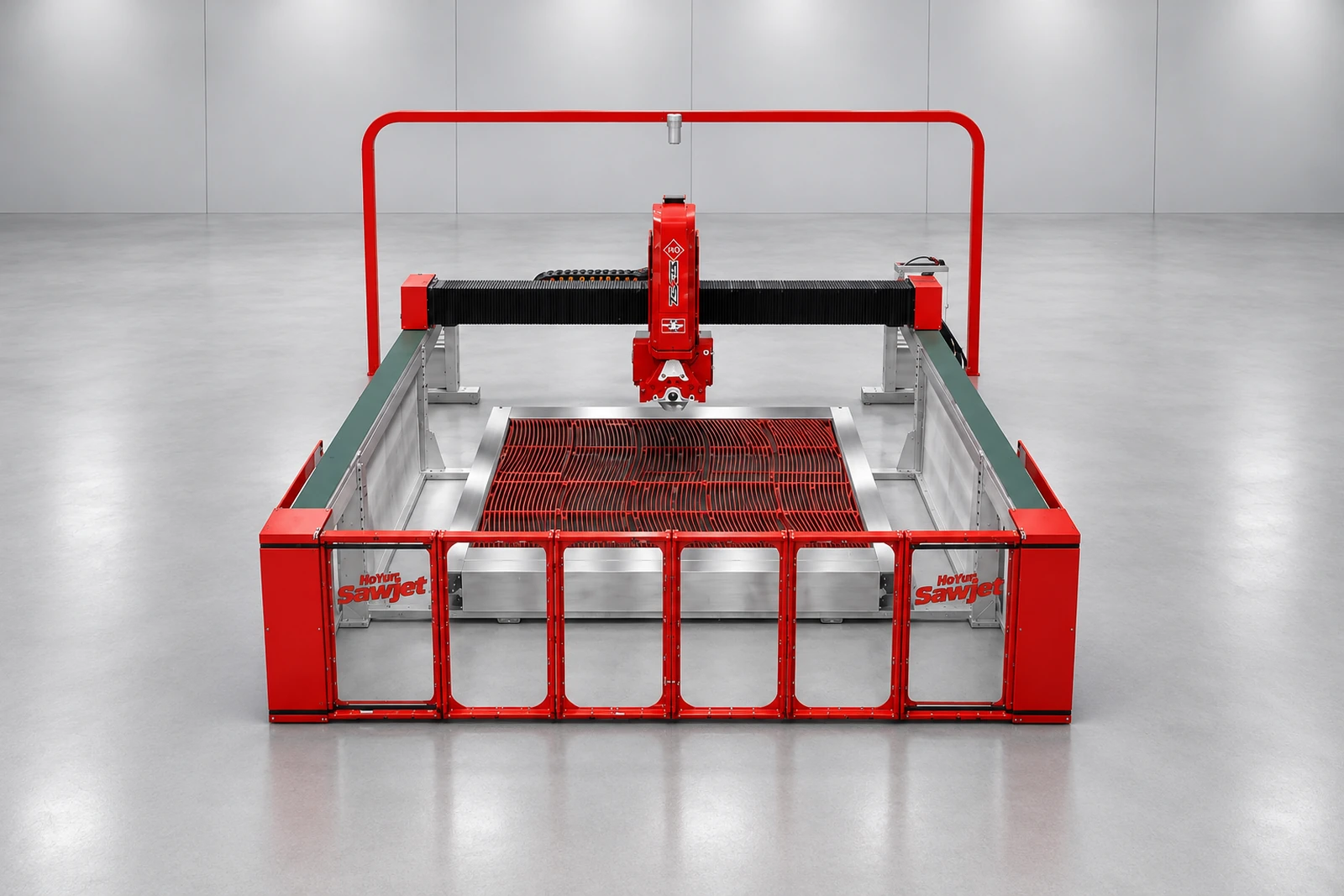 5-Axis CNC Sawjet3 questions
When should I use the saw or the waterjet?
Use the saw for slab sizing and straight cuts. Use the waterjet for curves, internal corners, angled paths and decorative inlays. Milling and profiling add openings, grooves and edge-shaping operations.
Which tools are needed for the different processes?
Saw cutting uses a diamond blade matched to the slab material. Milling and edge profiling use the corresponding cutters and profile tools. The waterjet uses its cutting-head components and abrasive supply. Confirm the tooling and consumables included with your chosen configuration.
What should I provide when selecting a configuration?
Share your material types, largest slab size, thickness range, drawings or sample parts, required processes and workshop utilities. These details help establish the cutting area, tooling and optional equipment for your work.
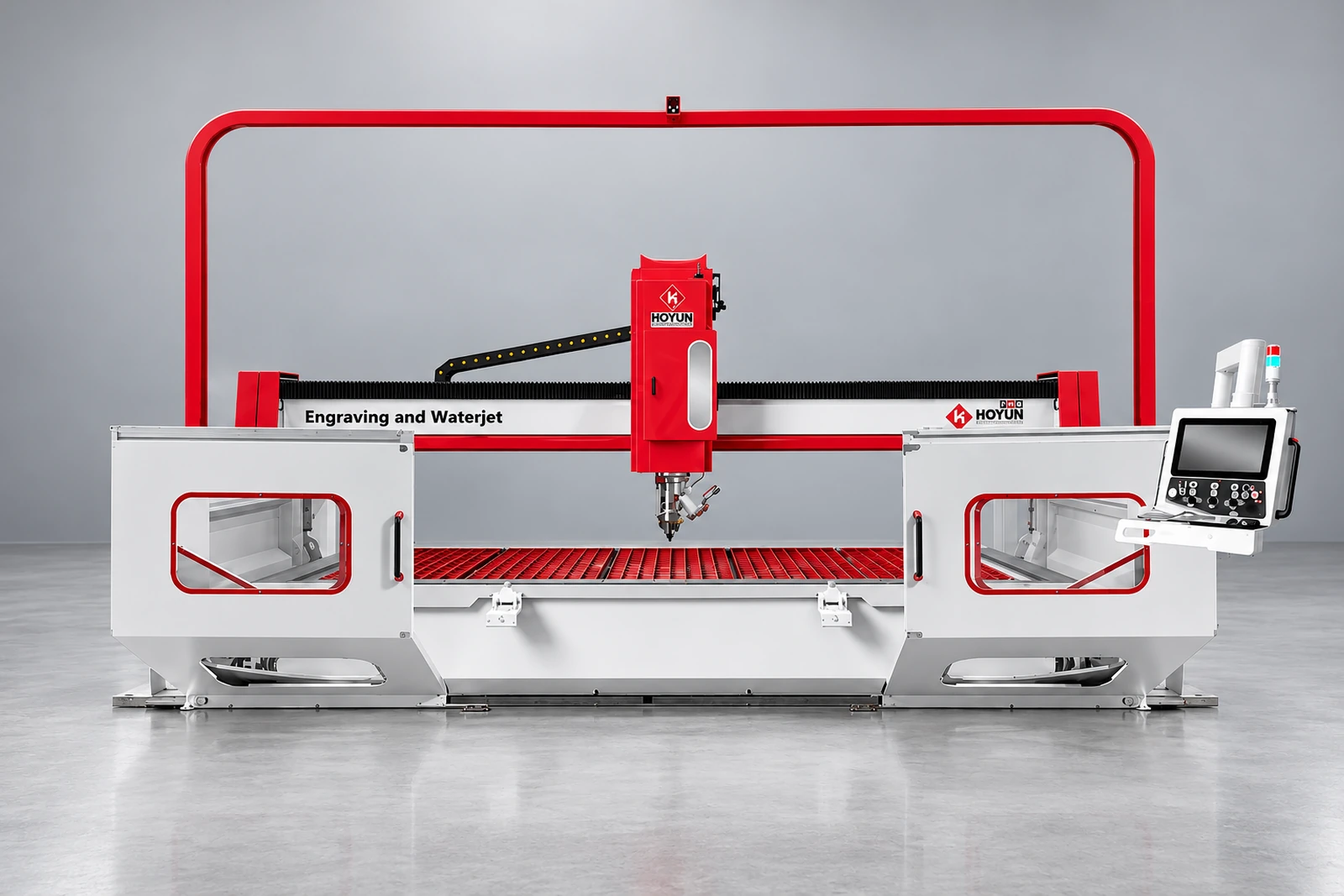 Waterjet & Engraving3 questions
How do waterjet cutting and engraving work together?
Use the waterjet for through-cuts and shaped openings. Use the spindle for lettering, reliefs, grooves and recessed details. The operations and tools are selected for the finished part.
Can I use my own drawings?
The engraving control supports DXF drawings. Share sample files and the finished result you need so the software workflow and tooling can be checked.
What information is useful for a quotation?
Send your material, slab size, thickness, drawings or samples, engraving depth and workshop utilities. Include any loading, enclosure or cooling requirements.
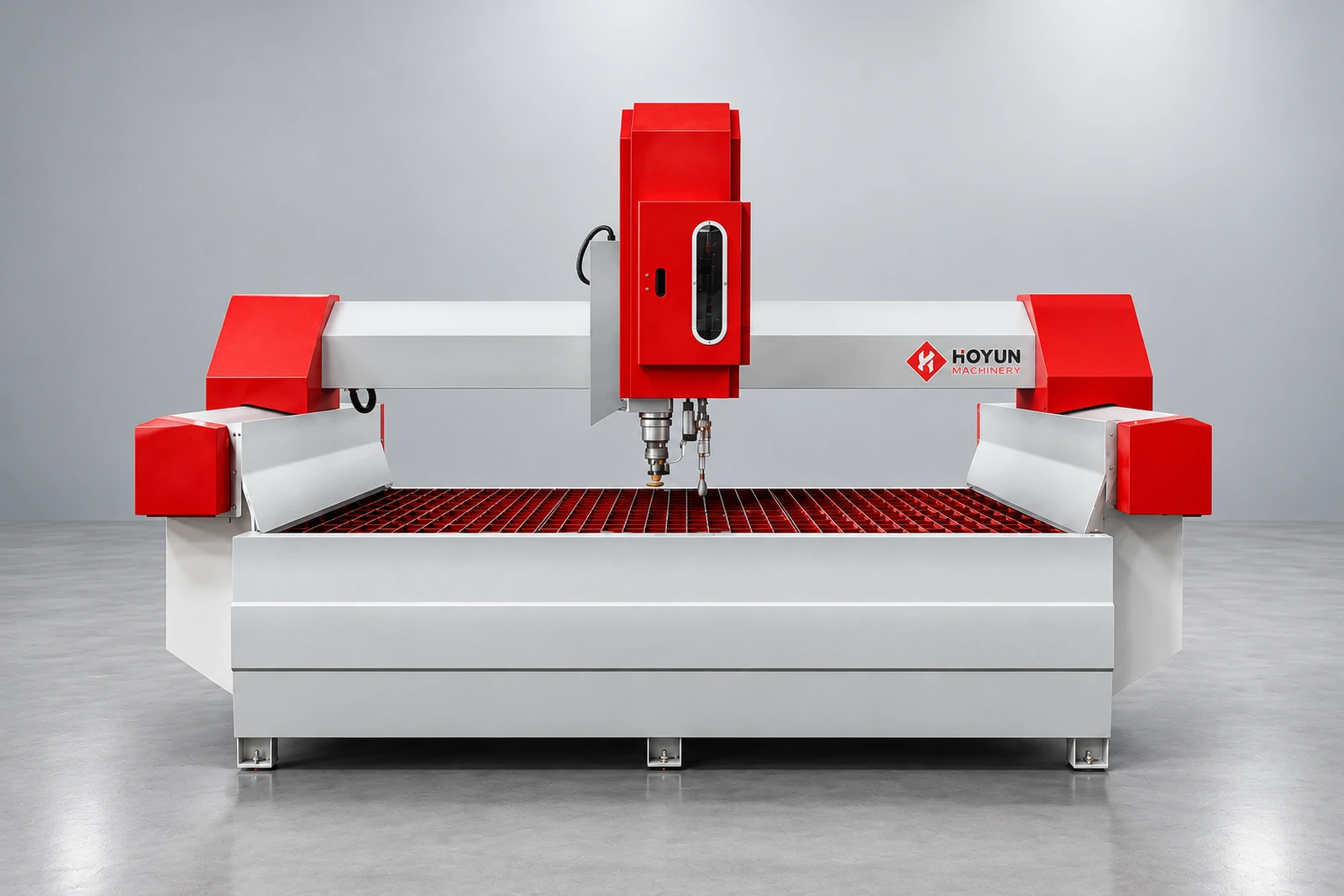 Waterjet & Hydrofinish3 questions
Does hydrofinish use abrasive?
The hydrofinish function uses pure-water spray heads for surface texturing. Abrasive waterjet cutting is a separate operation used for through-cutting.
Can cutting and texturing be done on the same platform?
The machine combines a five-axis waterjet head with a four-nozzle hydrofinish assembly. Share the intended sequence and final surface effect so the process can be planned.
How should I choose a surface finish?
Provide the stone type, a reference finish or sample, the treated area and the required pattern. Surface results depend on the stone and the selected operating settings.
Waterjet cutting machines
5 machines with FAQs
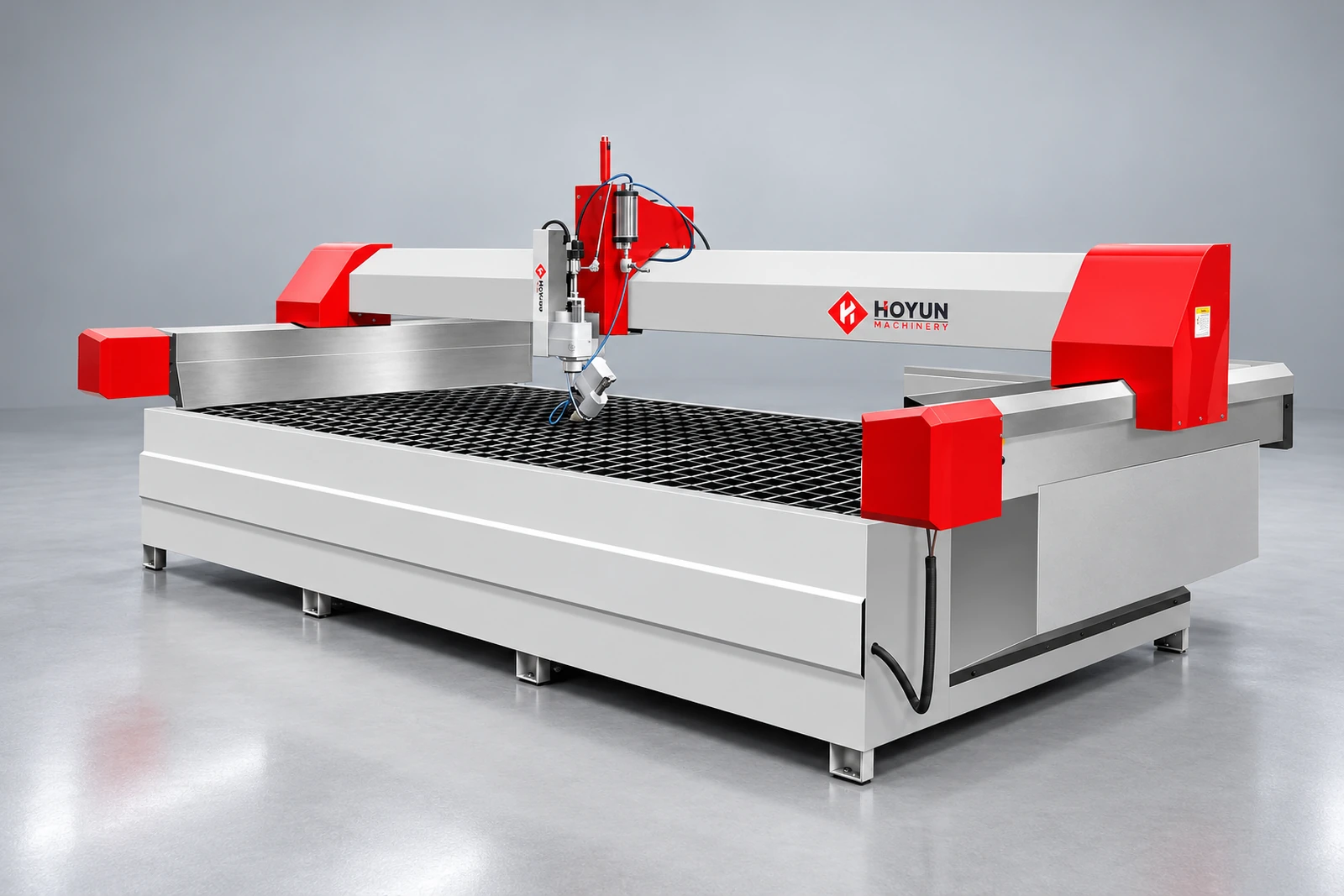 HY4020 AC 5-axis waterjet25 questions
Cutting area, head and accuracy
What is the effective cutting area?
The worktable accepts slabs up to 4,000 × 2,000 mm. The effective cutting area is 3,800 × 1,800 mm. The remaining margin allows for head and nozzle clearance.
What are the travels, footprint and table load?
X/Y/Z travel is 4,000/2,000/130 mm. Overall dimensions are 5,500 × 2,300 × 2,015 mm and the machine weighs about 5,000 kg. The worktable load is 3 t.
Who makes the head and what angles can it cut?
HoYun makes the sealed 5-axis head. The A-axis range is ±60° and the C-axis range is ±360°. The head covers 45° mitres and bevels from 0° to 60°.
What accuracy applies to 45° mitres?
Reference mitre accuracy is ±0.5 mm and repeatability is ±0.1 mm. NcStudio V10 includes taper compensation and 5-axis RTCP in this configuration.
What cutting speeds should I plan for?
Reference tests used 300 MPa, a maximum pump flow of 3.7 L/min, 80-mesh garnet and a 0.33 mm orifice. Use the lower end for fine edges and confirm speed on your material and required finish.
- 12 mm sintered stone or porcelain · 600–1,000 mm/min
- 20 mm marble · 400–940 mm/min
- 30 mm marble · 200–510 mm/min
- 20 mm granite · 360–846 mm/min
- 30 mm granite · 180–459 mm/min
Pump and wear parts
Which intensifier and motor does it use?
The hydraulic intensifier is made by HoYun. The reference build uses an ATUS A10VSO71-series hydraulic oil pump (71 mL/rev, 28 MPa rated and 35 MPa maximum oil pressure) and a Jiangsheng 37 kW, 1,440 rpm motor. High-pressure water flow is 3.7 L/min.
What are the three water-pressure ratings?
Maximum rated pressure is 420 MPa, maximum continuous pressure is 360 MPa and recommended production pressure is 300 MPa.
Which components are in the high-pressure circuit?
The documented configuration lists AccuStream cylinders, seals and check valves, a REFRACTRON ceramic plunger, a HoYun accumulator and Bieri high-pressure tubing. Confirm final brands and models in writing and check them in the factory acceptance test (FAT) report.
What wear-part intervals should I plan for?
Use these reference operating hours to plan spares. Actual service life depends on water quality, pressure and maintenance.
- High-pressure seals · about 500 h
- Ceramic plunger · about 5,000 h, with inspection at each seal change
- Check valves · 500–1,500 h
- Orifice · 40–80 h
- Mixing or focusing tube · 60–100 h
- ¼-inch high-pressure tubing · about 2,000 h
Loading, sensing and CNC
What can the heavy-duty loading table lift?
When ordered as the integrated package, the hydraulic loading table handles slabs up to 4,000 × 2,000 mm and 1 t. Its tilt range is 0–85° and minimum loading height is 10 cm above the floor. The 1 t limit is for loading, while the worktable supports up to 3 t.
What height sensing is standard?
This configuration uses automatic non-contact laser sensing. The pre-scan measures slab deformation to ±0.1 mm so the controller can compensate the 5-axis path before cutting.
Can I add camera-assisted nesting?
The optional package uses a fixed 20 MP industrial camera and LED lighting to capture slab veining, colour and defects for layout in NcStudio V10. The camera and laser height sensor serve separate functions. Ask for current option pricing.
Which CNC and servo system does it use?
The documented setup uses Weihong NC68E, a Lambda 21B/21E motion card, NcStudio V10, Inovance SV630N EtherCAT drives and absolute-value servo motors. Confirm the included CAD/CAM, nesting, bevel programming and licences in the quotation.
How do I back up CNC parameters?
NcStudio V10 supports separate backup of servo parameters and process parameter groups, plus a full CNC installation package for recovery. Save a copy of the installation package and the current settings.
Water and site utilities
Can I use a locally sourced water softener?
Yes, provided the treated water meets the machine requirements. Confirm the water quality and warranty conditions for your order.
What water-quality targets should I plan for?
These are reference targets pending factory verification or FAT. Confirm them before sizing treatment equipment.
- Residual hardness · ≤25 mg/L as CaCO₃, preferably ≤17 mg/L
- Multi-stage filtration · ≤5 µm
- pH · 6.5–8.5
- TDS · ≤250, ideally 60–100. Conductivity · 100–400 µS/cm. Avoid TDS below 0.5 mg/L.
- Cutting-water flow · ≥15–20 L/min, plus cooling water
- Inlet pressure · 2.4–5.5 bar, with about 3.5 bar steady recommended
What power, air, drainage and cooling are required?
The documented configuration includes a 37 kW main motor and a separate chiller. Confirm the following reference values during factory verification or FAT before preparing the site.
- Supply · 400 V ±10%, three-phase + PE, 50 Hz
- Installed power · about 45–50 kW, excluding the air compressor
- Compressed air · 6–7 bar, about 150–250 L/min, filtered to 10 µm
- Drainage · floor drain ≥DN25 and ≥10 L/min, plus pump drain DN15
- Cooling · about 7–10 kW chiller, 11–15 L/min cooling water, inlet ≤21 °C and hydraulic oil ≤54 °C
Maintenance, parts and warranty
What preventive maintenance should I plan?
Follow the supplied schedule and wear-part inspection intervals. The reference routine checks leaks, abrasive and cleaning daily, then filters, cooling and lubrication weekly. Check oil level and temperature, the tilting table and the 5-axis head monthly.
How do I plan spare parts for Europe?
Ask for availability, shipping options and the recommended kit for your operating hours. Confirm transit time and kit contents for your destination.
What warranty coverage should I check?
The documented terms list one year for the complete machine and electrical components, and three years for the high-pressure pump, CNC, servo system and oil pump. Confirm coverage, the commissioning or acceptance start date, replacement freight and exclusions in your signed order. Normal wear and out-of-spec water or power can affect coverage.
How do I get remote support?
The configuration supports authorised remote access, video calls and an online support group. Share your serial number and issue details, and confirm support availability for your order.
Can I order on-site installation and training?
On-site installation, commissioning and operator training are optional. Confirm the schedule, engineer fees and travel expenses in the quotation.
Factory acceptance and ordering
Can we agree on a factory acceptance test before final payment?
Agree on FAT and payment milestones before ordering. The documented test covers pump pressure, 5-axis motion, 45° mitres, height sensing and any ordered loading or camera package. Ask about sending a DXF file and material samples, and request the test video and written report with serial numbers and final component details.
What should the commercial package cover?
Confirm price basis, freight terms, production schedule and seller details in the written quotation. Check the included declaration, diagrams and English manuals before dispatch.
Where can I see a reference installation?
Ask for a reference project that matches your configuration. The technical notes cite similar setups in Albania, North Macedonia, Serbia, the UAE and the UK.
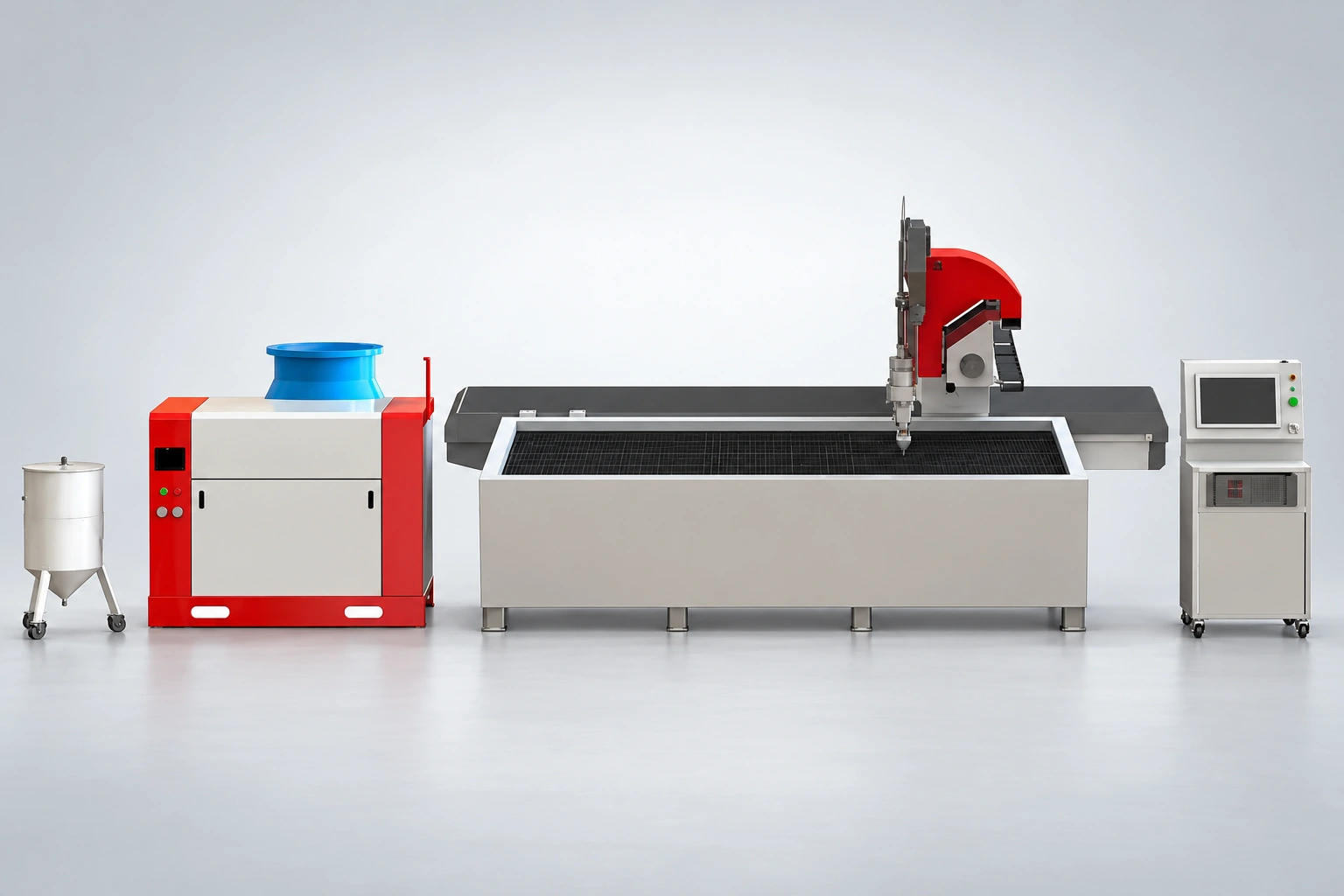
5-Axis CNC Waterjet3 questions
Which table size should I choose?
Start with the largest slab or part you expect to process. Compare the actual cutting area with your part layout, and allow room in the workshop for the pressure system, loading and service access.
Can the same machine cut stone, glass and metal?
These materials are listed for this waterjet platform. Abrasive selection, cutting settings and part support need to be adapted for each material and thickness.
What should I send for a cutting assessment?
Share a CAD file or drawing, material type, thickness, dimensions and edge requirements. Include your expected production volume and workshop utilities.
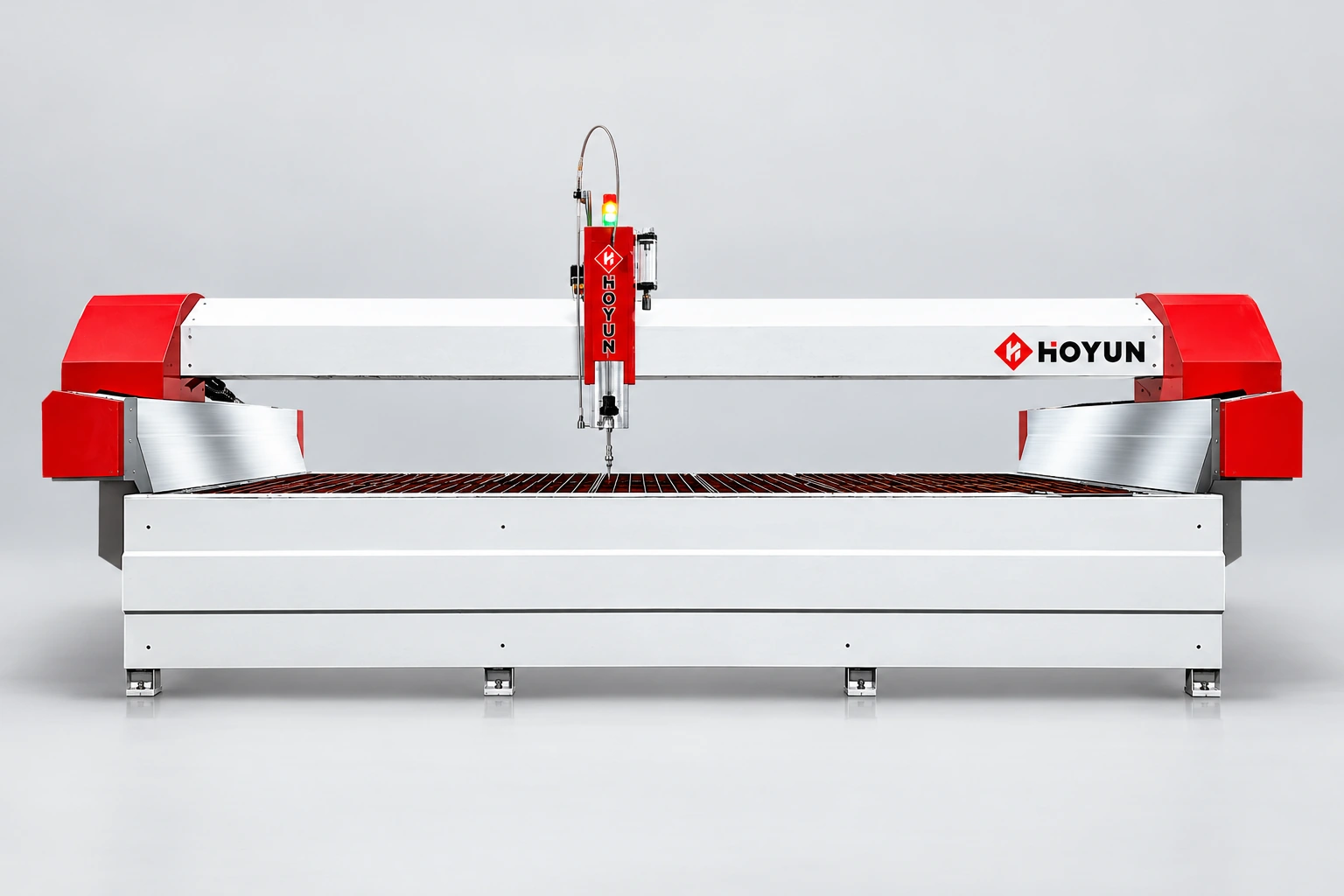
 AB 5-Axis Waterjet3 questions
What is the AB head used for?
The AB configuration controls the head angle along curved and fitted cutting paths. Share the intended edge, part geometry and assembly requirements to confirm a suitable configuration.
Can this machine also engrave stone?
The AB configuration is a waterjet cutting platform. For relief engraving, recessed details or drainage grooves made with a spindle, review Waterjet & Engraving.
Which dimensions should I use when choosing a model?
Compare the part with the machine’s usable cutting travel, then allow for support, loading and service access. The listed table dimensions are not the same as the axis travel.
 3-Axis Waterjet3 questions
When is a three-axis waterjet the right fit?
Choose it for flat outlines, internal openings and repeat two-dimensional parts. If the part requires a tilted cutting head or angled edges, discuss a suitable five-axis configuration.
Can one setup cut different materials?
The waterjet range processes stone, ceramics, glass and metals. Adjust the abrasive, cutting settings and workpiece support to suit the material and thickness.
What should I send for a quotation?
Share the material, thickness, largest part size, CAD drawing and expected production volume. Include workshop utilities and any loading or cooling requirements.
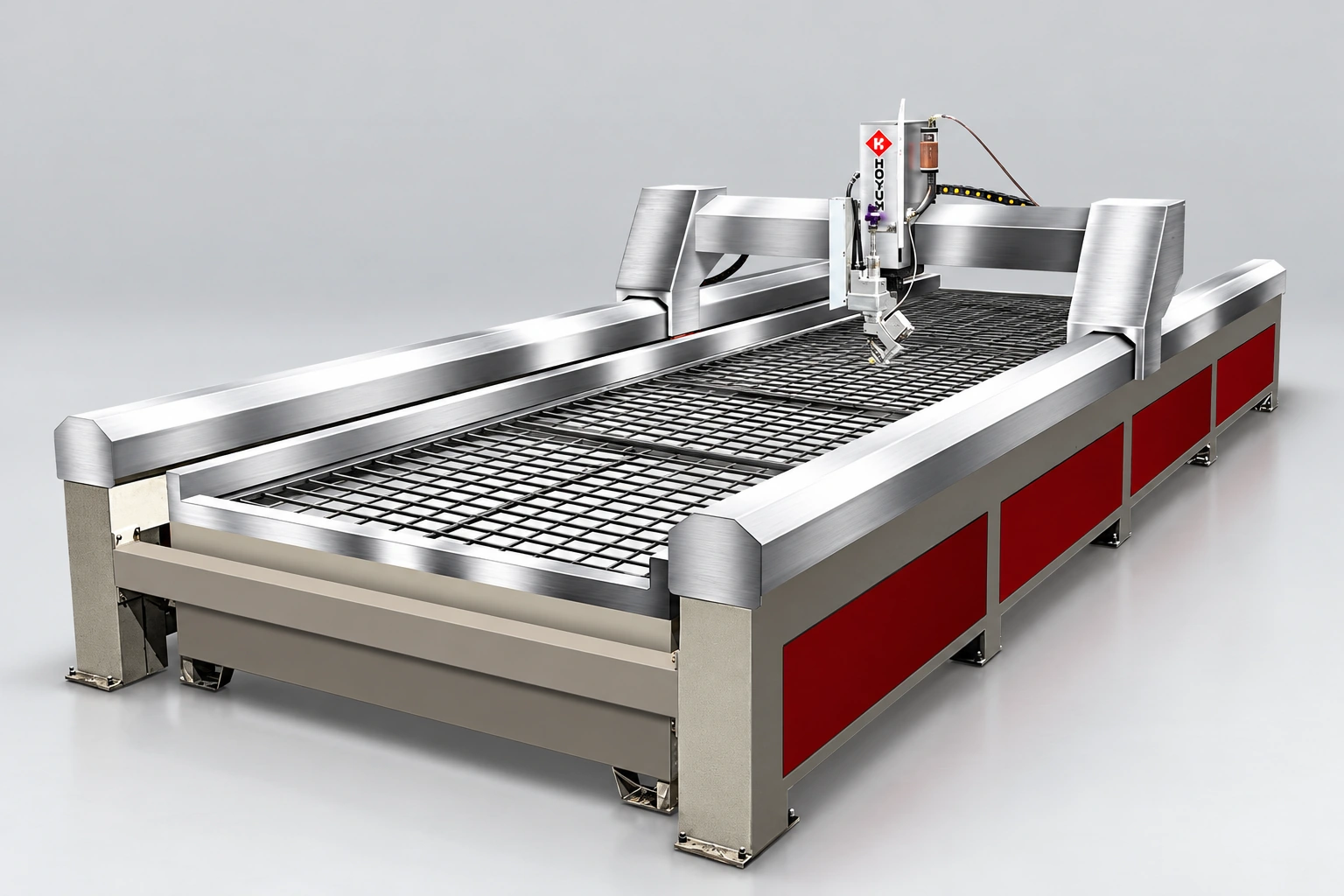 Metal Waterjet Cutting Machine3 questions
How much working space should I allow?
Plan for the full machine footprint, loading of the longest sheet or part, unloading, the high-pressure assembly and service access. Request an installation layout for the selected configuration.
Which cutting head should I choose?
The 2060 platform supports AB or AC swing-head configurations. Share the part geometry, edge angle and material so the appropriate head can be specified.
How is cutting capacity confirmed?
Send the metal grade, thickness, CAD drawing and required edge finish. Cutting settings, support and sample results should be checked for the intended part.
Bridge saws
2 machines with FAQs
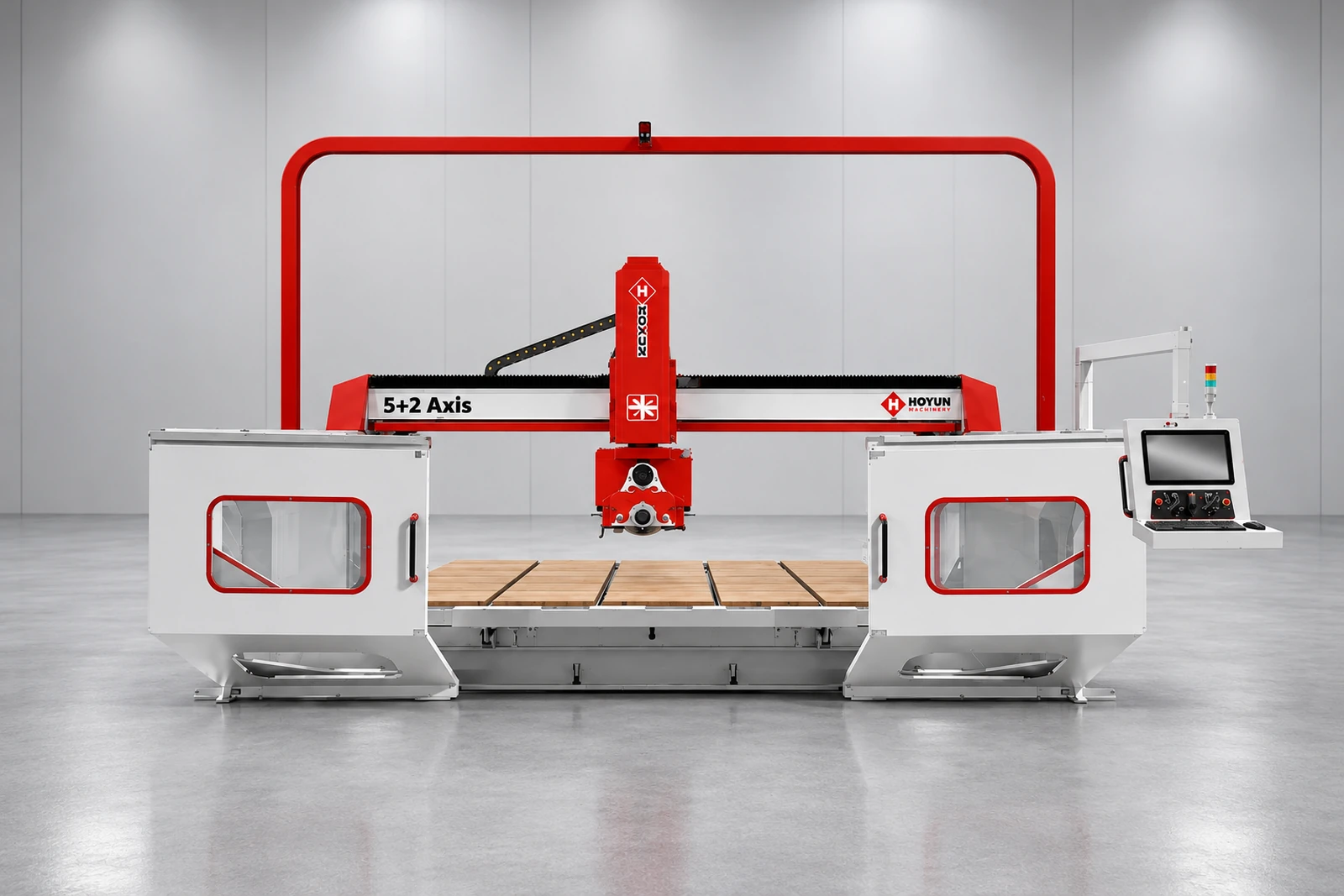 5+2 Axis CNC Bridge Saw3 questions
Which operations can be combined?
The platform supports saw cutting, milling and edge profiling. Select tools and fixtures for the openings, grooves, contours and edge details in your parts.
What does RTCP do?
RTCP compensates for the tool-center position as the head rotates and tilts. It helps coordinate tool movement along the programmed machining path.
Which configuration suits my workshop?
Share slab dimensions, material and thickness, sample drawings and the finished details you need. Confirm the worktable size, motor option, tooling and handling equipment in your quotation.
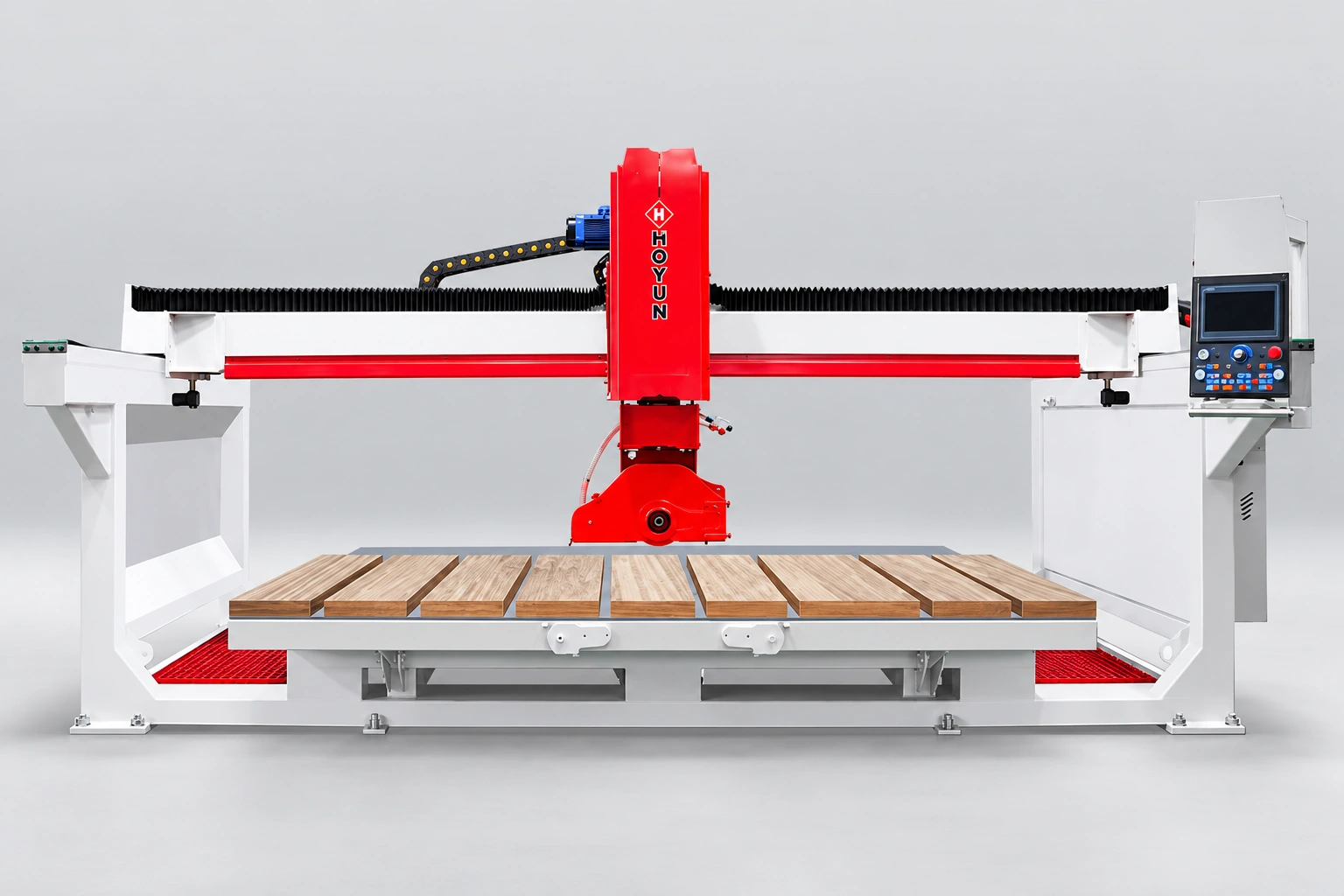 3-Axis CNC Bridge Saw4 questions
What does a 3-axis CNC bridge saw offer for stone cutting?
A standard 3-axis CNC bridge saw controls cutting movement across X, Y, and Z directions, enabling straight cuts, plunge cuts, and programmed positioning for consistent slab sizing. HOYUN Machinery’s 3-axis CNC bridge saw machine, built in Foshan, China, uses servo-driven positioning and a multi-language touchscreen, making it a practical starting point for stone shops moving from manual to CNC-controlled slab cutting.
How does a standard 3-axis CNC bridge saw handle daily slab production?
A standard 3-axis CNC bridge saw is built for reliable, consistent slab sizing through servo-driven positioning and programmable cut sequences. HOYUN Machinery’s 3-axis CNC bridge saw machine, built in Foshan, China, suits stone fabricators who need repeatable straight cuts on granite, marble, and quartz as their core daily workload, with a water-cooled motor that helps maintain stable cutting performance during extended production shifts.
Is there a CNC saw I can monitor and control remotely?
HOYUN Machinery’s 3-axis CNC bridge saw machine uses a self-developed control system that allows operators to adjust parameters and monitor machine status directly from the control panel. Built in Foshan, China, the multi-language touchscreen simplifies operation during long production shifts. For remote diagnostics or technical support, HOYUN provides one-to-one remote assistance through its after-sales service channel.
Can this saw handle extended production runs without overheating?
HOYUN Machinery’s 3-axis CNC bridge saw machine uses a water-cooled motor designed to support extended production shifts under proper operating and maintenance conditions. Manufactured in Foshan, China, this thermal management approach helps maintain stable cutting performance during extended production shifts on granite, marble, and quartz, reducing the heat-related slowdowns associated with air-cooled motors under sustained load.
Bullnose & profile polishers
4 machines with FAQs
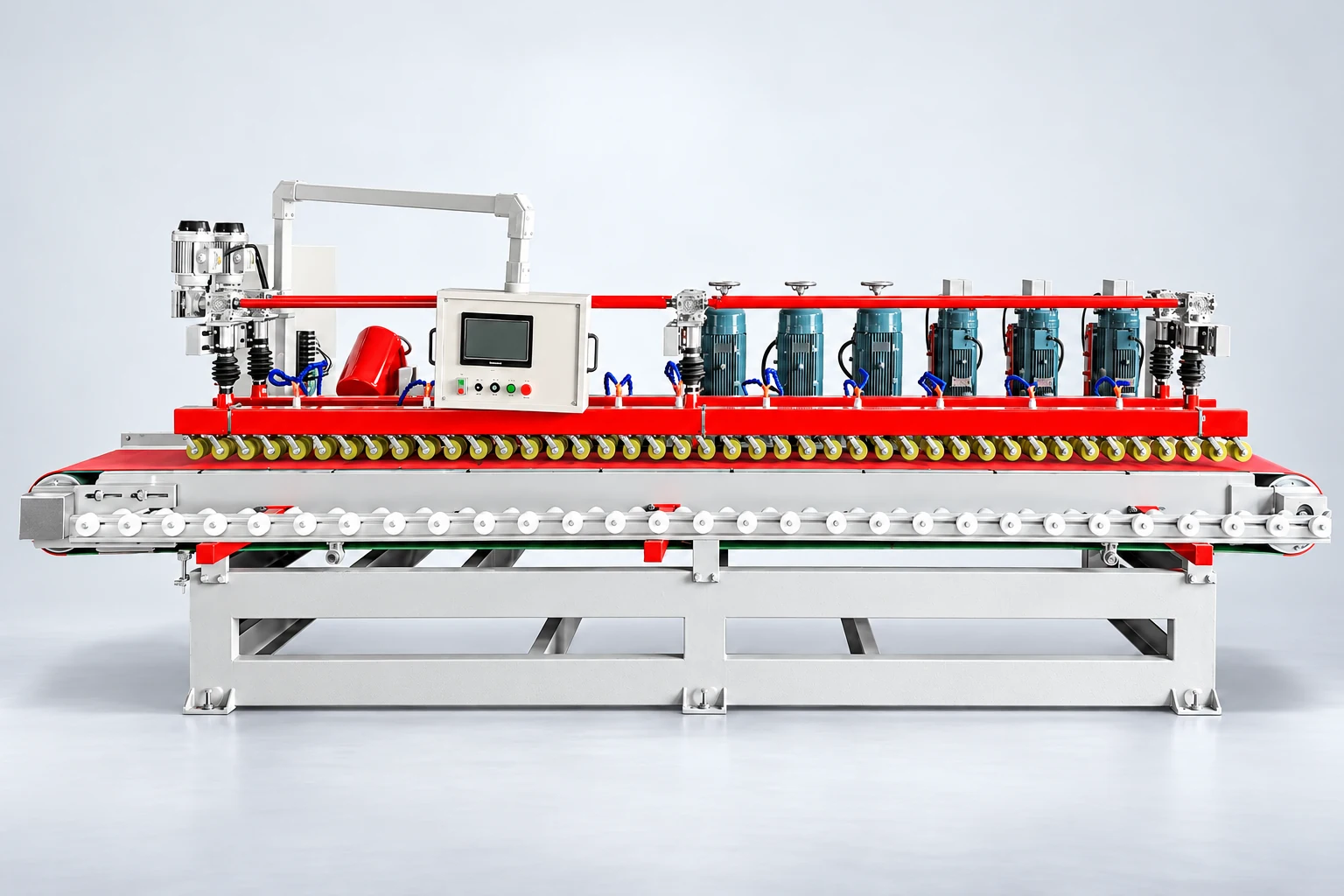 6+10 Stone Edge Polishing Machine3 questions
What information is needed to configure a bullnose machine?
Send the material, panel width and thickness, drawings or samples of the required edge profiles, target finish and planned production volume. These determine the head sequence, tooling, support and pressure-roller arrangement.
Should I choose a swing or non-swing structure?
Start with the required profiles and polishing process. A swing assembly uses a counterweighted moving head arrangement; a non-swing layout uses shaped wheels in a fixed sequence. Review the actual materials and sample edges before selecting the layout.
Are all the illustrated functions included on one machine?
The profile library shows choices across the customized range. The first three sections describe the reference setup on this page. Final functions, head quantities, tooling and technical data are confirmed in the project configuration and quotation.
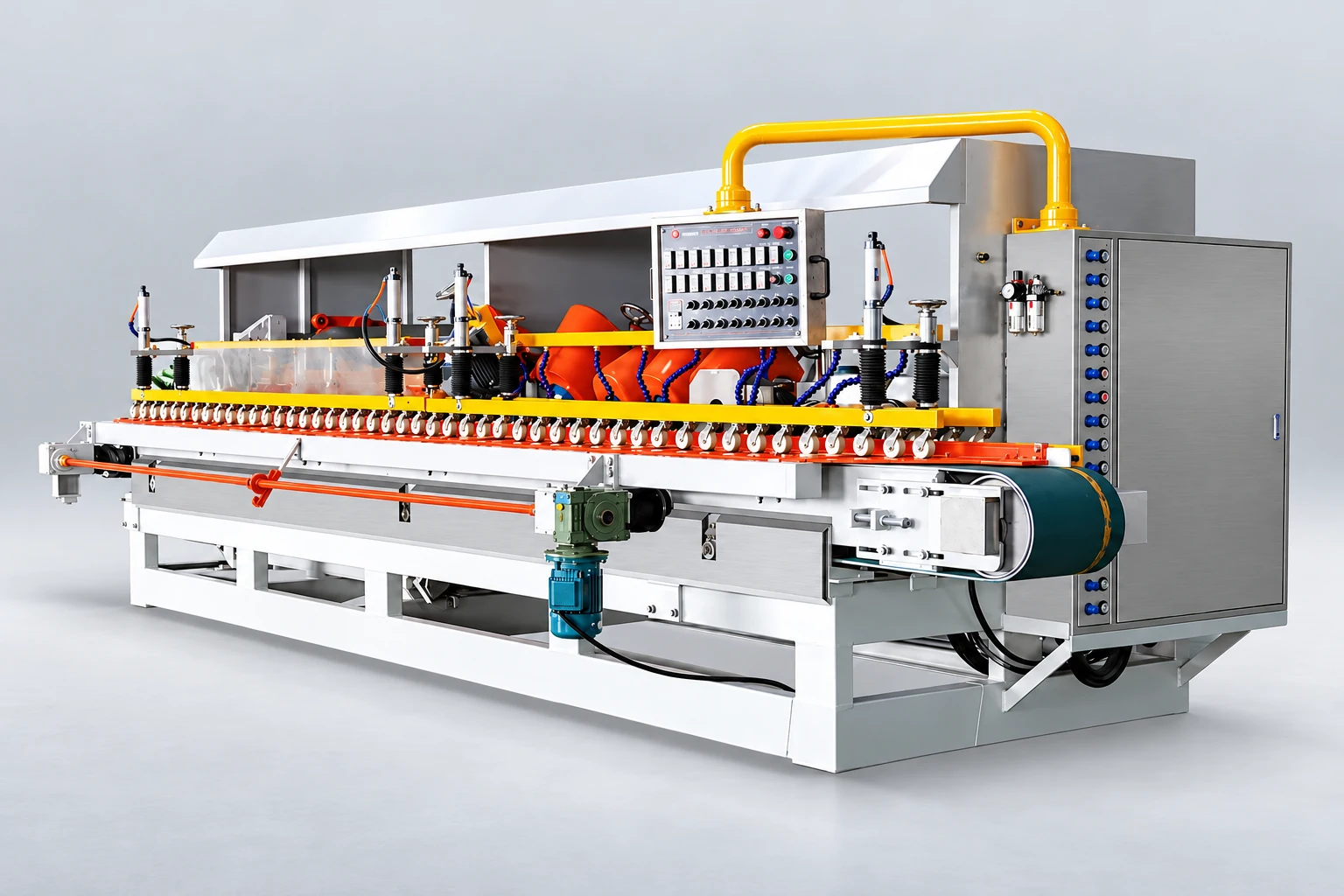 14-Head Bullnose Edge Polisher for Ceramic Tile, Marble & Granite3 questions
What information is needed to configure a bullnose machine?
Send the material, panel width and thickness, drawings or samples of the required edge profiles, target finish and planned production volume. These determine the head sequence, tooling, support and pressure-roller arrangement.
Should I choose a swing or non-swing structure?
Start with the required profiles and polishing process. A swing assembly uses a counterweighted moving head arrangement; a non-swing layout uses shaped wheels in a fixed sequence. Review the actual materials and sample edges before selecting the layout.
Are all the illustrated functions included on one machine?
The profile library shows choices across the customized range. The first three sections describe the reference setup on this page. Final functions, head quantities, tooling and technical data are confirmed in the project configuration and quotation.
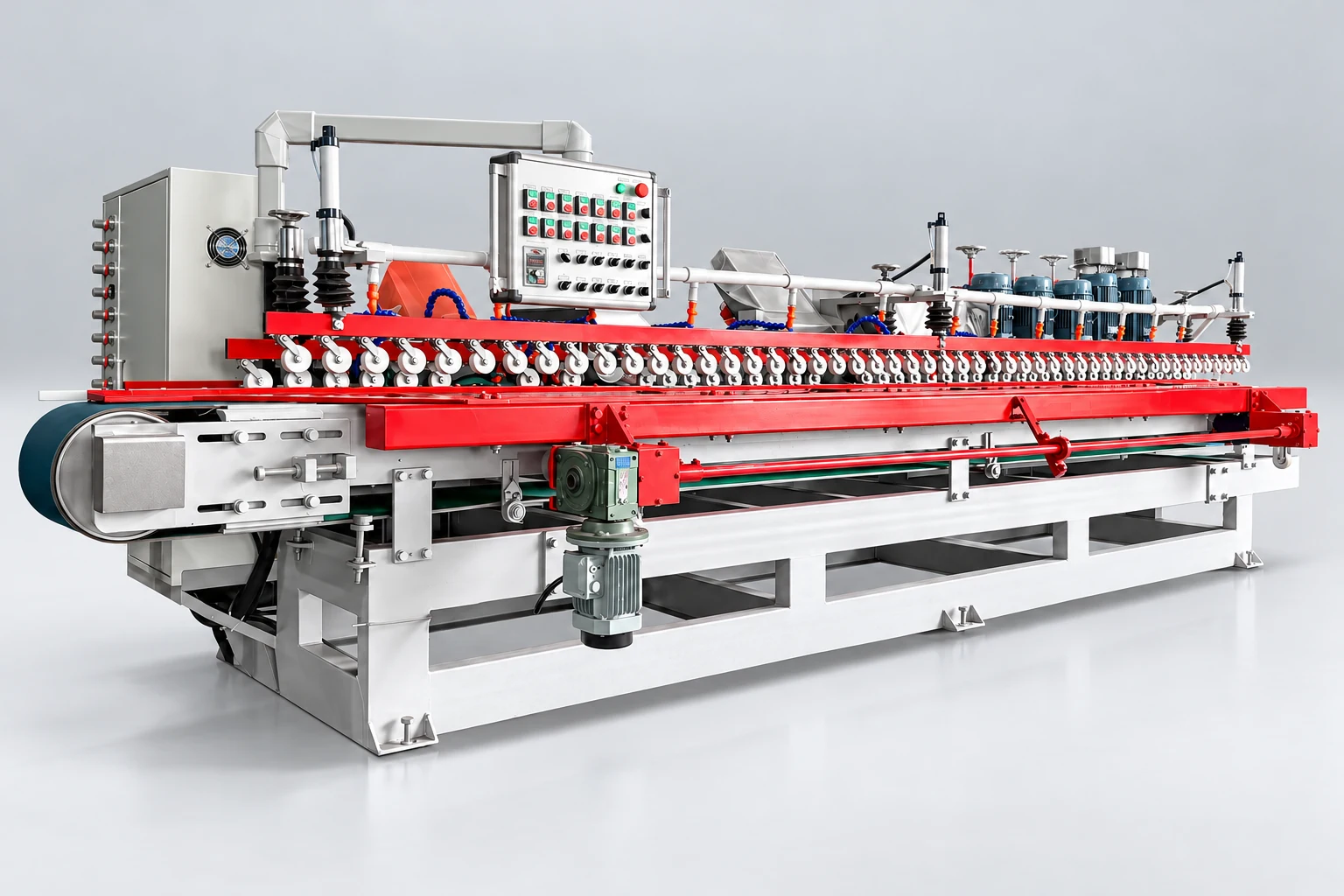 11-Head Custom Arc Polishing Machine3 questions
What information is needed to configure a bullnose machine?
Send the material, panel width and thickness, drawings or samples of the required edge profiles, target finish and planned production volume. These determine the head sequence, tooling, support and pressure-roller arrangement.
Should I choose a swing or non-swing structure?
Start with the required profiles and polishing process. A swing assembly uses a counterweighted moving head arrangement; a non-swing layout uses shaped wheels in a fixed sequence. Review the actual materials and sample edges before selecting the layout.
Are all the illustrated functions included on one machine?
The profile library shows choices across the customized range. The first three sections describe the reference setup on this page. Final functions, head quantities, tooling and technical data are confirmed in the project configuration and quotation.
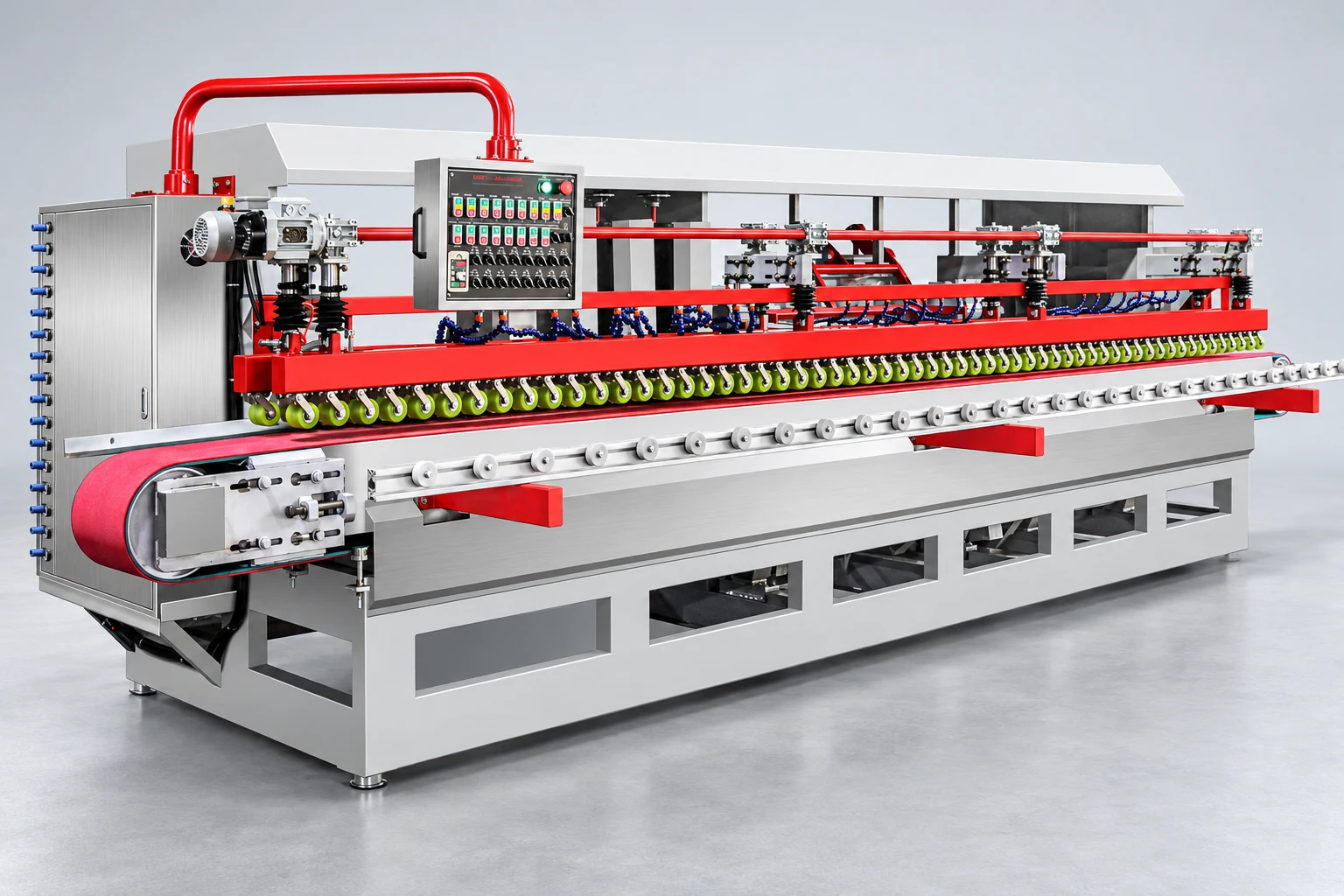 16-Head Stone Edge Polisher3 questions
What information is needed to configure a bullnose machine?
Send the material, panel width and thickness, drawings or samples of the required edge profiles, target finish and planned production volume. These determine the head sequence, tooling, support and pressure-roller arrangement.
Should I choose a swing or non-swing structure?
Start with the required profiles and polishing process. A swing assembly uses a counterweighted moving head arrangement; a non-swing layout uses shaped wheels in a fixed sequence. Review the actual materials and sample edges before selecting the layout.
Are all the illustrated functions included on one machine?
The profile library shows choices across the customized range. The first three sections describe the reference setup on this page. Final functions, head quantities, tooling and technical data are confirmed in the project configuration and quotation.
Batch cutting machines
1 machine with FAQs
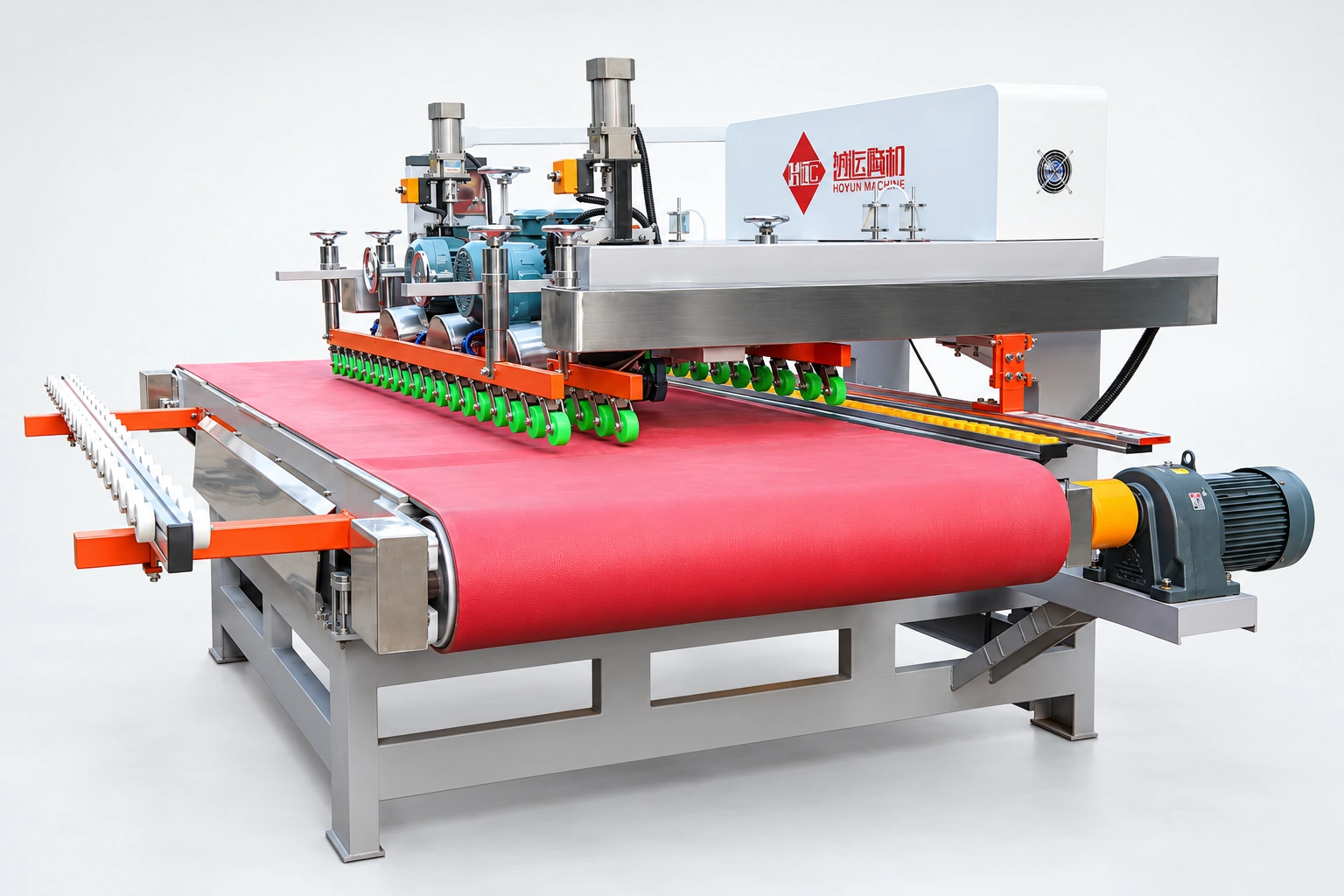 CNC Ceramic Tile Cutting Machine4 questions
What is special about this CNC tile cutting machine?
HOYUN Machinery’s automatic CNC ceramic tile cutting machine stands out for its combination of a self-developed CNC control interface, three rows of pressing wheels for material stability, and blade compatibility from 120 to 150 mm diameter. Manufactured in Foshan, China, it processes ceramic tiles, porcelain slabs, and sintered stone from 6 to 30 mm thickness, making it a flexible choice for tile plants handling varied formats in daily production.
How fast can a CNC tile cutter run without losing accuracy?
Cutting speed is 3–5 m/min. Check production tolerance with a sample of your material.
Which blade sizes and material thicknesses does this cutter support?
Blade diameters from 120 to 150 mm and material thicknesses from 6 to 30 mm define the working range of HOYUN Machinery’s automatic CNC ceramic tile cutting machine. Built in Foshan, China, it processes ceramic tiles, porcelain slabs, and sintered stone across this full range, giving tile production plants the flexibility to handle the most common slab formats without switching equipment.
Is there a tile cutter that staff can learn to run quickly?
New staff can get productive quickly on HOYUN Machinery’s automatic CNC ceramic tile cutting machine, which sets cut dimensions directly from a simple digital screen without complex programming knowledge. Made in Foshan, China with a self-developed interface and three rows of pressing wheels for material stability, it suits growing tile production facilities looking to add CNC precision with a short operator learning curve.
Vertical edge finishers
For questions about a machine in this category, contact HoYun with the model or application.
Chamfering & grooving machines
3 machines with FAQs
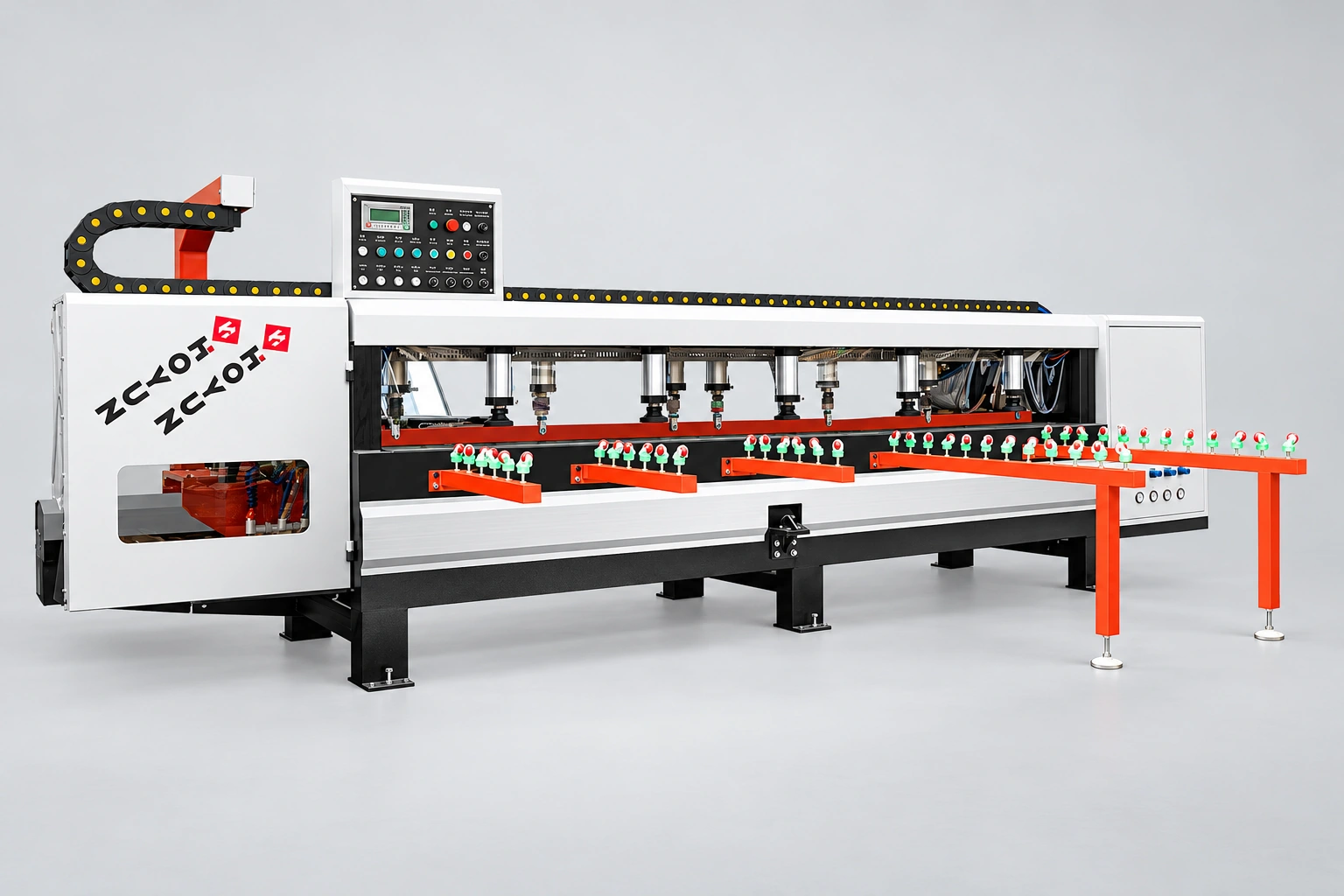 45° Miter Saw4 questions
What type of miter saw is best for cutting sintered stone at a 45-degree angle?
The listed maximum working size is 3200 or 3600 mm depending on the model. Confirm the blade and settings on your material.
How does automatic stroke control work on a stone miter saw and why does it matter for accuracy?
Automatic stroke control stops the cutting head the moment the chamfer reaches its programmed position, eliminating over-cut and size variation between pieces. HOYUN Machinery’s miter saw in Foshan, China uses this feature alongside oil-immersed linear guide rails and servo motor control to maintain consistent 45-degree bevel accuracy across long production runs on sintered stone and porcelain slabs.
Is there a stone cutting machine that can both chamfer and pull grooves in the same operation?
Combining chamfering and groove cutting in one pass reduces handling and setup time significantly on high-volume stone lines. HOYUN Machinery’s miter saw, produced in Foshan, China, integrates both functions, with three independently operable cutting heads and pneumatic lifting for quick reset, making it suited for sintered stone and porcelain fabrication plants processing varied tile and slab formats.
What machine do fabricators use to make waterfall countertop joints with invisible seams?
Waterfall countertop joints rely on precisely matched 45-degree miters where both surfaces meet flush without visible gaps. Stone fabricators producing this detail turn to miter saws with tight dimensional repeatability and stable guide systems. HOYUN Machinery’s miter saw, built in Foshan, China, produces these cuts on granite, marble, quartz, and sintered stone using oil-immersed linear guides and pneumatic clamping.
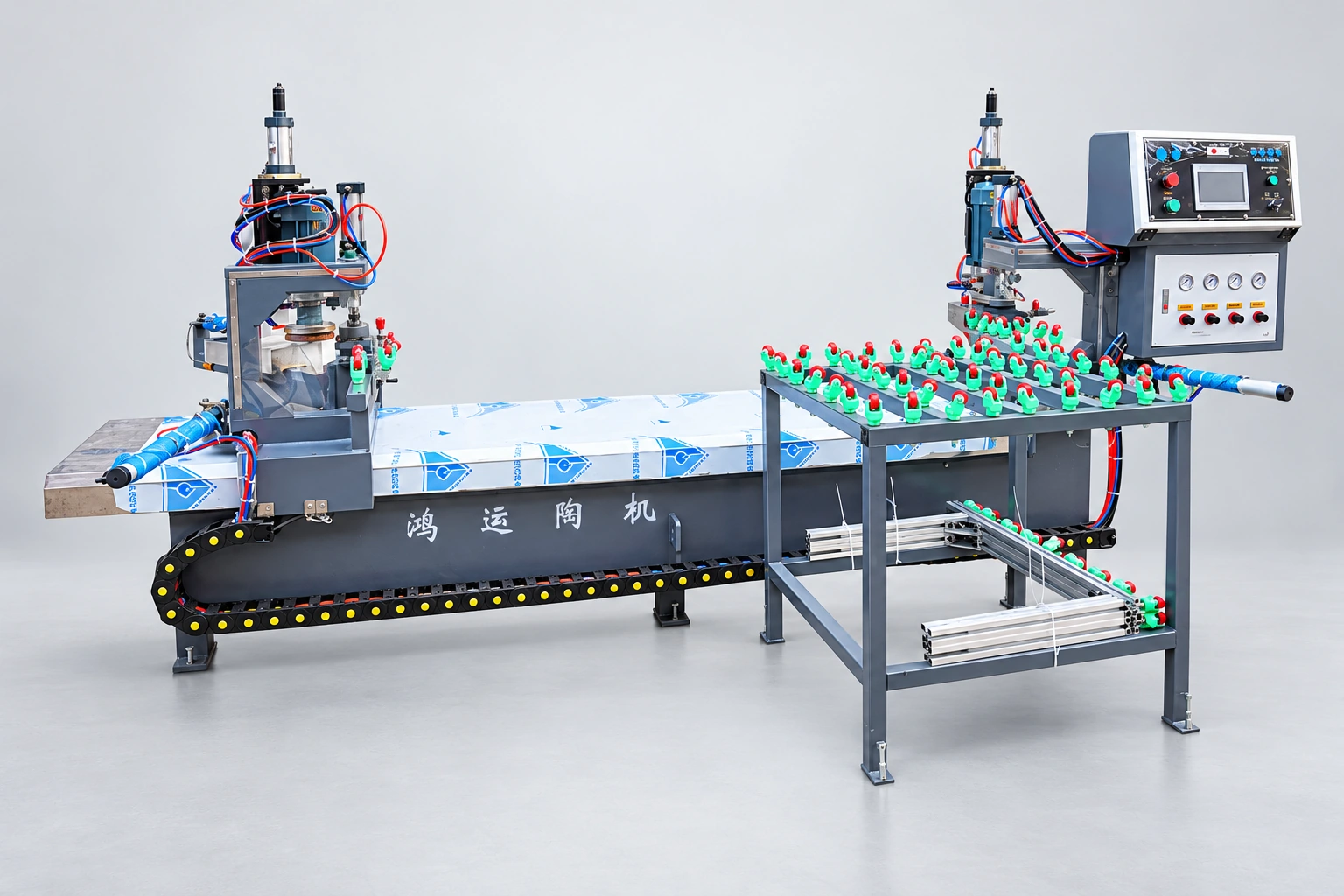 HY-P2H2300 corner rounding polisher26 questions
Machine and workpiece limits
What is the rated power?
Total power is 8 kW, with two 4 kW spindles.
How many wheels are on each head?
Each of the two heads carries three wheels.
Which steps run automatically?
Each head runs two automatic grinding steps. Add a separate polishing pass when the finish calls for it.
Can both heads run together?
Yes. Run both heads together or use one head for a single corner. Rotate the slab to finish the remaining corners as needed.
What are the workpiece limits?
Thickness is 6–30 mm. Maximum length × width is 2,300 × 800 mm. Minimum length is 400 mm and minimum width is 350 mm.
Will it handle standard worktops and small pieces?
Worktops 500–600 mm wide are within the width range. Pieces measuring 400 × 600 mm or 600 × 800 mm fit, while a 300 × 400 mm piece falls below the minimum in one direction. Use the standard pneumatic clamp for pieces within the stated range.
Is there a demonstration of this configuration?
Ask HoYun for the HY-P2H2300 demonstration and confirm the model and configuration against your quote.
CNC, clamping and radius
Do I have to measure each length manually?
CNC controls the length by positioning the stop and heads automatically.
How does a typical cycle work?
Position the piece at the stop, clamp it pneumatically, then start the cycle. Different lengths can run in sequence without manual length adjustment.
How many programs can it store?
Up to 50.
How do I set the radius?
Fit the mechanical template for the radius you need. A radius such as R25 requires its own template. CNC controls length.
Which radius templates come with the machine?
R5, R10, R20, R30 and R50. The template range is R5–R50 mm.
How long does a template change take?
About 5 minutes. A radius change by itself does not require different wheels.
Can I repeat the same radius after changing wheels?
Recalibrate after the wheel change. The installed template continues to set the radius.
Wheels, finishing and sample testing
How long does a wheel change take?
Allow about 5 minutes per head, or 10 minutes for both heads. Recalibrate after changing the wheels.
Can I use the same wheels for every thickness and material?
Use separate sets for 20 mm and 30 mm workpieces. Select wheels for the material to suit the finish and wear requirements.
What grit sequence is a starting point?
Start with #46–60, then #100–200, #400–800 and #1500–3000, followed by polishing. Confirm the sequence for your material and finish.
How long do the wheels last?
The reference figures are about 2,000 m for grinding wheels and 300 m for polishing wheels. Actual life varies with stone, pressure, water and operation.
What wheel mounting does it use?
The standard mounting is Ø150 mm with a 22 mm bore. Match that mounting when choosing third-party wheels.
Can it grind and polish 20 mm or 30 mm stone?
The machine is designed for grinding and polishing the vertical radius face within the stated thickness range. Confirm suitability on the specific stone, especially at 30 mm.
Has 30 mm granite or quartzite been factory-tested?
Factory testing on 30 mm granite and quartzite is still pending. Ask about a test on your own slab before specifying that application.
Dust control, shipping and support
What is the optional 4 m wet dust wall?
It is a partner-supplied vertical water curtain with a baffle mist separator and a coated Q235 carbon-steel body. A 3 m × 2 m option is also available. Confirm the dust-wall specification separately.
- Reference 4 m unit · 4,000 × 900 × 2,100 mm and 450 kg
- Supply · 400 V, 50 Hz, three-phase
- Airflow · 35,000 m³/h, with three 1.5 kW fans and a 1.5 kW pump
- Water · 800 L tank and about 30 L/h of make-up water
- Reference dust capture · about 90%. Noise · 70–80 dB.
How do I remove sludge from the wet dust wall?
The bottom sludge tray is accessible for routine cleaning.
How much space and water does the machine need?
The machine measures 4,500 × 1,300 × 1,700 mm, weighs 2,000 kg and uses about 150 L/h of water. Confirm the installation layout and utility connections for your site.
What are the packing dimensions?
The machine pack is about 4,600 × 1,400 × 1,850 mm. Each 4 m dust wall packs to about 4,100 × 1,000 × 2,250 mm and 500 kg. Confirm the loading plan and freight terms for your order.
What support can I arrange for this machine?
Ask about spare parts, remote video support and ongoing technical assistance. Confirm warranty duration and service terms in the sales contract.
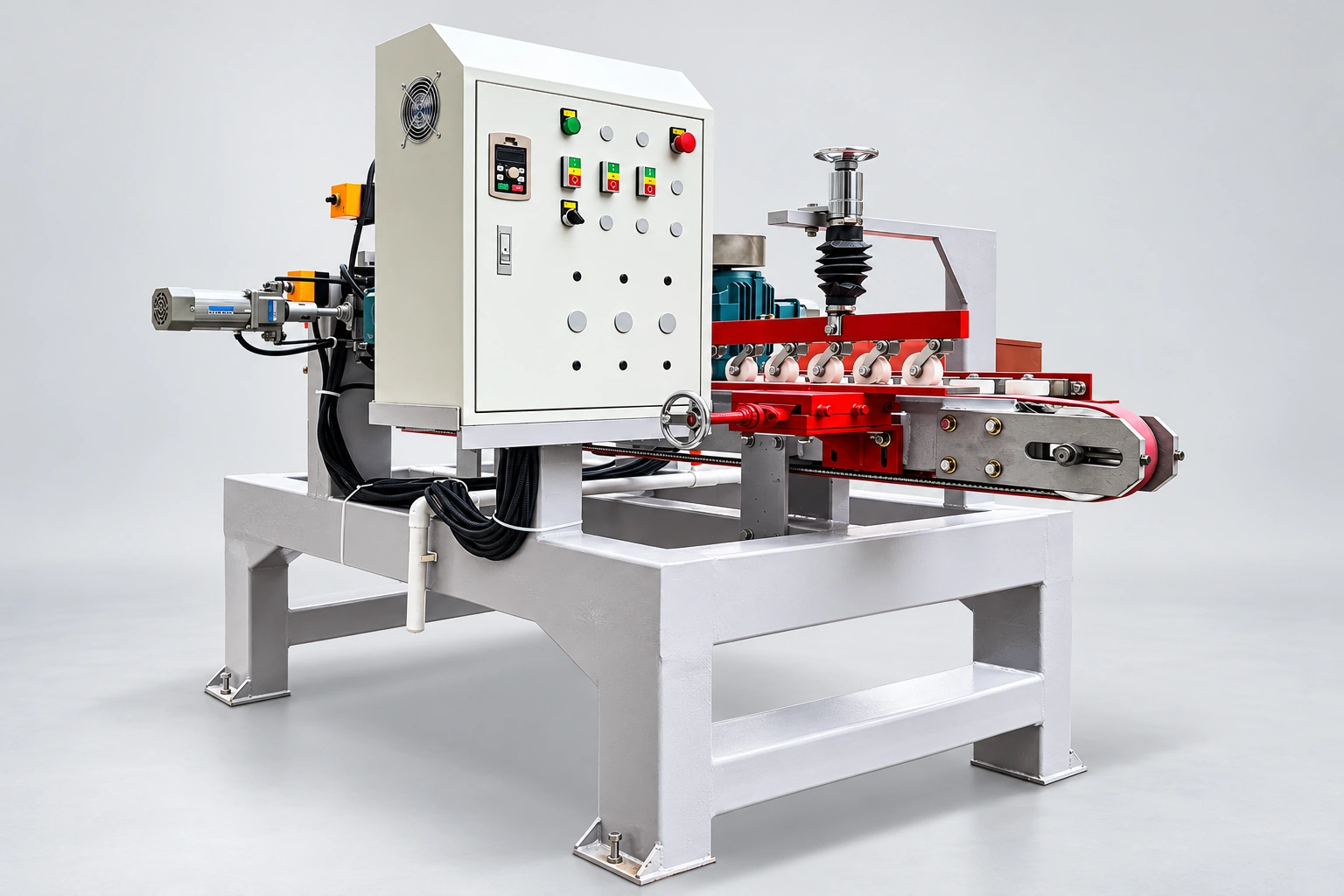 Double-Sided Stone Slotting Machine4 questions
Can a stone slotting machine handle sintered stone and porcelain panels for exterior wall cladding?
Sintered stone and porcelain are common materials for exterior facade cladding, and both require precise parallel slots for anchor system installation. HOYUN Machinery’s double-sided stone slotting machine, built in Foshan, China, processes porcelain, sintered stone, marble, and ceramic tile with simultaneous dual-blade slotting, making it suited for facade panel preparation in architectural and construction supply operations.
How does a differential mechanism in a stone slotting machine keep both conveyor belts running at the same speed?
Without a differential, slight speed variations between the two conveyor belt sides cause the panel to drift sideways during processing, which throws off slot positioning. HOYUN Machinery’s double-sided stone slotting machine, manufactured in Foshan, China, includes a differential that continuously equalizes belt speeds on both sides, maintaining straight, consistent feed and accurate slot placement on stone and porcelain panels of varying widths.
Is there a stone slotting machine designed specifically for processing small or narrow panels under 200mm wide?
Small-format stone panels are difficult to process on standard slotting machines because the conveyor system may not grip narrow pieces firmly enough for accurate slot placement. HOYUN Machinery’s double-sided stone slotting machine, built in Foshan, China, uses a single conveyor belt structure with pressing wheels and an adjustable scale specifically designed for small-sized plate processing, making it suitable for narrow facade slip bricks and tile strips.
Where can I find a manufacturer in China that makes slotting machines for brick or clinker facing slip installation?
Facing slip bricks and clinker panels require two parallel slots precisely positioned for hanging anchors, and these are commonly produced in European and Middle Eastern construction markets. HOYUN Machinery, founded in 2008 in Foshan, China, manufactures a double-sided stone slotting machine built specifically for this application, compatible with porcelain, stone, marble, and ceramic tile facing slip materials.
Polishing machines
1 machine with FAQs
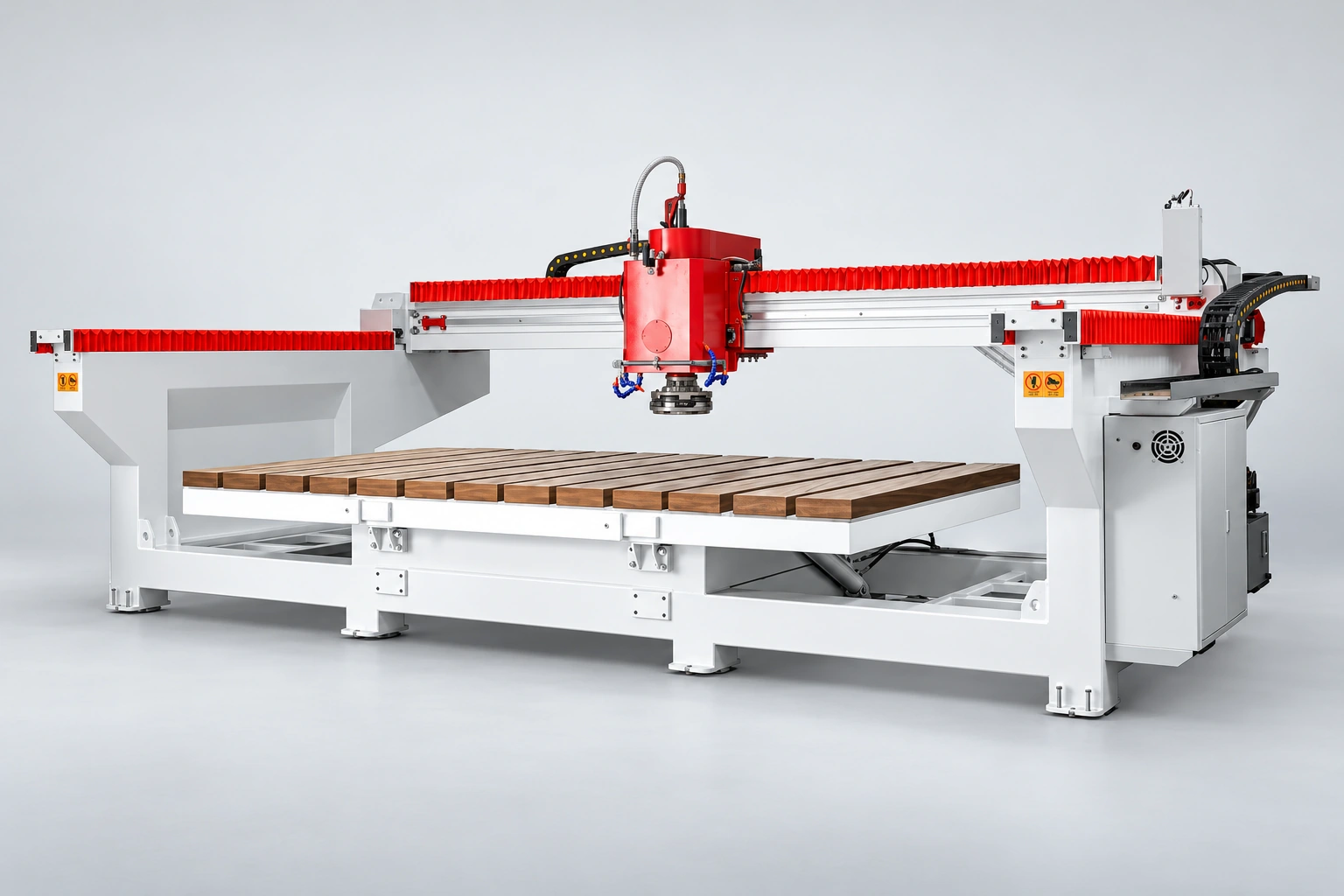 Granite & Marble Bridge Polisher4 questions
What is a stone bridge polishing machine and how does it polish large granite or marble slabs automatically?
A stone bridge polishing machine moves a rotating grinding head across a stationary slab on a traverse table, polishing the full surface automatically without manual repositioning. HOYUN Machinery’s bridge polishing machine, produced in Foshan, China, processes slabs up to 3200 x 2000 mm with a maximum thickness of 50 mm, covering granite, marble, quartz, and terrazzo tile in a single automated pass.
What advantage does an electric lifting pressure wheel give a stone polishing machine compared to a manual one?
Electric lifting makes pressure wheel adjustment faster and more precise than manual threading, letting operators dial in clamping force consistently across different slab thicknesses without interrupting the polishing cycle. HOYUN Machinery’s bridge polishing machine, built in Foshan, China, uses this system to keep slabs stable through the full 3200 mm travel, supporting a main shaft rotation speed of 450 rpm for granite, marble, and quartz finishing.
Can a bridge polishing machine handle special-shaped stone plates, or is it only for rectangular slabs?
Most bridge polishing machines are optimized for rectangular slabs, but servo motor-driven models can follow programmed paths for round and custom-shaped plates. HOYUN Machinery’s bridge polishing machine, built in Foshan, China with servo motor drive control, processes rectangular, round, and various special-shaped stone plates, making it a practical option for fabricators working on decorative architectural stone and custom countertop formats.
How do fabricators polish granite slab surfaces evenly without relying on manual grinding?
Consistent slab surface polishing without manual intervention requires a machine with even water distribution, stable head pressure, and programmable traverse control. Stone fabricators in markets like Australia, the UAE, and India use automatic bridge polishing machines for this purpose. HOYUN Machinery’s solution, manufactured in Foshan, China, uses a center water outlet and double-layer steel rack construction to maintain uniform polishing brightness across full-size granite and marble slabs.
Manual tile cutters
3 machines with FAQs
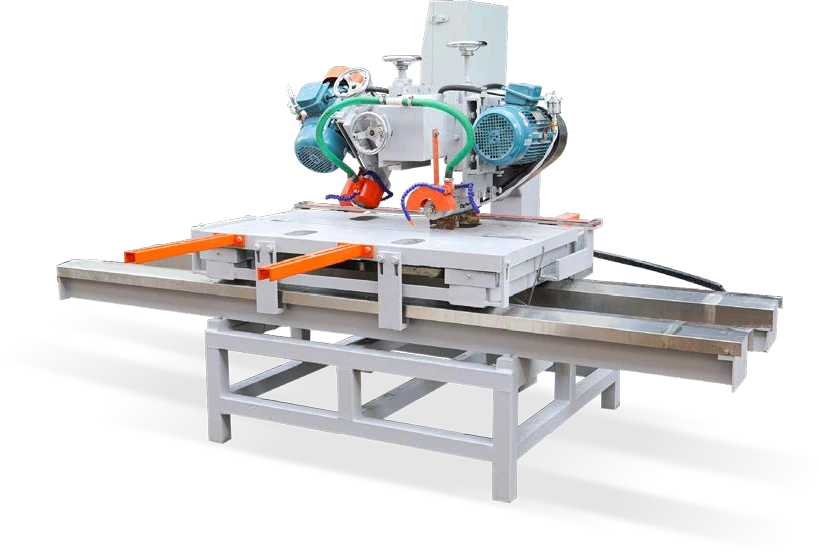 Hand-Push CNC Double-Blade Multifunction Cutter1 question
Which model fits my work?
Send the material, tile size and thickness, required cuts or grooves, and your available workshop space. We will review the appropriate model and tooling.
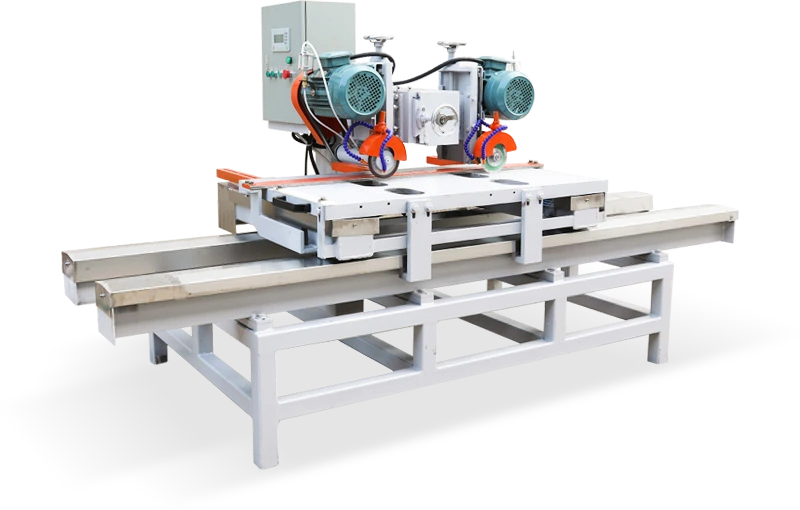 Hand-Push CNC Double-Blade Cutter1 question
Which model fits my work?
Send the material, tile size and thickness, required cuts or grooves, and your available workshop space. We will review the appropriate model and tooling.
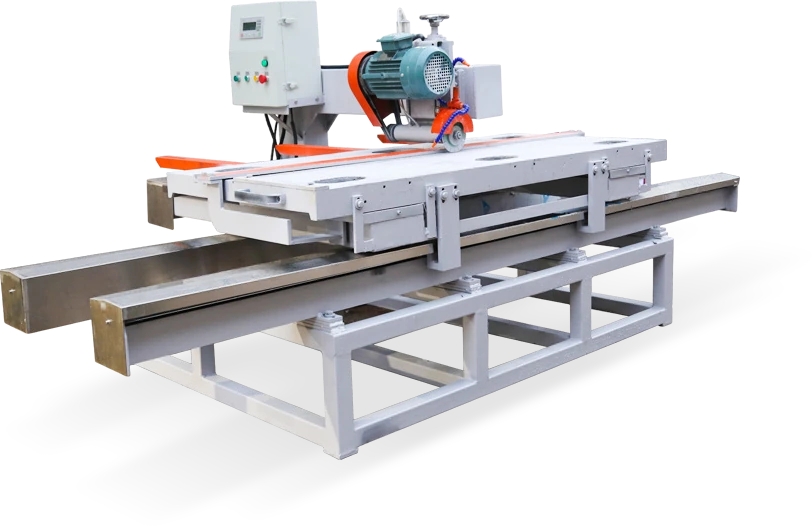 Hand-Push CNC Single-Blade Cutter1 question
Which model fits my work?
Send the material, tile size and thickness, required cuts or grooves, and your available workshop space. We will review the appropriate model and tooling.
Automated production lines
1 machine with FAQs
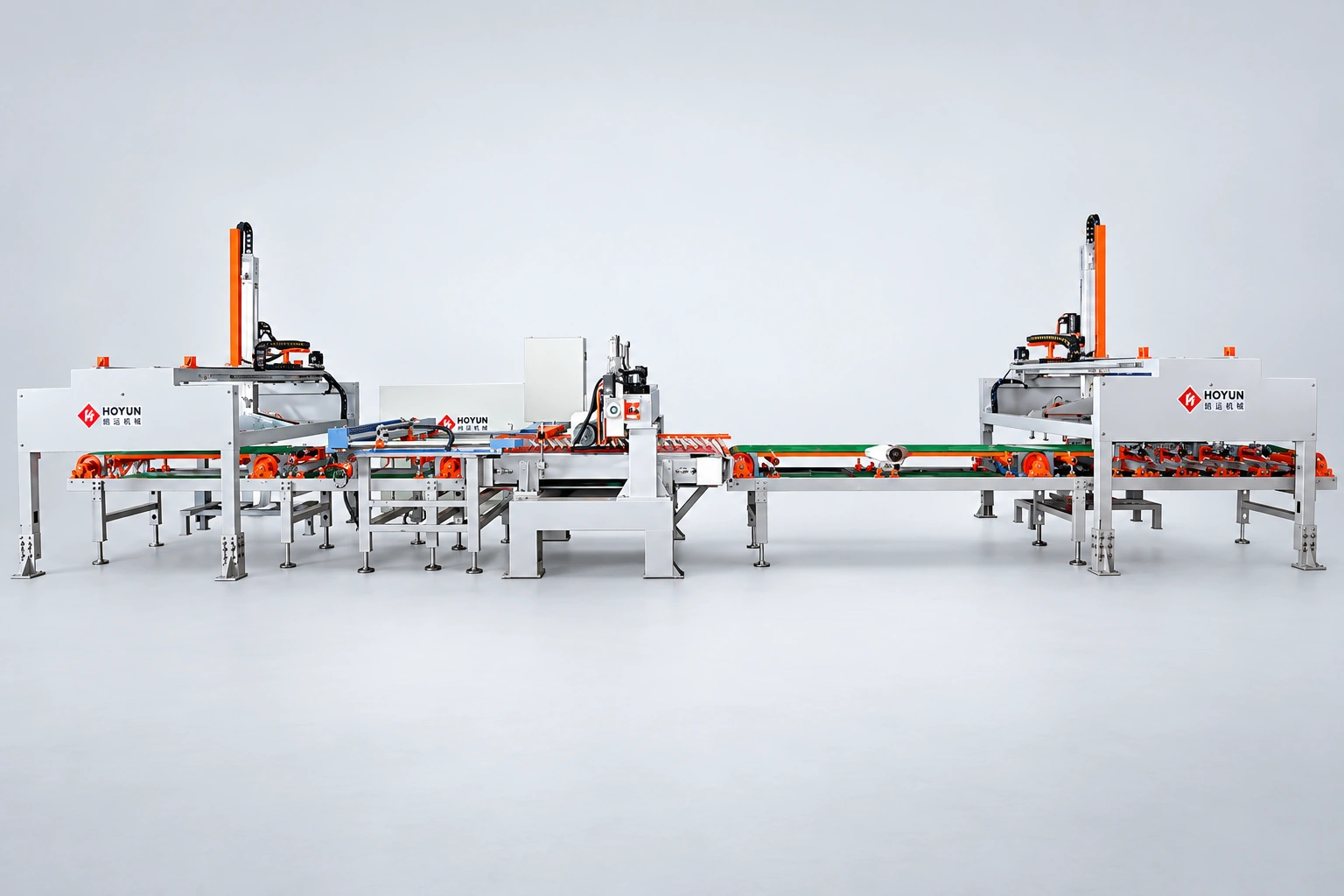 Ceramic Tile Cutting & Edging Line4 questions
What does an automatic tile cutting and edging line handle?
The line combines straight cutting, edging and chamfering for ceramic tile, porcelain and floor plates. Confirm the material range and output for the selected stations.
How can I run tile cutting around the clock with minimal staff?
Running tile cutting continuously with minimal staff requires automatic loading, unloading, and a control system that needs little operator input between shifts. HOYUN Machinery’s automatic ceramic tile cutting and edging machine, made in Foshan, China, supports optional auto-loading and unloading alongside a self-developed touch interface that keeps tile plants running around the clock with reduced supervision.
Is there a tile cutter that keeps accuracy over years of heavy use?
Maintaining cutting accuracy over years of heavy production use depends on the quality of the positioning mechanism. HOYUN Machinery’s automatic ceramic tile cutting and edging machine uses an oil-immersed lead screw positioning system, produced in Foshan, China, that is designed to extend the service life of the lead-screw positioning system significantly compared to standard dry setups, helping tile plants maintain dimensional consistency through demanding daily production schedules.
I need to batch-cut and chamfer tiles for cabinets and staircases, what fits?
Batch cutting and chamfering for cabinet pieces and staircase tiles both fall within the capability of HOYUN Machinery’s automatic ceramic tile cutting and edging machine, which handles varied formats in a single line. Produced in Foshan, China, its digital screen sets dimensions quickly, so tile processors can switch between custom and batch jobs without lengthy manual reconfiguration between runs.
Tools & workshop equipment
2 machines with FAQs
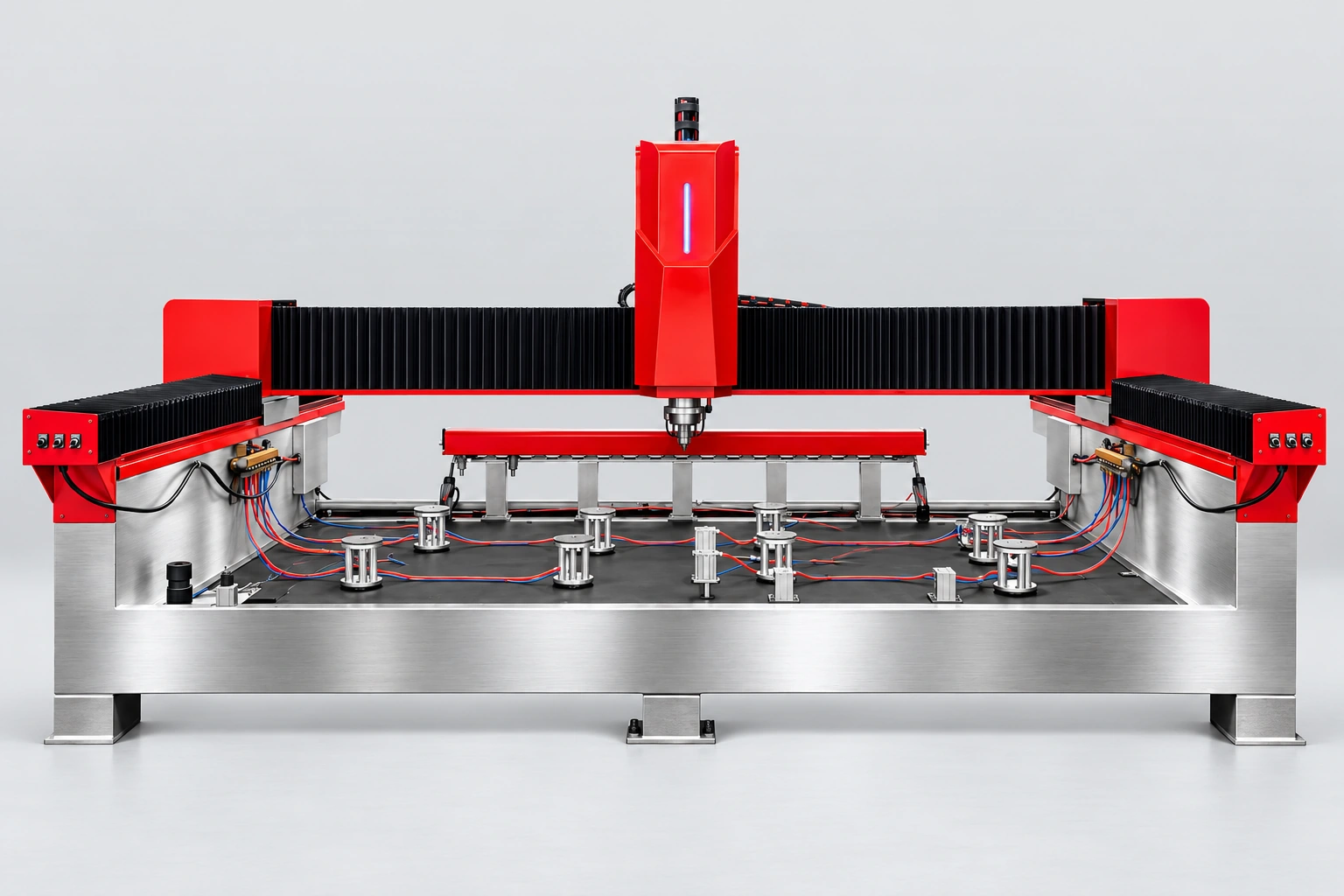 Quartz Countertop Fabrication Machine3 questions
How are tools changed and set?
Automatic tool changing is optional. Confirm the tool-changing and automatic tool-setting configuration in your quotation.
How is the workpiece held?
The machine uses a vacuum clamping system to hold the workpiece during the programmed machining operation.
Is the dual-spindle configuration standard?
The original product lists the dual-spindle arrangement as optional. Confirm the supplied spindle configuration with your quotation.
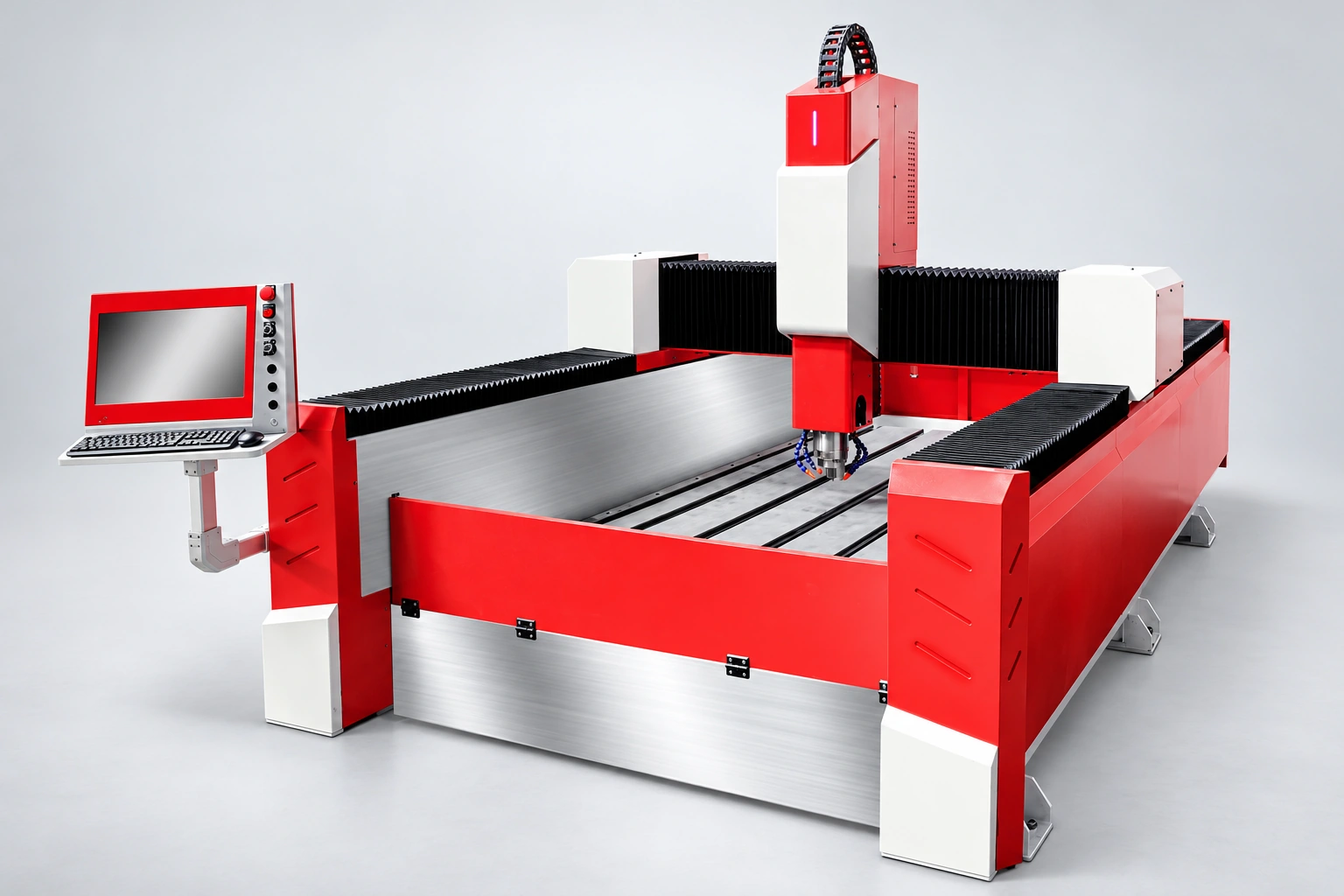 CNC Stone Router4 questions
What spindle speed does a CNC stone router need for detailed decorative work on marble and porcelain?
Detailed decorative routing on marble and porcelain typically requires spindle speeds between 18,000 and 24,000 rpm to produce clean, precise cuts without excessive vibration or surface tearing. HOYUN Machinery’s CNC stone router, manufactured in Foshan, China, runs at 24,000 rpm with a 5.5 kW spindle and supports an optional tool magazine for quick head changes when switching between different profiling and engraving operations.
Can a CNC stone router machine cut precise slots and grooves in stone panels for facade anchoring systems?
Facade anchoring systems require consistent, accurately positioned slots or grooves cut into the back or edges of stone panels so they align with the building substrate anchors. HOYUN Machinery’s CNC stone router, built in Foshan, China, handles this application on porcelain, marble, granite, and sintered stone, with a Y-axis stroke of 2500 mm and processing speeds up to 20,000 mm/min for production-scale facade panel preparation.
Is there a CNC stone router machine that supports remote monitoring or cloud connectivity for factory management?
Remote monitoring and cloud IoT connectivity on stone processing machines allow factory managers to track machine status, diagnose faults, and adjust parameters without being on the floor. HOYUN Machinery’s CNC stone router, produced in Foshan, China, integrates cloud IoT and intelligent service features as part of its fourth-generation design, alongside technical one-to-one guidance for installation and operation support.
What is the difference between the HY 1325 and HY 3013 CNC stone router models?
Both the HY 1325 and HY 3013 share a 1300 mm X-axis stroke, but differ in Y-axis travel: the HY 1325 has a 2500 mm Y-axis while the HY 3013 extends to 3000 mm for larger panel processing. HOYUN Machinery manufactures both models in Foshan, China, with a 24,000 rpm spindle, 580 mm Z-axis stroke, and WEIHONG CNC control. The HY 3013 also adds dual-motor simultaneous drive for increased cutting force on demanding stone and porcelain applications.
