Ceramic Tile Skirting, Treads & Trim
For tile skirting, rounded stair nosings and paired corner returns.
- Materials
- Ceramic and porcelain tiles, with tooling matched to the tile body and glaze.
- Process
- Cut repeat strips and tread blanks. Round exposed noses or mitre the two faces of a corner.

Recommended setup
Setup 01 matches the workshop image above. Compare other setups for different parts or processes.
Setup 01
Tile sizing + bullnose polisher + corner machine
Size skirting and tread blanks on the cutter. Use the bullnose station for rounded nosings and the corner machine for paired mitres.
Workflow
- Size and sort tile blanks
- Round treads or mitre corner pairs as specified
- Check the finished edges and dry-fit pairs
-
1200 Cutting & Beveling Machine
Size tiles and cut the specified compatible edge bevel.
- Output
- Sized tile pieces with eligible beveled edges.
- Overall size
- 2600 × 2000 × 1750 mm
-
5+14 BPM Bullnose Edge Polisher
Form and polish rounded edges on compatible tile.
- Output
- Rounded tread or trim edges.
- Overall size
- 5900 × 2300 × 1850 mm
-
1800 45° Tile Corner Machine
Cut complementary 45° faces for inside or outside corner assemblies.
- Output
- Matched tile pieces for dry fitting.
- Overall size
- 2200 × 1500 × 1600 mm
Compare other setups
Setup 02
Multi-blade strip cutter
For repeat-width skirting with square edges and no additional profiling.
Workflow
- Set blade spacing
- Cut supported strips
- Check widths and chipping
-
HY2-450 Twin-Group Multi-Blade Cutter
Pre-cut and finish parallel cuts to produce repeat-width strips.
- Output
- Repeat-width strips for sorting or a qualified cross-cut.
- Overall size
- 2400 × 1600 × 1750 mm
Setup 03
Three-blade cutter + tile corner machine
For repeat-size tile runs with a separate corner station.
Workflow
- Size repeat blanks
- Prepare mating faces
- Dry-fit a complete pair
-
1800 Three-Blade Ceramic Tile Cutter
Cut ceramic tile to repeated sizes with the selected blade positions.
- Output
- Repeat-size tile strips and blanks.
- Overall size
- 2800 × 2300 × 1750 mm
-
1800 45° Tile Corner Machine
Cut complementary 45° faces for inside or outside corner assemblies.
- Output
- Matched tile pieces for dry fitting.
- Overall size
- 2200 × 1500 × 1600 mm
Finished parts in use
Compare square-edged strips, rounded nosings and dry-fitted corner pairs. Applications are shown for illustration.
Skirting strips and corner returns
-

Skirting strips Check width at both ends and the center before grouping strips by room. -

Installed skirting Align the visible joints and the top edge with the floor and wall finish. -

Dry-fitted outside corner Check face alignment and the visible glaze at both tips before fitting. -

Installed tiled corner Check the visible seam along the return and protect the finished edge during fitting.
Rounded noses and installed treads
-

Rounded tread nose Check that the radius and glaze finish are consistent along the full edge and at both ends. -

Tread mock-up Dry-fit the tread and riser together to confirm the edge projection. -
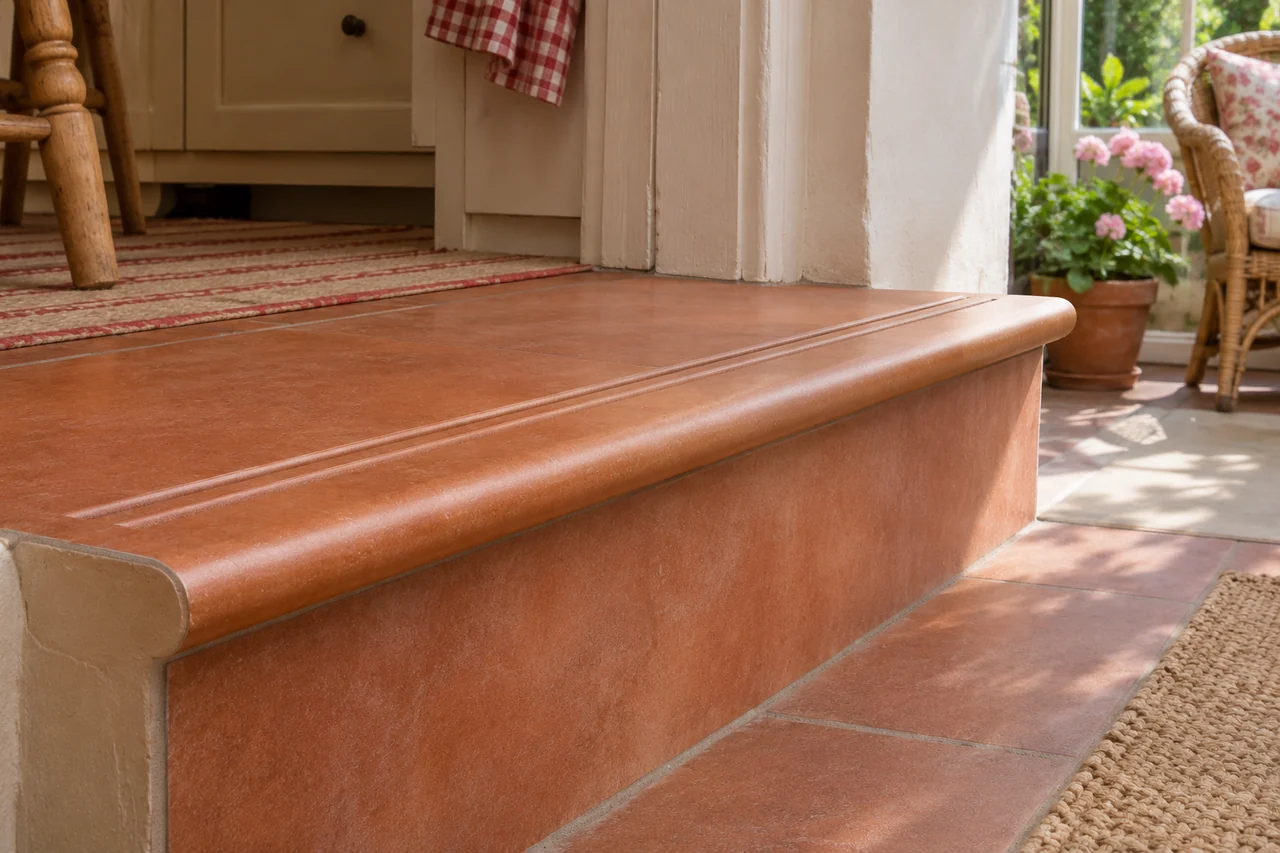
Rounded tile step Compare the nose profile on the full tread and its corner return before approving the set. -
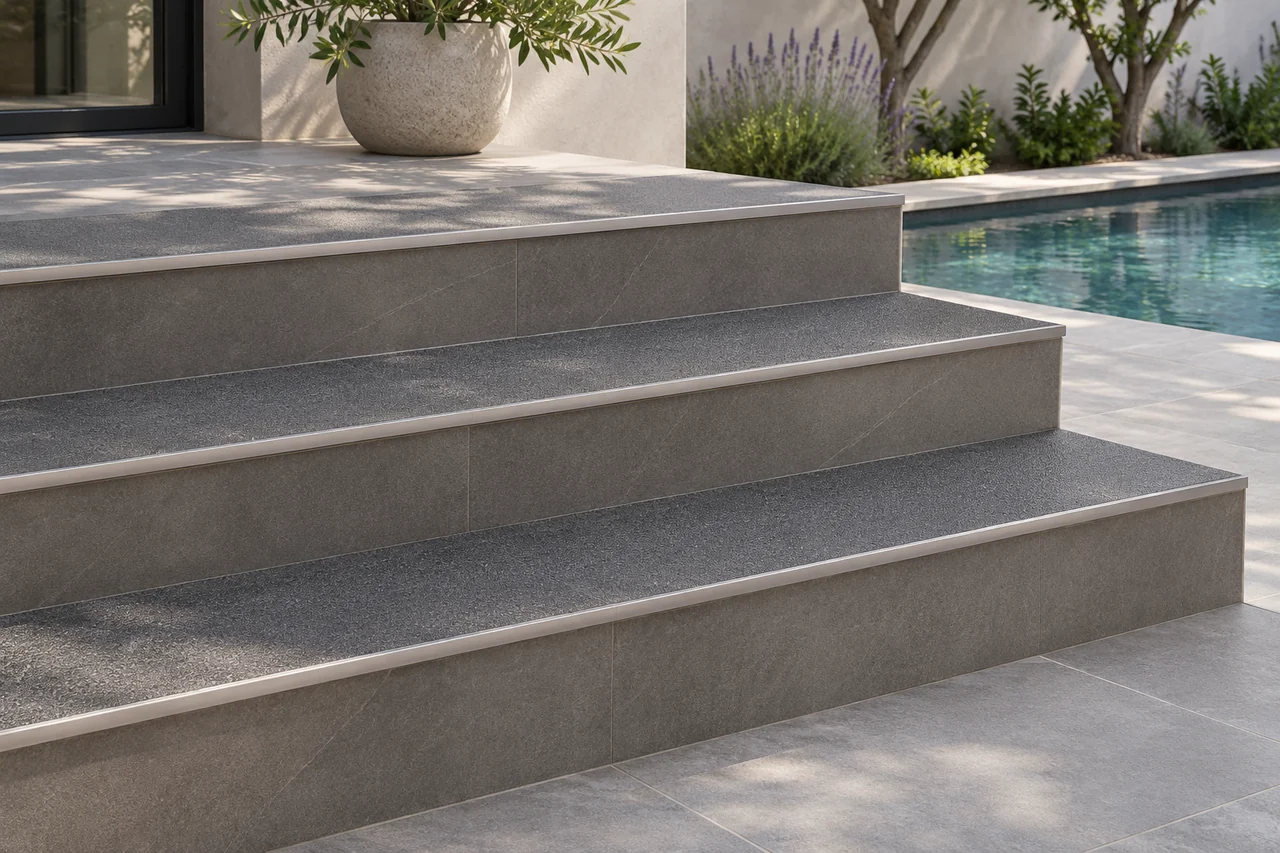
Tiled steps at a pool terrace Dry-fit a full tread and compare the exposed edge and joint alignment across adjacent steps.
Check the fit for your workshop
Check your drawings against machine limits, then plan how slabs and finished parts will move through the workshop.
Part requirements
Mark strip widths and profile codes on the cut list. Separate square-edge strips, bullnose treads and left/right corner pairs after sizing.
Strip dimensions
Mark nominal width and your narrowest strip, then measure both finished ends.
Tread edge
Specify the finished profile, projection and any separately required slip detail.
Corner pair
Identify the visible face, mating edge and desired glaze remainder on both parts.
Single-machine operations and model details
 Machine details
1200 Cutting & Beveling Machine
- Functions
- Size tiles and cut the specified compatible edge bevel.
- Core configuration
- Automatic cutting and beveling stations. Trial the intended tile body and bevel width.
 Machine details
5+14 BPM Bullnose Edge Polisher
- Functions
- Form and polish rounded edges on compatible tile.
- Core configuration
- 5+14-head single-swing configuration. Catalogue width is 90–1200 mm and thickness is 6–30 mm.
 Machine details
1800 45° Tile Corner Machine
- Functions
- Cut complementary 45° faces for inside or outside corner assemblies.
- Core configuration
- Dedicated 45° corner station. Verify support, chipping and the visible face remainder on the minimum strip.
 Machine details
HY2-450 Twin-Group Multi-Blade Cutter
- Functions
- Pre-cut and finish parallel cuts to produce repeat-width strips.
- Core configuration
- Two multi-blade groups pre-cut and finish in the same feed direction. Provide support for a separate perpendicular pass.
 Machine details
1800 Three-Blade Ceramic Tile Cutter
- Functions
- Cut ceramic tile to repeated sizes with the selected blade positions.
- Core configuration
- Three-blade CNC cutting configuration. Check feed and handling for the actual tile format.
Workshop layout and handling
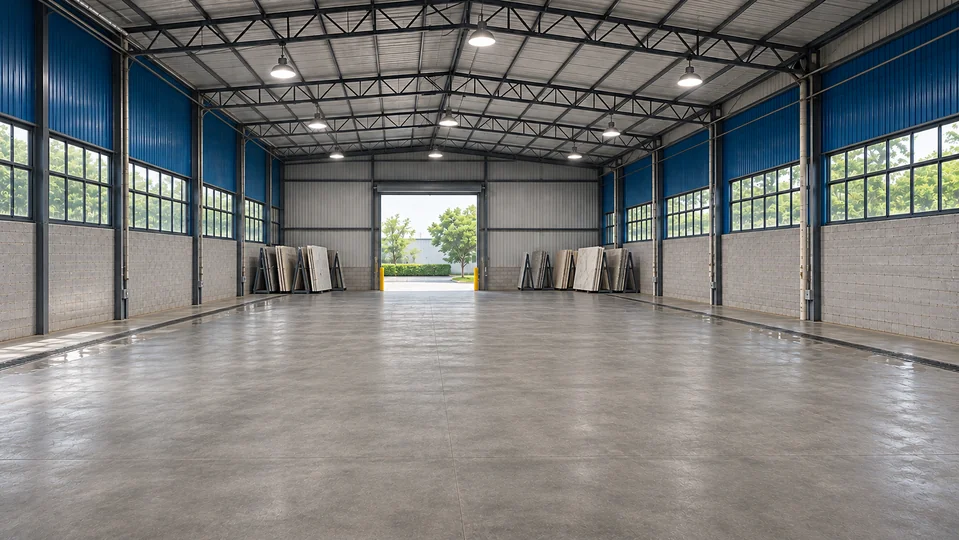
The estimate adds the footprints of the machines in Setup 01. Allow extra room for loading, aisles, servicing and auxiliary equipment. Confirm the installed layout for your site.
- Wet cutting zones
- Separate strip cutting and wet edge work so sorted batches stay together.
- Narrow-piece support
- Provide stable support on the feed and discharge sides of each station.
- Dry-fit bench
- Keep a separate clean area for checking full treads and return pieces.
Technical answers
Before you order
Review machine fit and sample checks, then see what to send for an equipment quote.
Discuss your setupWhich cutter suits repeat skirting?
Compare tile formats, strip widths and changeovers. A multi-blade station suits repeated widths when the tile and exit support are qualified.
Can I use the same setup for bullnose and mitres?
Treat them as separate edge specifications. Trial the rounded profile and the full 45° pair on tiles from the actual order.
What should I record from the trial?
Cut the narrowest skirting strip, finish a full-length bullnose and dry-fit a complete mitred pair. Check the glaze at each edge and at the ends. See the finished-part checks.
What do you need for a quote?
Send tile dimensions, thickness, body and glaze, your strip widths, tread profiles and corner drawings. Include the volume of each finish.
