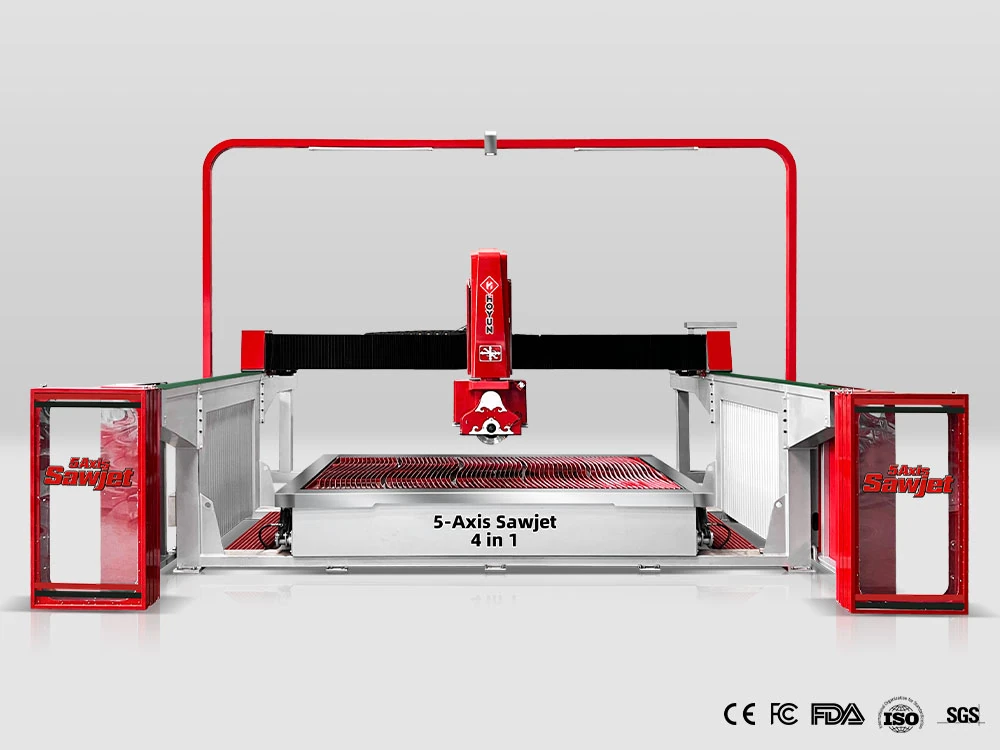
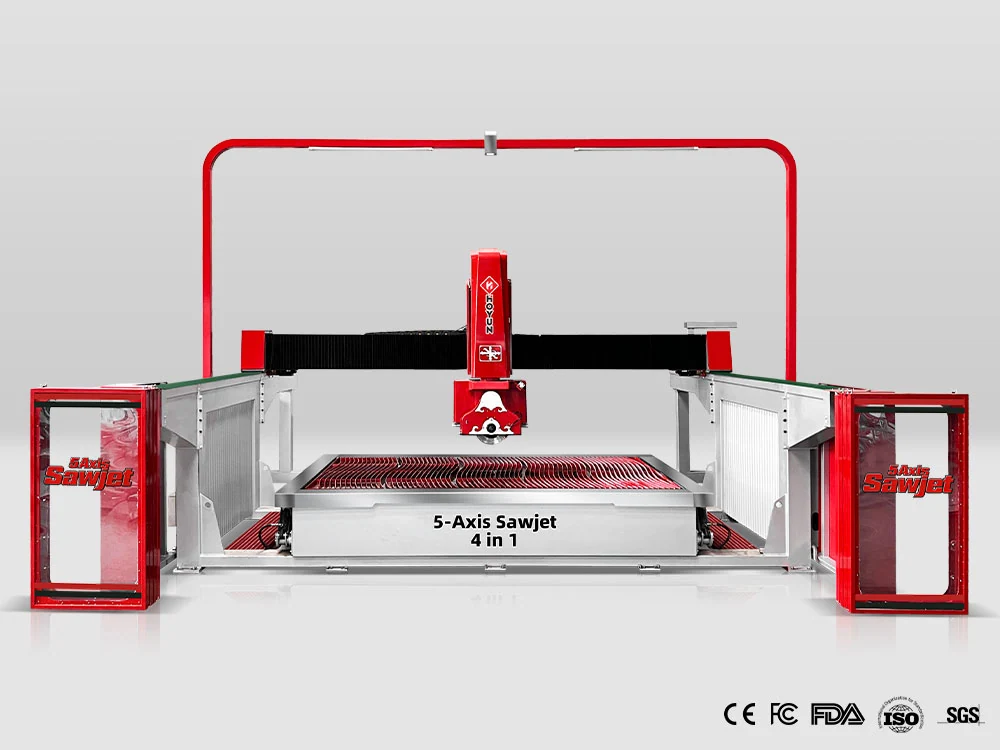
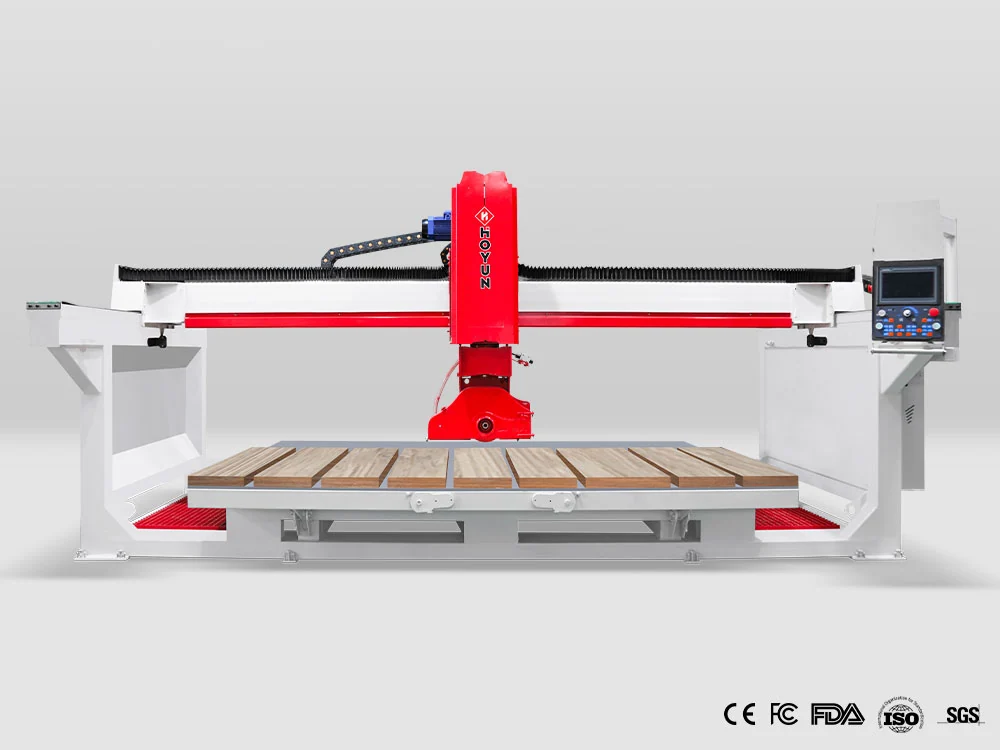
CNC Sawjet 4-in-1: One Stone Sawjet Machine for Saw, Waterjet, Mill & Edge
A CNC Sawjet is a stone Sawjet that puts a diamond bridge-saw blade and an abrasive waterjet—plus milling and edging—on one CNC frame, so straight cuts and complex openings share one fixture instead of two (or three) separate cells.
- Published
- Reading time
- 5 min read
- Published by
- HoYun Machinery
In this articleBrowse all sections
Fabricators who run sintered stone cutting, quartz kitchens, and granite islands in the same week feel the gap first: every slab transfer between a bridge saw and a waterjet adds labor, risk, and floor space. A Sawjet machine is built for that mixed-work reality—not for shops that only blank straights or only jet openings all day.
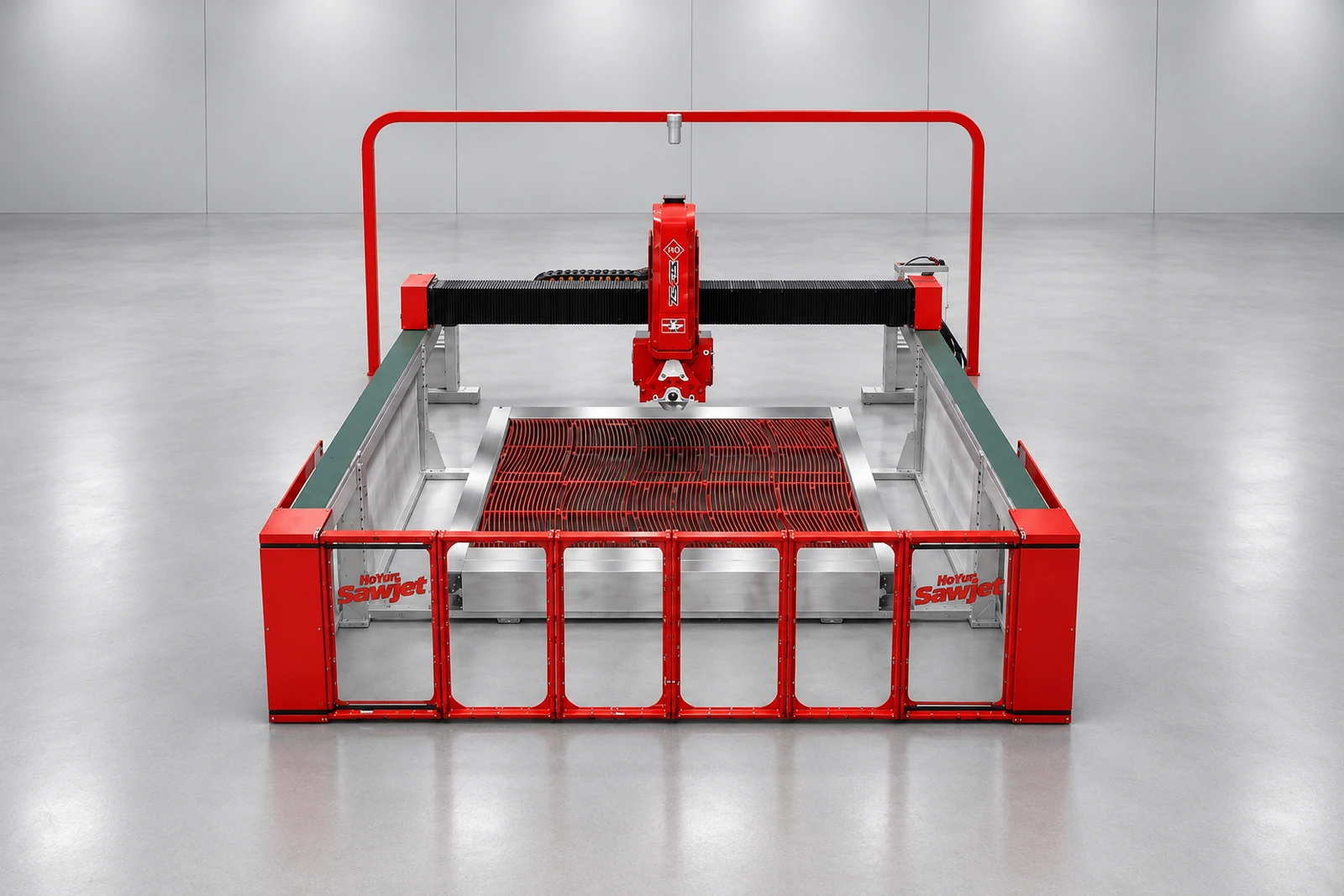
HOYUN Machinery’s HOYUN Sawjet line follows that logic from 2020 drawings through the 2023 Gen-1 dual-head parallel layout to the 2026 Gen-3 / 3.0 front–rear beam platform shown at the Xiamen Stone Fair. Soft next step: review the current platform on the HOYUN CNC Sawjet 5 Axis product page.
What Is a CNC Sawjet?
A CNC Sawjet is a CNC stone fabrication machine that combines a bridge saw and a waterjet—and, on HOYUN’s platform, milling and edging—so one nest can finish straight cuts and openings without moving the slab to another cell.
Buyers also search this category as a stone Sawjet, a Sawjet machine, a 5 axis Sawjet / 5 axis Sawjet stone platform, a bridge saw and waterjet combined cell, or a 4-in-1 stone cutting machine / CNC 4-in-1.
| Function | Typical use on a CNC Sawjet |
|---|---|
| Saw blade | Fast, lower-consumable straight cuts, miters, outer slab breakdown |
| Waterjet | Sink/cooktop openings, curves, corners, chip-sensitive sintered detail |
| Milling | Contours, slots, cutouts that need a cutter rather than a jet or blade alone |
| Edging / polishing | Profile and edge finish without a separate dedicated cell for every job |
That CapEx question is usually the same: keep a Sawjet vs bridge saw and waterjet as two machines—or buy one integrated CNC 4-in-1.
Why Fabricators Choose a 4-in-1 Sawjet Machine
This is the decision most shops are really making. A 4-in-1 stone cutting machine only wins when the weekly cut mix rewards one fixture path more than peak parallel capacity on two floors.
Multi-material work on one CNC Sawjet
Operators can switch or combine saw, milling cutter, and waterjet as the job demands—covering sintered stone, quartz, and granite fabrication without booking three different cells. That matters when the same week mixes porcelain vanity tops, engineered-stone kitchens, and natural-stone islands.
Bridge saw and waterjet combined → less floor space
One bridge saw and waterjet combined footprint is designed to replace the combined hall space of a separate waterjet + bridge saw + machining-center layout. Urban shops, retrofit plants, and exporters who pay for every covered square meter feel this first.
No secondary slab handling — one fixture path
Straight cuts, openings, milling, and edge work stay on one fixture path. Removing “saw → cart → waterjet → cart → center” handoffs cuts non-cut time that never shows up on a blade brochure but shows up on payroll and scrap reports.
Yield: saw for straight cuts, waterjet for openings and corners
Use the saw for routine cuts and the waterjet for complex shapes and corners to reduce blade overcut and protect usable slab area—especially on high-value sintered panels and book-matched material where chip risk is expensive.
Whole-home / custom shops and limited floor space
Gen-1 was already aimed at workshops with limited floor space, multi-material order books, and whole-home custom fabrication where every top is a different nest. Programming flexibility often beats pure commodity throughput in those shops.
Gen-3 productivity: shorter footprint, faster traverse
HOYUN’s Gen-3 / 3.0 briefing claims a shorter machine (~6.5 m → ~5.5 m), rapid traverse +50%, and processing efficiency +1/3 or more versus Gen-1, plus galvanizing, a movable console, and enclosure protection. Those gains only matter if operators actually use saw and waterjet on the same nest—detail in the Gen-3 section below.
Sawjet vs Separate Bridge Saw and Waterjet
| Factor | One CNC Sawjet (4-in-1) | Separate bridge saw + waterjet |
|---|---|---|
| Floor space | One combined footprint | Two (or three) cells + aisles between them |
| Slab handling | One fixture / one program path for mixed nests | Unload, re-fixture, re-zero between cells |
| CapEx logic | One capable platform now; fewer under-used machines | Higher parallel capacity if both cells stay loaded |
| Skill stack | One CNC skill path for operators | Machine-specific tribes (saw vs jet) |
| Best fit | Mixed materials, openings + straights, tight shops, custom / whole-home | Peak saw hours and peak waterjet hours always collide at high volume |
| When two cells still win | — | Both processes already paid for and staffed at full load; or almost 100% straight blanks with almost no openings |
Choose a Sawjet when mixed jobs, openings, and space dominate. Keep two machines when both processes run at full load all day—or buy a dedicated CNC bridge saw / waterjet from HOYUN’s lineup and skip the Sawjet.
HOYUN Sawjet Layout Evolution: Gen-1 → Gen-2 → Gen-3
HOYUN’s design drawings show a clear footprint path: parallel dual-head packaging on Gen-1, then front-to-back beam layouts on Gen-2 / Gen-3, with Gen-3 offering 3600 / 3200 plan options. The drawings below are for layout orientation only—confirm live dimensions on the formal quotation.
Gen-1 — parallel waterjet + bridge saw
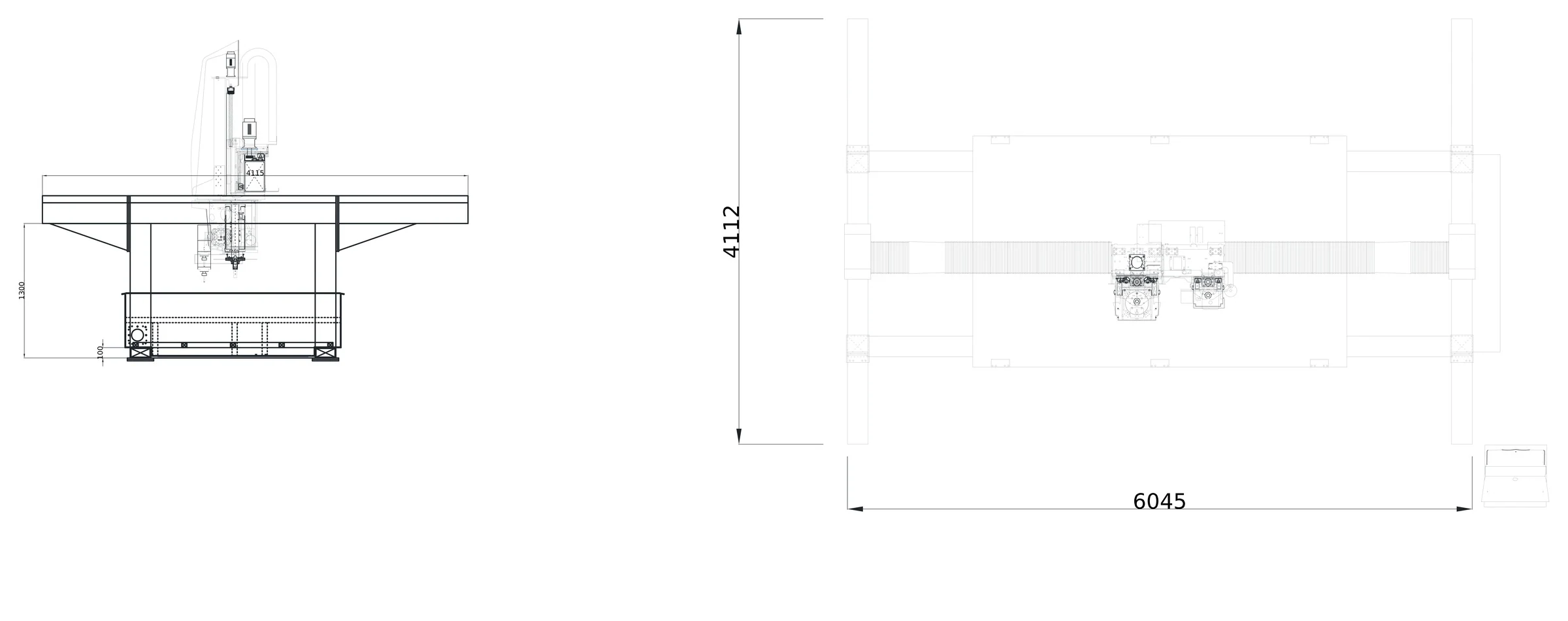
2020 drawings → 2023 Gen-1 prototype (Foshan). Dual tool heads / dual Z side-by-side; machine length about ~6.5 m. HOYUN describes Gen-1 as China’s first fully self-developed 4-in-1 (saw + waterjet + milling + edging/polishing)—treat that as HOYUN positioning, not independent third-party certification.
Gen-2 — front-to-back beam options
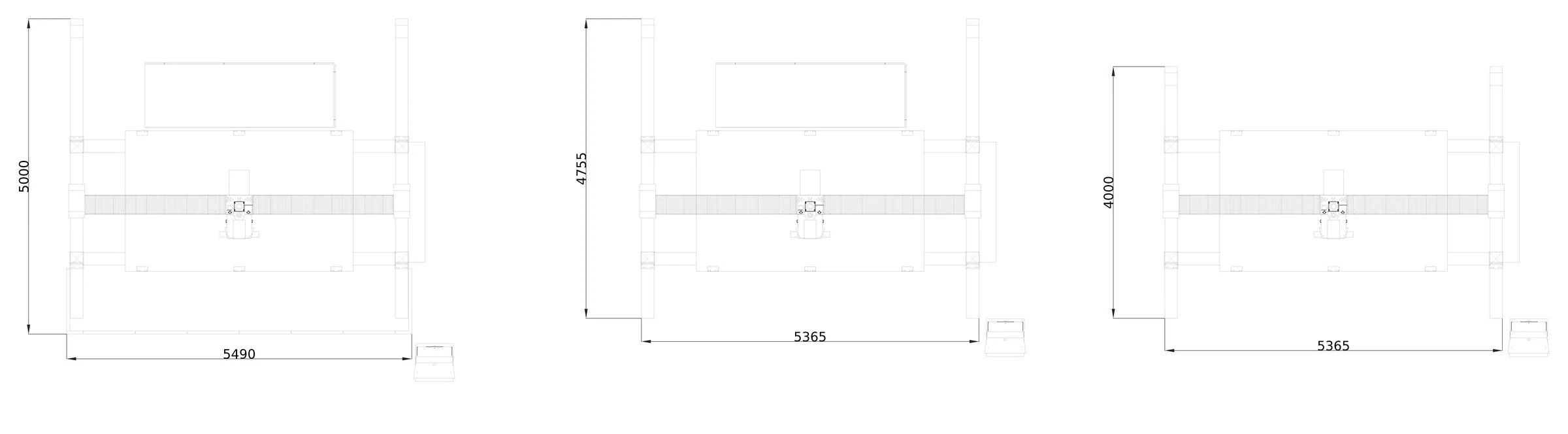
Front–rear packaging shortens the packaging logic versus side-by-side dual heads and opens clearer plan options for shops comparing hall depth vs width.
Gen-3 — 3600 / 3200 front-to-back footprints
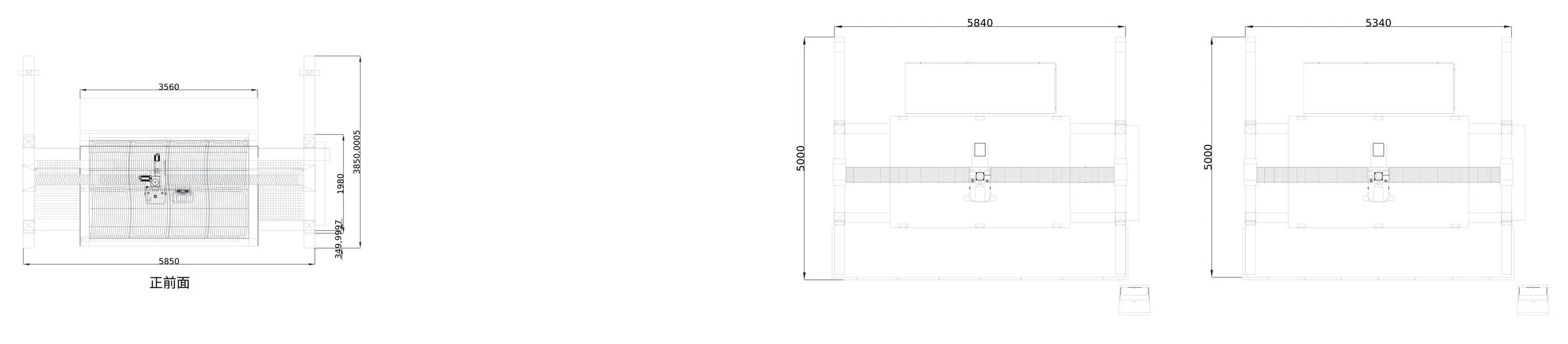
Gen-3 / 3.0 (Xiamen Stone Fair 2026 per briefing): X-axis beam redesigned to a front–rear array, length about ~5.5 m, with plan options aimed at different slab and shop constraints.