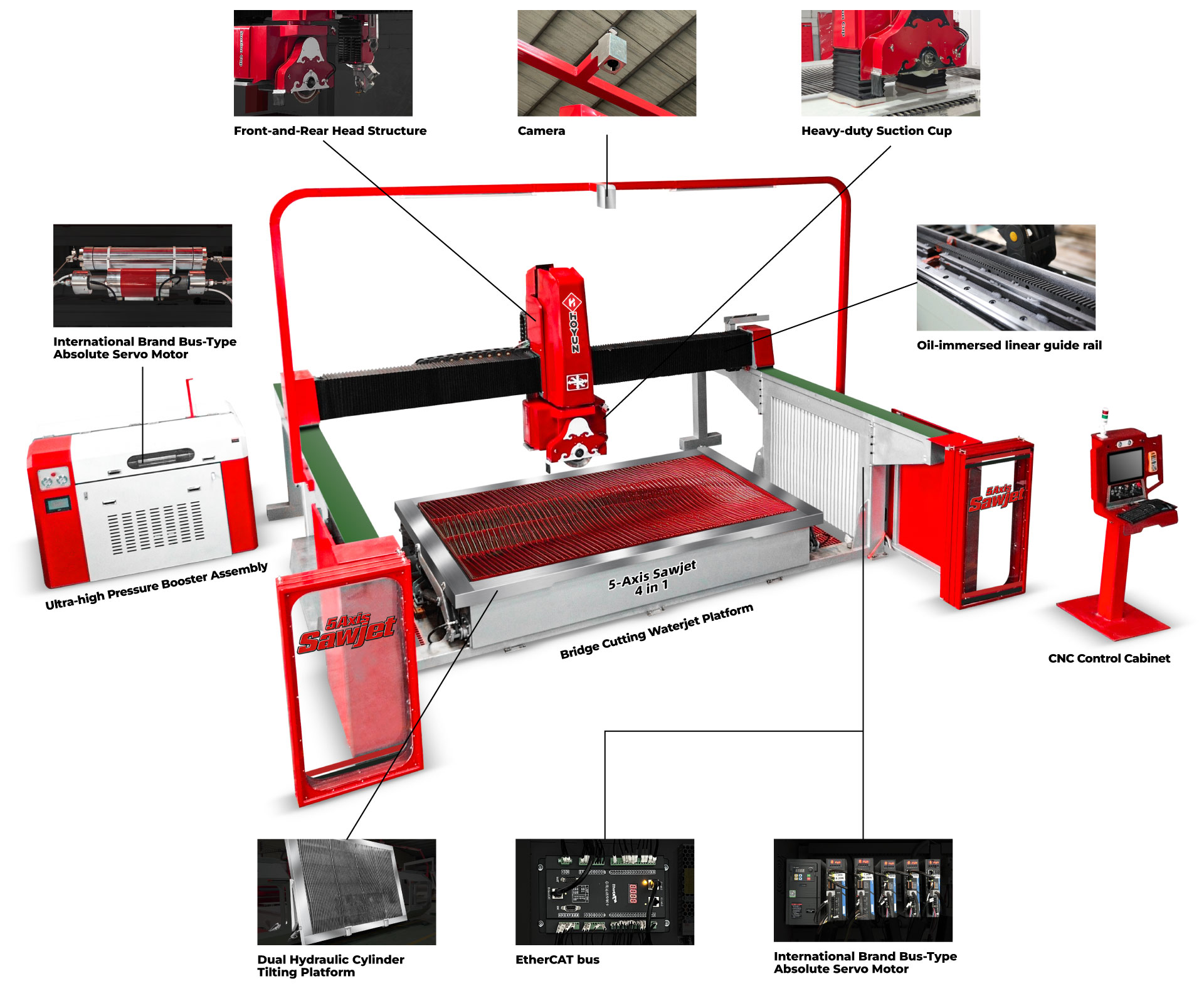
CNC Sawjet 4-in-1: One Stone Sawjet Machine for Saw, Waterjet, Mill & Edge
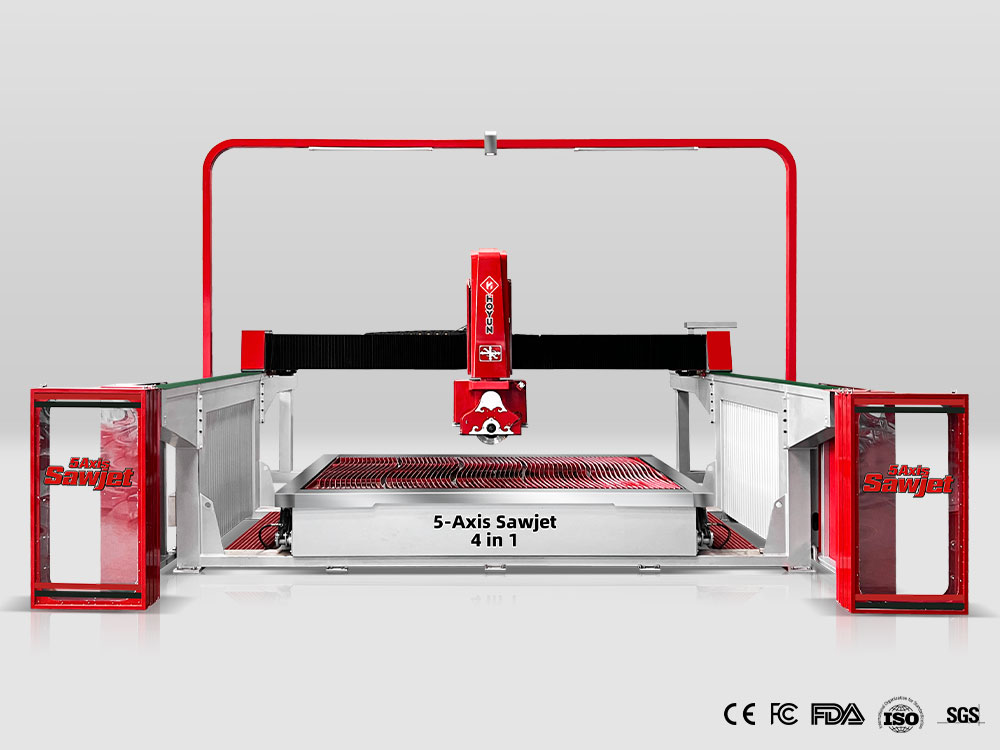
A CNC Sawjet é um stone Sawjet that puts a diamond bridge-saw blade and an abrasive waterjet—plus milling and edging—on one CNC frame, so straight cuts and complex openings share one fixture instead of two (or three) separate cells.
Fabricators who run sintered stone cutting, quartz kitchens, and granite islands in the same week feel the gap first: every slab transfer between a bridge saw and a waterjet adds labor, risk, and floor space. A Sawjet machine is built for that mixed-work reality—not for shops that only blank straights or only jet openings all day.
HOYUN Machinery’s HOYUN Sawjet line follows that logic from 2020 drawings through the 2023 Gen-1 dual-head parallel layout to the 2026 Gen-3 / 3.0 front–rear beam platform shown at the Xiamen Stone Fair. Soft next step: review the current platform on the HOYUN CNC Sawjet 5 Axis product page.
A CNC Sawjet is a CNC stone fabrication machine that combines a bridge saw and a waterjet—and, on HOYUN’s platform, milling and edging—so one nest can finish straight cuts and openings without moving the slab to another cell.
Buyers also search this category as a stone Sawjet, a Sawjet machine, a 5 axis Sawjet / 5 axis Sawjet stone platform, a bridge saw and waterjet combined cell, or a 4-in-1 stone cutting machine / CNC 4-in-1.
Contours, slots, cutouts that need a cutter rather than a jet or blade alone
Edging / polishing
Profile and edge finish without a separate dedicated cell for every job
That CapEx question is usually the same: keep a Sawjet vs bridge saw and waterjet as two machines—or buy one integrated CNC 4-in-1.
Why Fabricators Choose a 4-in-1 Sawjet Machine
This is the decision most shops are really making. A 4-in-1 stone cutting machine only wins when the weekly cut mix rewards one fixture path more than peak parallel capacity on two floors.
Multi-material work on one CNC Sawjet
Operators can switch or combine saw, milling cutter, and waterjet as the job demands—covering sintered stone, quartze granite fabrication without booking three different cells. That matters when the same week mixes porcelain vanity tops, engineered-stone kitchens, and natural-stone islands.
Bridge saw and waterjet combined → less floor space
One bridge saw and waterjet combined footprint is designed to replace the combined hall space of a separate waterjet + bridge saw + machining-center layout. Urban shops, retrofit plants, and exporters who pay for every covered square meter feel this first.
No secondary slab handling — one fixture path
Straight cuts, openings, milling, and edge work stay on one fixture path. Removing “saw → cart → waterjet → cart → center” handoffs cuts non-cut time that never shows up on a blade brochure but shows up on payroll and scrap reports.
Yield: saw for straight cuts, waterjet for openings and corners
Use the saw for routine cuts and the waterjet for complex shapes and corners to reduce blade overcut and protect usable slab area—especially on high-value sintered panels and book-matched material where chip risk is expensive.
Whole-home / custom shops and limited floor space
Gen-1 was already aimed at workshops with limited floor space, multi-material order books, and whole-home custom fabrication where every top is a different nest. Programming flexibility often beats pure commodity throughput in those shops.
HOYUN’s Gen-3 / 3.0 briefing claims a shorter machine (~6.5 m → ~5.5 m), rapid traverse +50%e processing efficiency +1/3 or more versus Gen-1, plus galvanizing, a movable console, and enclosure protection. Those gains only matter if operators actually use saw e waterjet on the same nest—detail in the Gen-3 section below.
Sawjet vs Separate Bridge Saw and Waterjet
Fator
One CNC Sawjet (4-in-1)
Separate bridge saw + waterjet
Floor space
One combined footprint
Two (or three) cells + aisles between them
Slab handling
One fixture / one program path for mixed nests
Unload, re-fixture, re-zero between cells
CapEx logic
One capable platform now; fewer under-used machines
Higher parallel capacity if both cells stay loaded
Peak saw hours and peak waterjet hours always collide at high volume
When two cells still win
—
Both processes already paid for and staffed at full load; or almost 100% straight blanks with almost no openings
Choose a Sawjet when mixed jobs, openings, and space dominate. Keep two machines when both processes run at full load all day—or buy a dedicated CNC bridge saw / waterjet from HOYUN’s lineup and skip the Sawjet.
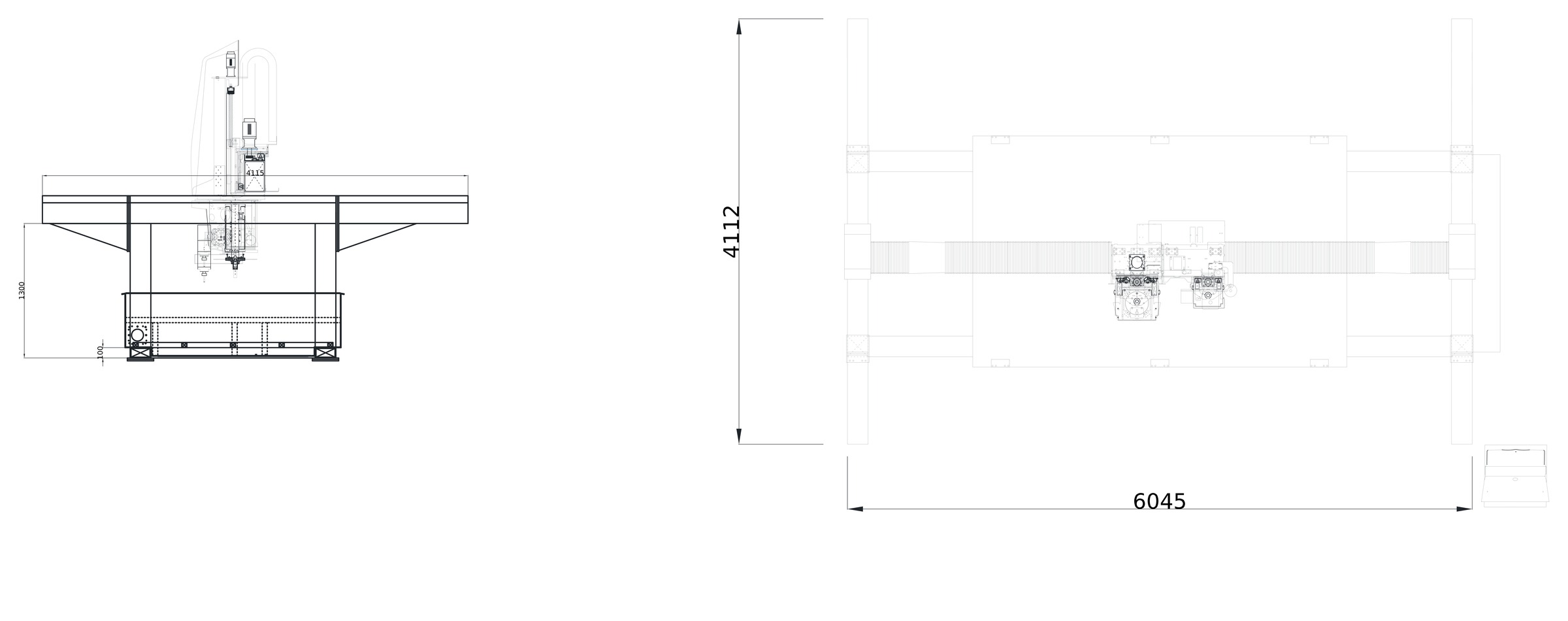
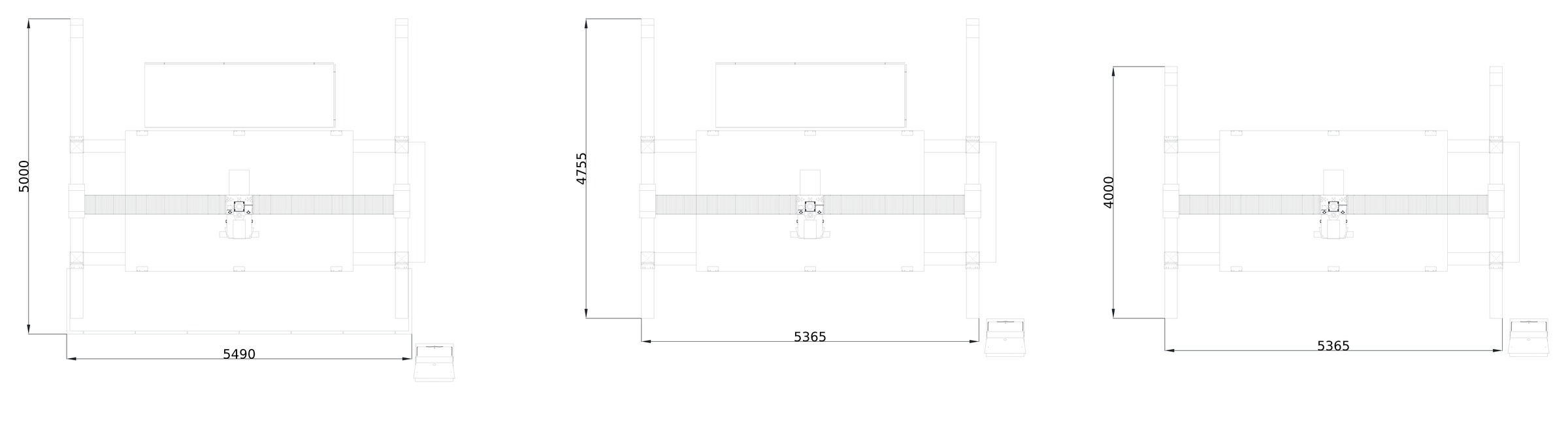
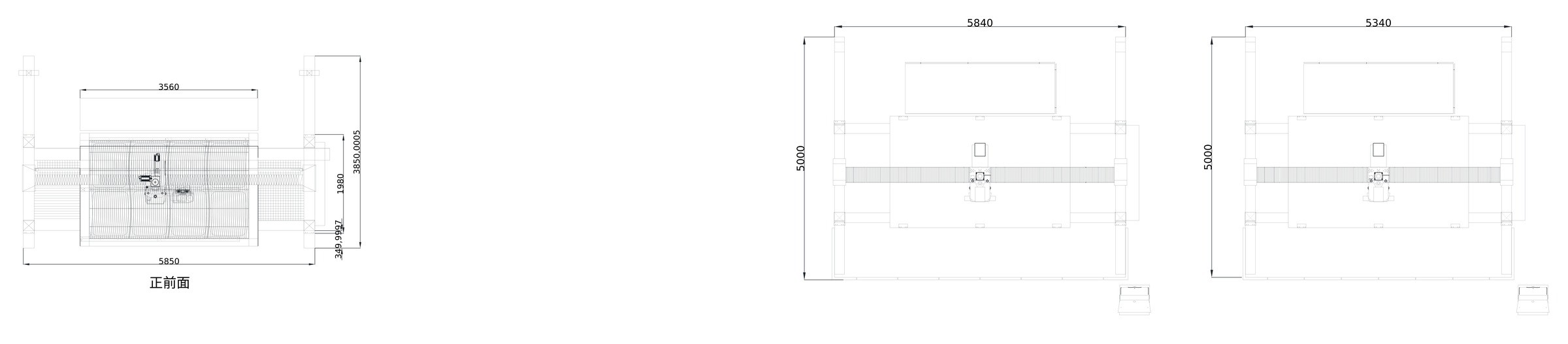
HOYUN’s design drawings show a clear footprint path: parallel dual-head packaging on Gen-1, then front-to-back beam layouts on Gen-2 / Gen-3, with Gen-3 offering 3600 / 3200 plan options. The drawings below are for layout orientation only—confirm live dimensions on the formal quotation.
Gen-1 — parallel waterjet + bridge saw
Figure: Gen-1 parallel waterjet-bridge-saw layout — side & plan (HOYUN design drawing).
2020 drawings → 2023 Gen-1 prototype (Foshan). Dual tool heads / dual Z side-by-side; machine length about ~6.5 m. HOYUN describes Gen-1 as China’s first fully self-developed 4-in-1 (saw + waterjet + milling + edging/polishing)—treat that as HOYUN positioning, not independent third-party certification.
Gen-2 — front-to-back beam options
Figure: Gen-2 front-to-back Sawjet plan options — three footprint variants.
Front–rear packaging shortens the packaging logic versus side-by-side dual heads and opens clearer plan options for shops comparing hall depth vs width.
Gen-3 — 3600 / 3200 front-to-back footprints
Figure: Gen-3 evolution — prior plan vs new 3600 / 3200 front-to-back footprints.
Gen-3 / 3.0 (Xiamen Stone Fair 2026 per briefing): X-axis beam redesigned to a front–rear array, length about ~5.5 m, with plan options aimed at different slab and shop constraints.
Improved tool setting, process selection, visual work maps
Public showing
Factory prototype path from 2020 drawings
Xiamen Stone Fair 2026 (per briefing)
Figures are HOYUN briefing claims for orientation. Confirm configuration, options, and acceptance criteria on the formal quotation.
Buyer Checklist: Is a Stone Sawjet Right for Your Shop?
Check the boxes that match your shop. If you tick four or more, a stone Sawjet deserves a serious quote alongside separate bridge-saw and waterjet options.
Floor space is tight — you cannot comfortably site a full waterjet cell e a CNC bridge saw e a machining center.
Mixed materials weekly — sintered/porcelain, quartz, and granite (or marble) share the same schedule.
Sink openings + outer cuts on the same top — you currently move slabs between saw and waterjet.
Custom / whole-home orders dominate — few repeat nests; programming flexibility beats pure commodity throughput.
Chip risk on sintered openings is already costing rework or warranty time.
Labor for handling (forks, carts, re-fixturing) is as expensive as cutting time.
You want one CNC skill stack for operators instead of three machine-specific tribes.
You are comparing bridge saw and waterjet combined platforms, not only standalone waterjets.
You need 5 axis Sawjet stone capability for angled/curved waterjet and saw work on one nest.
CapEx preference is one capable platform now rather than two under-utilized machines “someday.”
When separate machines still win: peak saw hours and peak waterjet hours always collide at high volume; you already have both cells paid for and staffed; or your business is almost 100% straight blanks with almost no openings.
Who Builds the HOYUN Sawjet
HOYUN Machinery is a Foshan-based building-material processing equipment maker founded in 2008. Company materials describe roughly a 10,000 m² factory, about 200 staff, equipment presence in about 105 countries, and around 30,000 factory users. The stated mission is “Make building-material processing simpler.” HOYUN reports investing about 20% of revenue in R&D and holding about 102 patents, with a product focus on stone and tile equipment—waterjet, bridge saw, and multifunction platforms such as the HOYUN Sawjet.
That context matters for overseas buyers evaluating a Chinese sawjet machine exporter: you are looking at a category specialist with a documented multifunction R&D path (2020 → 2023 Gen-1 → 2026 Gen-3), not a trading-only catalog.
Soft CTA: Next Step for Fabricators
If your cut mix matches the checklist above, request a configuration discussion around the current HOYUN CNC Sawjet rather than only pricing a “waterjet or saw” binary:
Share materials (sintered brands you actually buy), thickness range, weekly share of openings vs straight cuts, available floor length/width, and utilities. HOYUN can then map Gen-3 options—beam layout, enclosure, console, and process packages—to your real nests.
FAQ: CNC Sawjet / Stone Sawjet
What is a CNC Sawjet?
A CNC Sawjet is a stone fabrication machine that combines a diamond saw and a waterjet (plus milling and edging on HOYUN’s 4-in-1 platform) on one CNC frame. Fabricators use it to run straight cuts and complex openings without transferring the slab between separate machines.
Sawjet vs bridge saw and waterjet as two machines — which wins?
A Sawjet integrates both processes on one footprint and one handling cycle; two machines keep higher parallel capacity but need more space and slab transfers. Choose the Sawjet when mixed jobs and space dominate; choose two cells when both processes run at full load all day.
Is a 5 axis Sawjet stone machine suitable for sintered stone cutting?
Yes—use the waterjet for chip-sensitive openings and complex corners, and the saw for suitable outer/straight cuts with correct blades and parameters. HOYUN’s briefing positions the Sawjet for multi-material shops that include sintered/porcelain slab work alongside quartz and granite fabrication.
What changed from HOYUN Sawjet Gen-1 to Gen-3 / 3.0?
Gen-3 shortens the machine (~6.5 m → ~5.5 m), redesigns the X-axis beam to a front–rear array, claims +50% rapid traverse and +1/3+ processing efficiency, and adds hot-dip galvanizing, a movable console, full enclosure, and improved software usability. Those points come from HOYUN’s Oct 20, 2026 briefing and 2026 Xiamen Stone Fair showing.
Who should buy a stone Sawjet instead of only a waterjet?
Buyers who need both high-speed saw blanking and waterjet openings in one cell—especially limited-space, multi-material, or whole-home custom shops. If you almost never cut straights with a blade, a dedicated waterjet may still be the cleaner CapEx; if you almost never cut openings, start with a CNC bridge saw.
Is HOYUN’s 4-in-1 the only Sawjet worldwide?
Treat “China’s first self-developed 4-in-1” and global uniqueness wording as HOYUN positioning from the company briefing—not as independent third-party certification. Validate fit against your cut mix, footprint, and local competitors on a formal quotation.
Claims on R&D dates, Gen-1 layout, Gen-3 gains, and market positioning are taken from HOYUN’s Oct 20, 2026 internal briefing and company introduction materials. Confirm specifications, options, and commercial terms on the official quotation from hoyunmachinery.com.
Share what you produce, the processes required and your target output. We will recommend a suitable machine and send the matching catalog.
How It Works
01
Product & process
What you make and the cutting, shaping, drilling, milling, profiling or polishing required.
02
Output & setup
Your target capacity, current equipment and any production-line requirements.
03
Matched recommendation
We review your request and send the suitable machine, key options and product catalog.
Not sure about every detail? Send what you know. We will help with the rest.
REQUEST RECEIVED
Your Matching Product Catalog Is Ready
Thank you. Your requirements have been sent to HOYUN. Open the matching product catalog now. Our engineer will follow up with a suitable machine recommendation and configuration.