


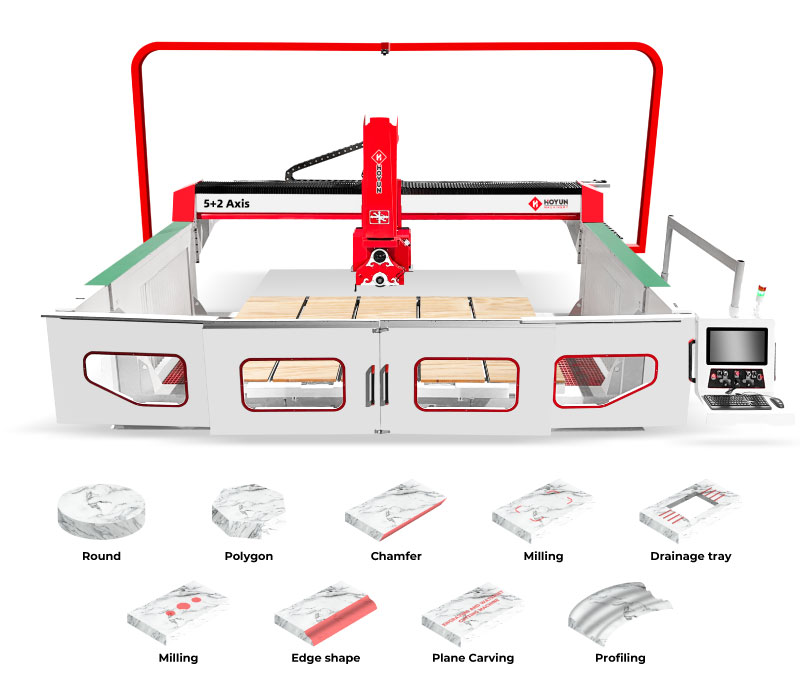
When fabricators ask us about CNC bridge saw price, we give them the number first. A HOYUN MACHINERY 5+2 axis CNC bridge saw for marble, granite, quartz and sintered stone usually costs USD 34,000 to USD 38,000. Where it lands depends on the control system, mechanical configuration, working size, cutting functions and options. Treat that as a reference range, not a fixed quote for every configuration.
Then comes the follow-up: “Why is that one only USD 12,000?” You’ll find machines sold as 5-axis bridge saw units at USD 12,000, USD 15,000 or USD 20,000. Some are honest machines for simpler work. The problem is that “five-axis” gets used for machines with very different frames, controls and real cutting capability. Before you compare prices, confirm you’re comparing machines that can do the same jobs. Counting axes doesn’t tell you much. What matters is how those axes move together during the cut.
Shops that mainly run straight rip cuts and basic angles may also look at a 3 axis CNC bridge saw or a 4 axis bridge saw. Those machines can be the right fit when countertop fabrication stays simple. Once you need coordinated miters, curves and complex sink cutouts, the conversation usually moves to a 5+2 axis configuration—and that is where CNC bridge saw price comparisons get messy if you only match the axis label.
HOYUN Machinery (hoyunmachinery.com) focuses on stone and building-material processing equipment—making building-material processing simpler. This guide breaks stone bridge saw / bridge saw machine price into the parts buyers should check before they order. Whether you cut with a marble cutting machine, a quartz cutting machine, or a broader máquina de corte de pedra lineup, the same buying logic applies: match motion type, structure, software and landed cost—not brochure axis count.
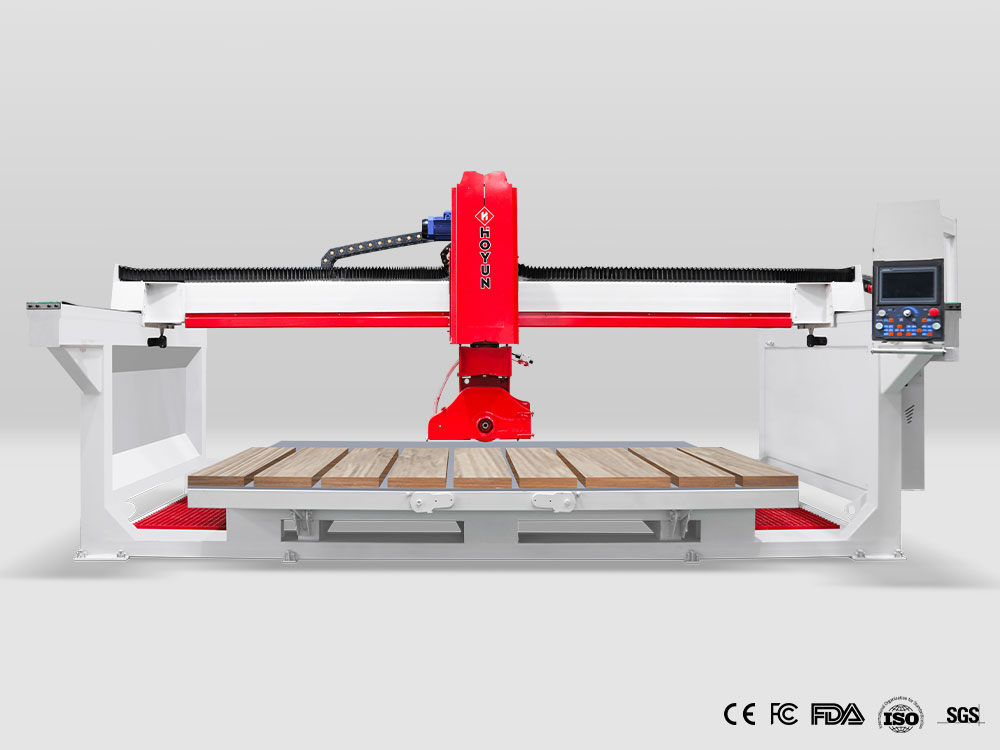
1. Indexed vs. Simultaneous: What “5-Axis” Really Means
A conventional bridge saw does straight cuts and basic angle cuts. A proper Serra de ponte CNC—also called a CNC stone cutting machine in many shops—adds automatic positioning, miters, curves, circles and complex countertop shapes. Not every machine labelled five-axis can do that work.
Indexed positioning
Plenty of machines have five controllable axes but work by indexed positioning. The head rotates to a set angle, locks, and then makes a fairly simple cutting pass. That’s fine for many straight and angled cuts on a marble bridge saw or a granite bridge saw when the job list stays predictable.
Simultaneous interpolation
Other machines support simultaneous interpolation: several axes move together along a programmed toolpath. You need that for curved shapes, complex profiles and any geometry where the blade has to change orientation while it cuts. So don’t buy by the axis count on the brochure—buy by what the machine actually cuts. On a quartz bridge saw line for kitchen work, simultaneous motion is often the difference between “we can do it slowly with fixtures” and “we can run the customer drawing as-is.”
Where RTCP fits
RTCP (Rotational Tool Center Point control) is a function in some multi-axis CNC systems. It compensates for the tool center shifting when the rotary axes move. Implemented properly, it helps hold the intended tool position during coordinated multi-axis machining.
Whether you get RTCP, and how well it works, depends on the controller, the machine’s kinematics and the software. Not every operation on a five-axis bridge saw needs it. Ask whether the machine supports the tool-center compensation you need, then have the supplier prove it on your process.
If you want a model-level walkthrough of HOYUN’s 5+2 offering, open the Hoyun 5+1 / 5+2 axis CNC bridge saw for sale product page. For granite-heavy shops that also want camera-assisted nesting, see the 5-axis granite bridge saw configuration. A related mid-range option for stone and marble is the HOYUN 4+1 axis stone and marble cutting machine.
2. Why Some Five-Axis Bridge Saws Cost So Much Less
The classic purchasing mistake is comparing appearance, axis count and advertised table size. Two “five-axis” saws can differ a lot in frame, transmission, control and actual output. CNC bridge saw price gaps usually come from these five places:
1. Rigidity and structure
Rigidity decides cutting stability, accuracy and vibration. The bridge, crossbeam, supports, cutting head and moving axes all shape how the machine behaves under load. Cheaper machines may use lighter structural parts or simpler designs. But weight alone is not rigidity—look at the overall structure and real cutting performance on the material you actually sell—granite, marble, quartz or sintered stone.
2. Guide rails, ball screws, rack and pinion
Some low-cost configurations use size 20 or 25 guide rails, or racks with a smaller module. Other configurations use larger transmission parts sized for different loads and speeds. Bigger isn’t automatically better. Sizing depends on load, axis span, support method, acceleration, cutting force and overall design. Ask for detailed transmission specs and compare how the machine actually runs.
3. Rapid traverse and cutting efficiency
Spindle power doesn’t set your output on its own. Rigidity, transmission, servo control, acceleration, blade choice and cutting parameters all play a part. For 12 mm sintered stone, you can ask for a demo targeting about 3 minutes per meter, and you can ask to verify 30 m/min rapid traverse. Treat both as proposed test conditions, not universal standards. Real speed depends on configuration, material, blade, toolpath and required edge quality. A serious manufacturer will prove performance under recorded conditions.
4. Control system and software
The CNC controller decides how flexible and fast your programming is. Look for graphical programming, CAD import, toolpath generation, angle and curved cutting, tool compensation and remote support. Some machines only handle basic cutting. Confirm which functions are included in the quote and whether extra licenses or upgrades cost more. Countertop fabrication shops should watch a full sink-and-miter program, not just a straight rip.
5. Electrical parts and maintenance
Servo motors, drives, contactors, breakers and sensors decide how reliable the machine is and how easy it is to service. Brands differ in cost, support and spare-part availability. A low price can mean a simpler electrical package. Ask for a full component list and confirm you can get spare parts when you need them.
Shops that still need high straight-cut throughput sometimes pair a multi-axis head with a HOYUN 3-axis double-knife CNC bridge saw for slab breakdown. That is a different CNC bridge saw price conversation: two machines, two roles, one production plan—not one brochure claiming to replace everything.
3. What to Ask About Each Component
Before you order, send this table to any stone bridge saw / 5-axis bridge saw manufacturer—including us:
| Component | What to ask the supplier | What a good answer looks like |
|---|---|---|
| Motion control | Indexed positioning or simultaneous interpolation? | A live curved or profile cut from your drawing |
| RTCP / tool-center compensation | Supported on this controller and kinematics? | Demonstrated on your intended process |
| Frame and bridge | How is rigidity achieved? | Structure explained, stable cut shown—not just a weight quote |
| Guide rails and rack | Rail size (e.g. 20/25 or larger)? Rack module? | Sizing justified by load, span and acceleration |
| Spindle | Motor type and power? | Clear spec, e.g. 22 kW permanent-magnet synchronous on selected HOYUN configs |
| Software | Which functions are included? Extra licenses? | Written list of included functions |
| Electrical | Servo, drive and sensor brands? | Full component list and spare-part plan |
Note: The 22 kW permanent-magnet synchronous spindle is an example from selected HOYUN configurations—it shows what a clear answer looks like; it is not a fixed promise for every model.
For a broader overview of how bridge saws sit next to other CNC stone equipment, see how to choose the right stone cutting machine e which CNC stone cutting machine type works best for your shop.
4. Six Cutting Tests Before You Order
At HOYUN we’d rather show a machine cut than describe it. Ask any Serra de ponte CNC manufacturer, us included, for tests that match your production:
- Straight cut accuracy: cut a representative stone or sintered stone slab and measure it. Agree the tolerance before the test.
- 45-degree miter cut: essential for countertops. Check angle accuracy, edge consistency, chipping and surface finish. A clean miter cut on quartz or sintered stone is often the first filter that separates marketing “five-axis” from production-ready machines.
- Curved and profile cut: if curves are advertised, cut one from a real customer drawing.
- Cutting speed: for 12 mm sintered stone bridge saw work, test under agreed conditions. Record blade spec, material, cut length, feed rate and edge quality. (Proposed target ~3 minutes per meter—not a universal standard.)
- Rapid traverse: check rapid speed and stability under the stated conditions (proposed conditions may include 30 m/min). Don’t confuse rapid traverse with cutting feed rate.
- Software and programming: watch the operator import a drawing, program it and turn it into a cut. For countertops, sinks and complex shapes, programming time matters as much as cutting speed.
If quartz countertops are your main work, also see the best 5-axis bridge saw for quartz countertops reference. Fabricators who mix sawing with waterjet openings should keep the bridge saw vs waterjet comparison open while they watch demos.

5. What a Bridge Saw Quotation Should List (Buyer Checklist)
A proper quote for a bridge saw machine spells out the mechanical and electrical configuration:
- Working table size and effective cutting area
- Cutting head rotation and tilt ranges
- Main spindle motor specifications
- Blade diameter range
- CNC controller and software functions
- Servo motors and drives
- Guide rails and transmission parts
- Optional milling, drilling or tool functions
- Installation, training and warranty
Selected HOYUN 5+2 axis configurations can be supplied with a 22 kW permanent-magnet synchronous main spindle motor. Some configurations also offer advanced CNC programming and optional auxiliary machining functions. Specs vary by model and quote—confirm the final configuration list before you order. Ask the same checklist whether you are quoting a granite bridge saw, a marble bridge sawou um quartz bridge saw cell—the materials change; the missing line items on a thin quote do not.
6. Machine Price vs. Landed Cost (FOB)
The price on the quote is not the landed cost. Buying a bridge saw from China means adding:
- Ocean freight
- Insurance
- Customs duties and import taxes
- Port handling
- Inland transport
- Installation, training and spare parts
Under FOB terms, confirm the named loading port and who carries which responsibility under the contract. Final import cost depends on destination, route, container needs, HS code and local regulations. Work out the landed cost before you decide. Comparing FOB numbers alone will mislead you—especially when one quote looks cheaper only because options, training or spare kits were stripped out.
The same landed-cost discipline applies when you compare a bridge saw against a máquina de corte a jato de água or a full jato de água cell. Use our waterjet cutting machine price guide for the abrasive side of the CapEx picture, then add freight and duties the same way you would for a saw.
7. Payment Terms Both Sides Can Live With
We buy materials, book production capacity, assemble the machine and test it in the factory before it ships. You arrange freight, import paperwork and extra working capital. So payment terms should follow order value, production requirements, lead time and a reasonable cash safeguard for both sides. On a first order, factory acceptance and clear payment milestones remove a lot of uncertainty. Large orders can ship in phases. Put every agreement in the sales contract.
8. Seven Questions for Any CNC Bridge Saw Manufacturer
- Can the machine demonstrate the simultaneous-axis cutting you need?
- Does the controller support the programming and compensation features required?
- What are the real cutting accuracy and stability?
- What cutting speed can be shown on your material?
- Which guide rails, transmission parts and servo systems are included?
- Is factory acceptance testing available?
- What after-sales support and spare-parts service is there?
The goal isn’t the most expensive machine. It’s the one whose capabilities fit your production and whose running costs make sense. If the same order also needs waterjet contours and openings, compare a Jato de água de 5 eixos or browse the HOYUN waterjet cutting machine options. If you want one multifunctional cell—saw, waterjet, mill and edge—look at a CNC Sawjet / Sawjet layout instead of buying three standalone machines.
For shop layouts that mix saw and jet, read how to choose a 5-axis bridge saw and waterjet, Sawjet vs multi-machine solution, and the CNC Sawjet 4-in-1 overview.
Related reading (live on hoyunmachinery.com)
- Waterjet cutting machine price guide (required internal link · already live)
- How to choose a 5-axis bridge saw and waterjet
- Bridge saw vs waterjet
- Sawjet vs multi-machine solution
- CNC Sawjet 4-in-1
- Best 5-axis bridge saw for quartz countertops
- How to choose the right stone cutting machine
- CNC stone cutting machines — which type for your shop
9. Final Thoughts on CNC Bridge Saw Price
A five-axis saw at USD 15,000 and one at USD 36,000 can’t be compared by axis count or paint. The gap usually comes down to coordinated motion control, structure, accuracy, output, software and long-term service. A low price isn’t the risk by itself. Not knowing which capabilities, parts or processes were simplified to hit that price is the risk.
Planning a 5+2 axis Serra de ponte CNC for marble, granite, quartz or sintered stone? Send us your materials, cutting drawings and production targets. We’ll suggest a configuration and quote it to what you actually need—whether that is a dedicated bridge saw machine, a paired máquina de corte a jato de água, or a combined CNC Sawjet cell.
Request a Configuration-Based Bridge Saw Quote · Website · CNC bridge saw category · Stone bridge saw machine · CNC bridge saw hub
10. FAQ
How much does a 5+2 axis CNC bridge saw cost?
HOYUN 5+2 axis Serra de ponte CNC machines typically cost USD 34,000–38,000, depending on controller, mechanical configuration, working size, functions and options. This is a reference range, not a fixed quote. Always compare CNC bridge saw price against the same motion type, table size and included software.
Why are some five-axis bridge saws priced below USD 20,000?
Machines sold at USD 12,000–20,000 may use indexed rather than simultaneous motion, lighter structures, smaller rails or racks, basic software or a simpler electrical package. Compare real cutting capability—not the label. A lower-priced 3 axis CNC bridge saw ou 4 axis bridge saw can still be the right buy when your shop does not need full simultaneous five-axis work.
What is the difference between indexed five-axis positioning and simultaneous five-axis machining?
Indexed machines rotate the head to a set angle, then make a simple cut. Simultaneous machines move several axes together along a programmed toolpath—needed for curves and complex profiles in countertop fabrication.
Does every five-axis bridge saw need RTCP?
No. RTCP compensates for tool-center movement during rotary motion and helps in coordinated machining, but not every operation needs it. Availability depends on the controller, kinematics and software.
What affects bridge saw cutting accuracy and speed?
Rigidity, transmission design, servo control, acceleration, blade selection, cutting parameters, material and required edge quality—not spindle power alone. That holds for a granite bridge saw, a marble bridge saw, and a sintered stone bridge saw alike.
How can buyers verify machine rigidity?
Weight alone won’t tell you. Review the bridge, crossbeam, supports and cutting head design, then check stability and accuracy in real cuts: straight, 45-degree miter and curves on your material.
What should be included in a CNC bridge saw quotation?
Table size and cutting area, head rotation and tilt ranges, spindle motor, blade diameter range, controller and software, servos and drives, rails and transmission, optional milling/drilling functions, plus installation, training and warranty. Use the buyer checklist above. If your CapEx plan also includes jet cutting, factor a separate waterjet cutting machine price line—or evaluate a CNC Sawjet instead.