


소개
A stone shop can own a strong 브리지 톱 and still burn hours on one countertop fabrication job. We hear this from stone fabrication shops all the time. The bottleneck is often not how fast the blade moves—it is how many times the slab gets lifted, flipped, re-clamped and walked to the next station.
In a talk with an overseas fabricator who had been processing for 12 years, two of his own jobs stuck with us. He said a 30 mm natural granite project could take about four hours. Another job on 20 mm quartzite took more than five.
VERIFY: Those times are that overseas fabricator’s 12-year shop experience. They are not HOYUN Sawjet measurements, and they are not a performance promise for any machine.
Those times push a better question: when a job takes five hours, how much is real cutting, and how much is the rest of the manufacturing process? That answer changes how you buy equipment—especially when you compare a multi-machine layout 와 CNC Sawjet / 4-in-1 Sawjet on one platform.
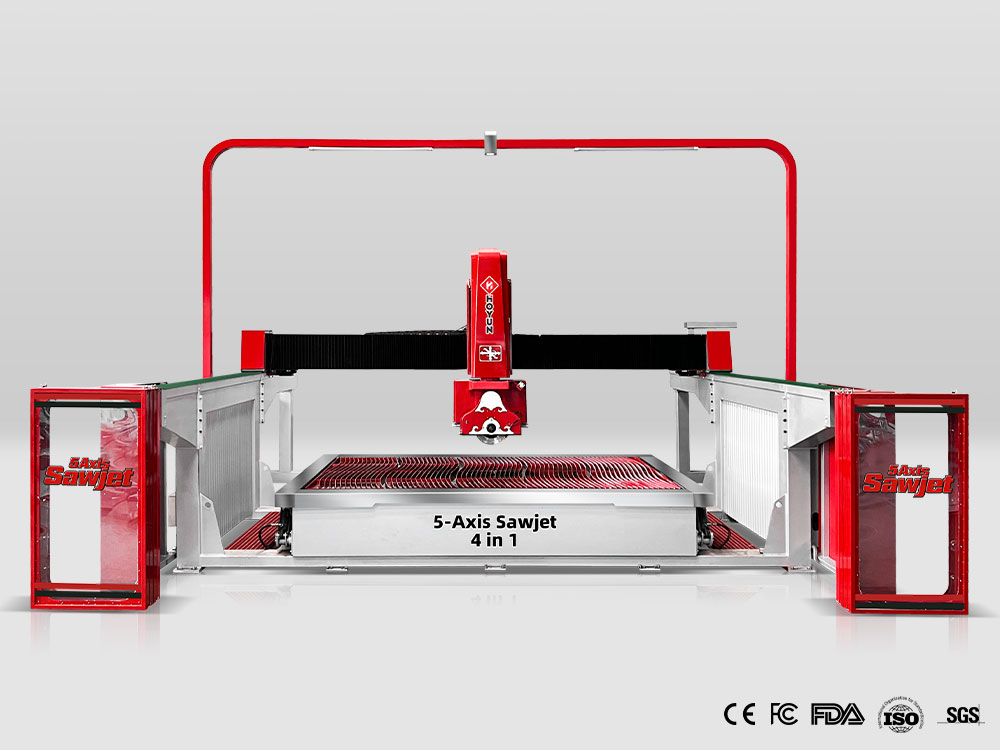
HOYUN Machinery (hoyunmachinery.com) develops and manufactures equipment for stone, sintered stone / porcelain slab, and ceramic processing. This article focuses on the stone fabrication workflow: why transfers cost hours, and how a 5-axis Sawjet keeps more operations on one machine. For product-function detail, read the 4-in-1 product overview 그리고 Sawjet vs multi-machine solution separately—this piece is about workflow, not a feature dump.
1. The Countertop Is Not Done When the Blade Stops
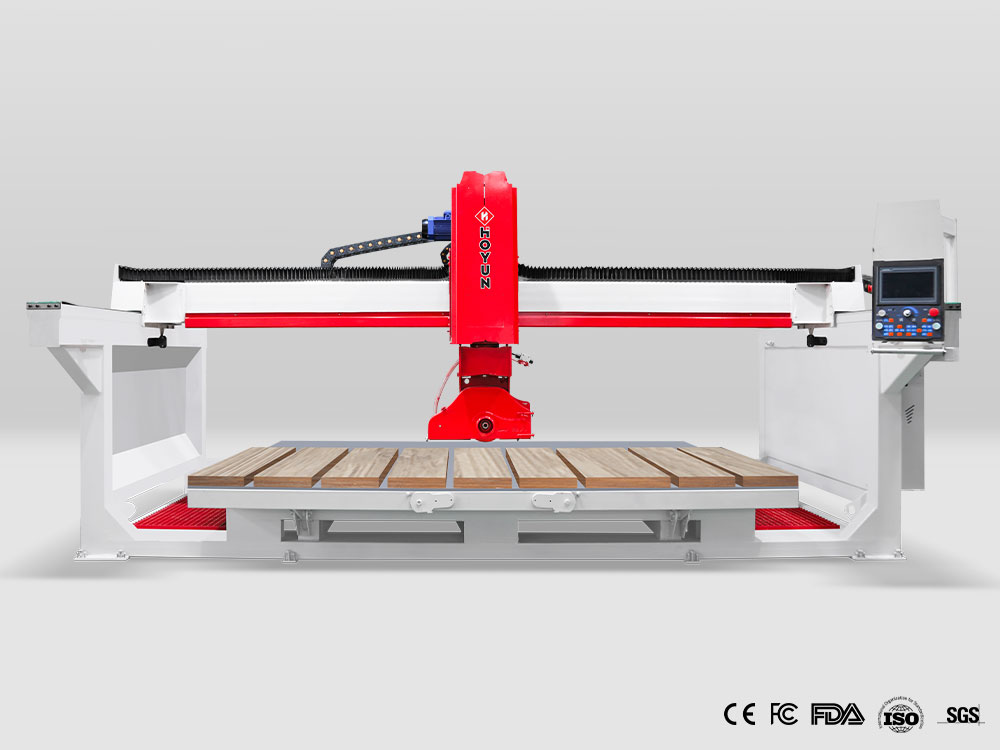
A conventional CNC 브리지 톱 / 석조 교량 절단기 is excellent at straight cuts, slab sizing and miters. A finished countertop usually needs more: sink openings, internal corners, drilling, milling, shaping and finishing. In many shops those steps live on different machines—bridge saw, 워터젯 절단기, CNC mill, separate edge gear.
모든 transfer means lifting, moving, positioning again, checking size and setting up the next tool. On natural stone and large-format sintered stone, handling also raises the chance of chips or cracks. So chasing a few more millimeters of cutting speed does not always move the day. Cutting the number of moves often does.
That is also why a pure “bridge saw vs waterjet” cutting comparison is not enough—you still have to look at the full countertop fabrication chain. See: bridge saw vs waterjet 그리고 how to choose a 5-axis bridge saw and waterjet.
2. What a HOYUN 5-Axis Sawjet Puts on One Platform
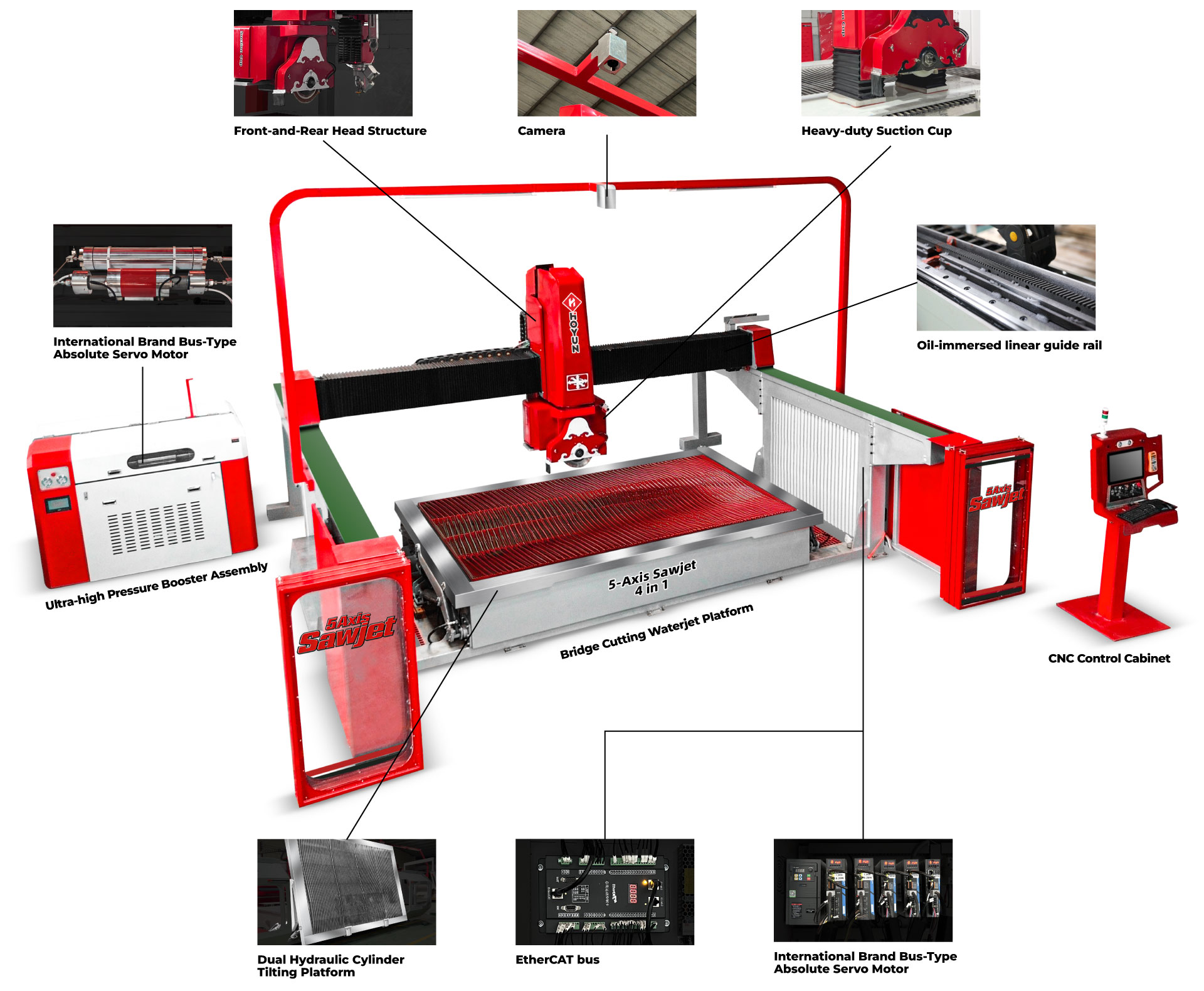
People often call a Sawjet “bridge saw plus waterjet.” Our 5-axis Sawjet concept goes further: four processing functions on one platform (4-in-1 Sawjet / CNC Sawjet).
| Function | What it does on the job | When we reach for it |
|---|---|---|
| Diamond saw cutting | Straight cuts, sizing, angles | Paths where a circular blade removes material efficiently |
| Abrasive waterjet | Tight insides, curves, intricate openings | Shapes a large blade cannot finish cleanly or quickly |
| Independent milling spindle | Drilling, sink cutouts, milling | Work that would otherwise go to a separate CNC—this is its own spindle, not a second name for the saw motor |
| Edge profiling | Selected countertop edge shapes, including curved and decorative profiles | With the right tools and programs; not the same as every stage of high-gloss edge polish |
Power, speed, tooling and cooling for the milling spindle have to match the workload you actually run. Edge finish depends on tooling, material and sequence.
Key constraint: The value of the four functions is not that they all run at once. It is that more of the job can stay on one coordinated platform. The workpiece can move less—four processes are not racing in parallel.
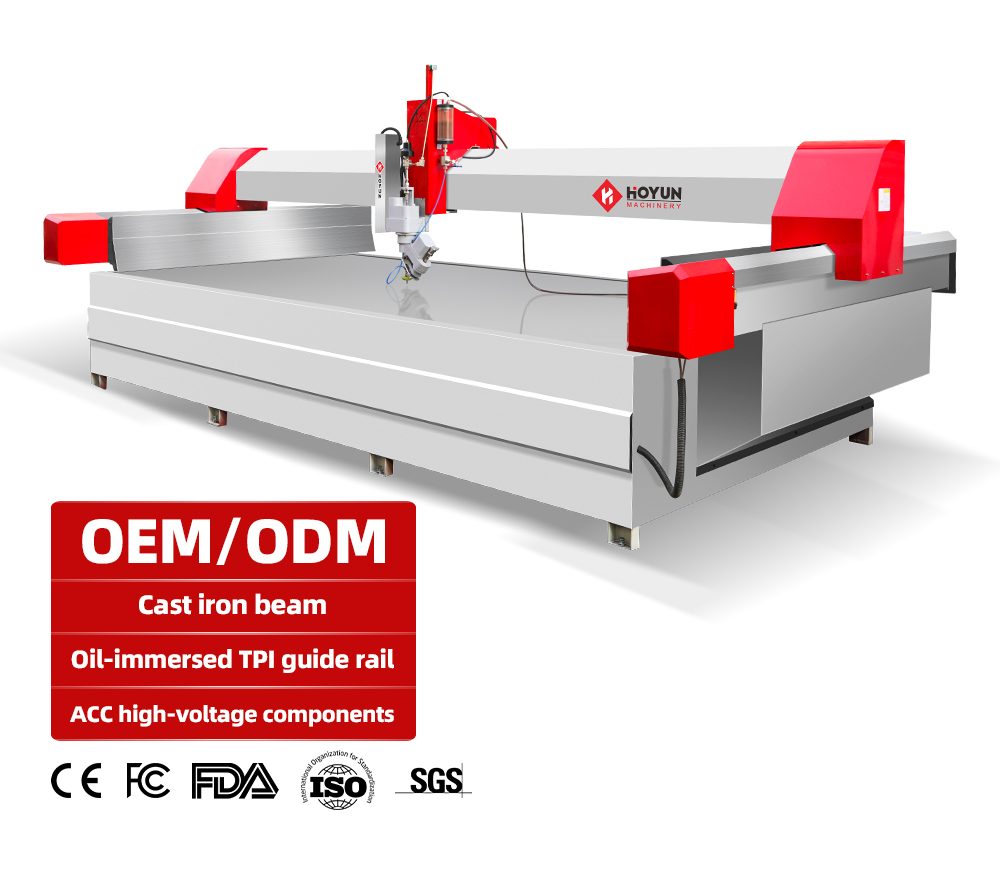
Product and selection links: CNC Sawjet 5-axis water jet marble and stone cutting machine · standalone waterjet line: 5축 워터젯 그리고 waterjet cutting machine for sale · category hubs: 워터젯 · 워터젯 절단기.
3. Four Processes on One Machine vs. Four Separate Stations
Picture a top with straight outer cuts, a sink opening, tight internal corners and a shaped edge. In a conventional layout you may need a bridge saw, a waterjet, a CNC mill and separate edge gear. Each station can be good at its own task. The hard part is the chain between them.
A 4-in-1 Sawjet can cut transfers and simplify planning. That helps subcontract fabricators especially—their mix jumps from granite one day to quartzite, engineered stone or sintered stone / porcelain slab the next. You pick the right process for each part of the piece inside one system (saw, 워터젯, milling spindle, edge profiling).
That does not mean an integrated Sawjet always beats a dedicated high-volume line. If you run the same cut all day, specialized machines can still win on throughput. The right choice follows product mix, daily volume and how many operations each workpiece needs. More comparison: Sawjet vs multi-machine solution.
4. Weight and Power: Useful Numbers, Easy to Misread
Buyers notice machine weight first. A heavier frame can help, but total kilograms alone do not prove accuracy, rigidity or speed. Look at the load-bearing frame, gantry, guide rails, spindle mounting, how the structure deflects under load and how it behaves when cutting. Two machines of similar weight can cut very differently. Two quotes with very different weights may not even be the same model or scope. Check working range, structure and what is included before you compare.
Motor power matters on hard natural stone. It is not linear with production speed. Torque, blade choice, material, feed, cooling and machining strategy all sit in between. A bigger saw motor may add capacity under the right conditions; it does not automatically shrink total job time by the same percentage.
Heavier / more kW ≠ always faster. On a four-function Sawjet, choosing the right method matters as much as peak kilowatts: straight path on the blade, tight corner on the waterjet, milling and profiling with their own tools and speeds. The goal is to finish the whole job cleanly—not to redline every tool.
Price and configuration side: CNC bridge saw price guide, waterjet cutting machine price guide.
5. CNC Software Has to Run the Whole Sequence
A multifunction machine is only as good as the software that strings the operations together. Do not stop at the brand name on the controller or CAD/CAM box. Ask:
- 1. Can it import the drawing files you actually use?
- 2. Can operators build and edit paths without fighting the system?
- 3. Does it coordinate saw, waterjet, milling and profiling?
- 4. How are tool changes, positioning and sequences handled?
- 5. Can the operator preview the job and catch mistakes early?
- 6. Which software modules are in the license you are buying?
Italian and Chinese control platforms can both work when they are properly integrated. What matters is whether this software, postprocessor, controller and mechanical package have been tested together. A familiar software logo is helpful. A live cut on your parts is better.
6. Test Checklist: Use Your Own Drawings
We would rather evaluate a machine on your work than on a brochure. A customer recently sent real fabrication drawings for a demo. We ran the machining they asked for, shared the results, and they were happy with what they saw. That confirmed a simple rule: test the work you actually sell.
For a useful Sawjet evaluation, record:
- Material type and thickness (granite / quartzite / sintered stone / porcelain slab, etc.)
- Drawing and machining requirements
- Which cutting, milling and profiling steps are included
- Tooling and machining parameters
- Actual processing time
- Dimensional accuracy and finished-part quality
If time is part of the buying decision, agree the test conditions and acceptance criteria before the demo. A written factory acceptance test beats an unsupported claim that one machine is faster. For stone CNC routing beyond milling on the Sawjet, see also the CNC stone router.
7. Cooling, Reliability and Support
Putting several processes on one frame makes maintenance planning more important, not less. Know the care needs of the saw motor, high-pressure waterjet, independent milling spindle, tooling and motion system.
Cooling should match each motor’s duty cycle. The main saw motor and the milling spindle often work under different loads. For long, heavy milling, a spindle with dedicated internal water cooling may be the right choice; for other loads, another manufacturer-approved thermal design can be enough.
Tool cooling ≠ spindle cooling. Water sprayed on the cutting tool is for the cut. Internal spindle cooling protects the motor under load. They are not interchangeable.
Also ask about spare parts, remote diagnostics, software licensing, technical support and warranty. For overseas shops, after-sales support can matter as much as the original configuration. Related reading: waterjet cutting machine price, CNC bridge saw price, advanced waterjet notes on 5축 워터젯 시스템, and the countertop cutting machine complete guide.
8. Who Should Look at a 4-in-1 Sawjet?
A multifunction Sawjet fits shops with varied countertop designs, mixed materials and jobs that need several different machining steps:
- Kitchen countertop fabrication workshops
- Natural stone and quartzite processors
- 소결석 and porcelain slab fabricators
- Stone subcontract manufacturers
- Custom architectural and interior stone companies
The business case comes from the full stone fabrication workflow—not from counting how many machines the Sawjet might replace. Compare total processing time, handling, labor, tooling, consumables, maintenance and expected volume before you invest. High-volume lines that repeat the same cut all day may still prefer a dedicated CNC 브리지 톱 or a dedicated 워터젯 절단기.
9. Process Integration Beats Another Standalone Machine
The next gain in stone fabrication will not always come from more motor power or one more single-purpose machine. For many workshops, the opening is smarter coordination of saw cutting, waterjet, milling and edge work.
A 5-axis Sawjet that combines diamond saw cutting, abrasive waterjet cutting, independent milling 그리고 edge profiling is one way to chase that. Measure it on real projects: fewer unnecessary moves, a practical sequence, consistent quality and production you can count on.
Bring your actual fabrication drawings when you talk to us. The question that matters is not “How many functions does this machine have?” It is “How efficiently can this machine finish the work my factory ships every day?”
Get a configuration quote / job evaluation · 홈 · CNC Sawjet product page · 연락처 · About HOYUN · 블로그
Related reading (live on site)
- CNC Sawjet 4-in-1 product overview (product-function angle; this article is workflow)
- Sawjet vs multi-machine solution
- Bridge saw vs waterjet
- 5-axis bridge saw & waterjet buying guide
- Waterjet cutting machine price guide
- CNC bridge saw price guide
- Best 5-axis bridge saw for quartz countertops (optional)
10. About HOYUN MACHINERY
HOYUN MACHINERY develops and manufactures stone, sintered stone and ceramic processing equipment, including multifunction Sawjet systems, CNC bridge saws, abrasive waterjet cutting machines, edge processing equipment and CNC machining centers.
11. FAQ
Q1: What is a 4-in-1 Sawjet?
A 5-axis platform that combines diamond saw cutting, abrasive waterjet cutting, an independent milling spindle 그리고 edge profiling on one machine, so more of a countertop job can stay on a single coordinated setup. See the CNC Sawjet product page and the 4-in-1 overview.
Q2: Why can stone fabrication take four or five hours on one countertop?
Cutting is only part of the job. Sink openings, internal corners, milling, edge work and every transfer between machines add time—and handling risk on stone and large-format slabs. A fabricator with 12 years of experience reported about four hours on a 30 mm granite job and more than five hours on 20 mm quartzite in his own shop (his experience, not HOYUN measured data).
Q3: Is the milling spindle the same as the saw motor?
No. On HOYUN’s Sawjet platform the milling spindle is a separate processing unit. Its power, speed, tooling and cooling must match the milling workload.
Q4: Does a heavier or higher-power Sawjet always produce faster?
Not by itself. Weight and kilowatts matter only together with frame design, rails, spindle mounting, vibration behavior, blade or tool choice, feed, cooling and which process you use for each part of the job.
Q5: What should a Sawjet demo include?
Your material and thickness, your drawings, the cutting/milling/profiling steps you need, tooling and parameters, timed processing, and measured accuracy and finish—with acceptance criteria agreed before the test.
Q6: Who should buy a multifunction Sawjet?
Shops with mixed designs and materials that need several machining operations per piece—kitchen tops, natural stone and quartzite, sintered/porcelain slabs, subcontract and custom architectural work. High-volume repetitive lines may still prefer dedicated machines.
Q7: How is tool cooling different from spindle cooling?
Water sprayed on the cutting tool is for the cut. Internal spindle cooling protects the motor under load. They are not interchangeable; match cooling to each motor’s duty cycle.
Q8: Is edge profiling the same as high-gloss edge polish?
No. Edge profiling shapes a selected edge profile (including curves and decorative edges). High-gloss edge polish often has multiple stages; do not treat the two as the same thing.