


Introducción
When a stone, tile or sintered stone factory plans new capacity, the first question is often: how much does the machine cost?
Compare a few separate machines with one automatic production line and the line looks more expensive on day one. For a plant that will run for years, that sticker price is only one line on the spreadsheet.
The real comparison covers equipment investment, labor, production capacity, material handling, product consistency and long-term operating cost. That is why many high-capacity shops eventually move from standalone machines toward an automatic stone production line or a tile Processing Line—not because conveyors look modern, but because cost per finished product starts to dominate. Labor markets, overtime and scrap from mis-aligned pieces sit on the same side of the ledger as spindle hours—ignore them and a “cheap” layout becomes expensive by year three.
HOYUN Machinery (hoyunmachinery.com) manufactures stone, sintered stone and ceramic processing equipment and designs automatic and semi-automatic production lines around product, process and capacity targets. This article is not a catalog dump. It focuses on how to compare an automatic stone production line with separate machines on total cost.
What You Are Actually Buying
| Factor | Separate machines | Automatic / semi-automatic line |
|---|---|---|
| Equipment price | Often lower upfront | Higher initial package |
| Material moves | Manual move, reposition, align, rotate, transfer | Designed conveying + positioning + rotation |
| Trabajo | Continues every shift for years | Fewer operators per coordinated rhythm |
| Bottlenecks | Machine waits on people; people wait on machines | Line paced as one system |
| Coherencia | Manual positioning variation | Fixed references, repeatable orientation |
| Decision metric | Machine list price | Cost per finished product + daily capacity |
A factory is not only buying machines. It is buying production capacity for the coming years.
Related line and cell pages (choose by process—not a must-buy list): Processing Line (ceramic cutting & edging) · automatic CNC ceramic tiles cutting machine · automatic 45° ceramic tile chamfering machine · 610 stone edge polishing machine.
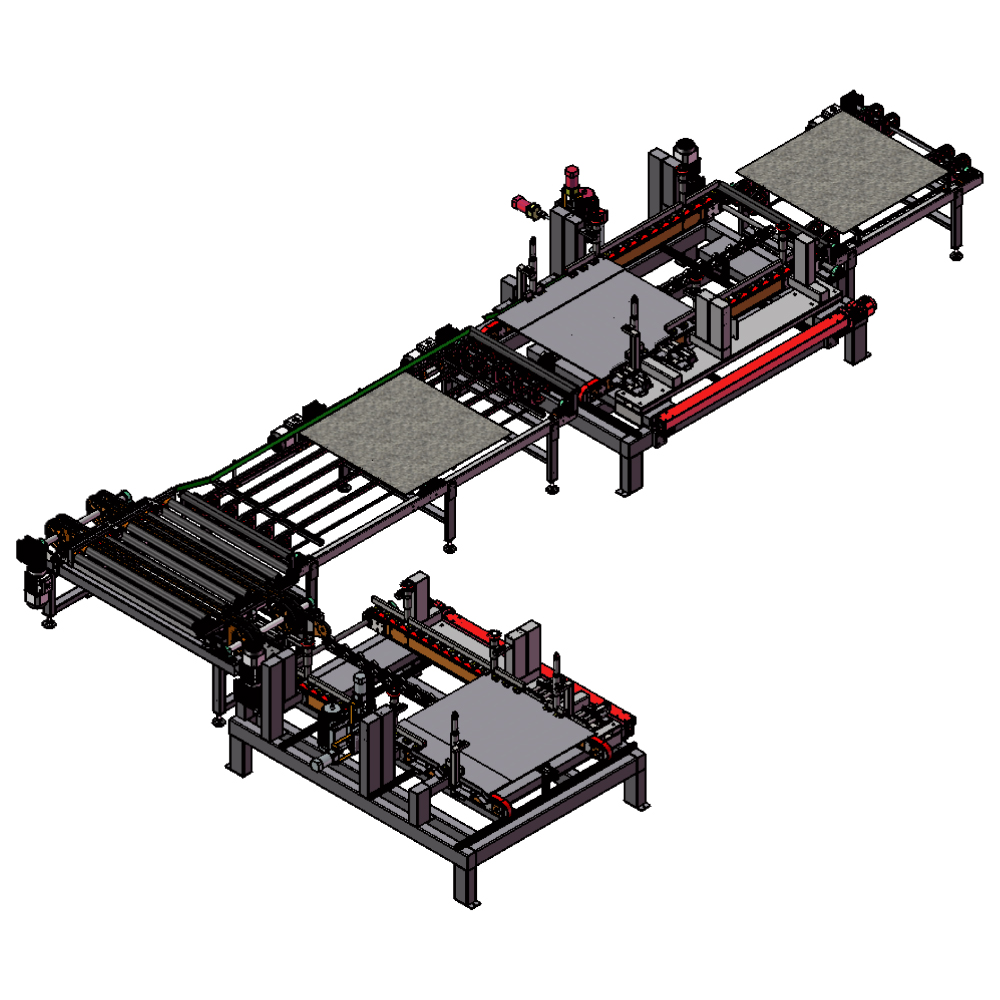
1. Lower Machine Price Is Not Lower Production Cost
Several standalone machines may cost less than a complete automatic production line. Material still does not walk itself from one process to the next.
After each operation, a stone, tile or slab may need to be:
- moved by workers
- repositioned
- aligned
- rotated
- transferred to another machine
- checked again before the next cut or polish
Without an automatic material-handling system, every one of those steps is labor—and that labor does not stop after commissioning. It repeats every day for the life of the factory.
If you already run a bridge saw, waterjet or Sawjet cell, the same ledger applies when you link them: the cell may be fast, but the factory only gains if transfer, rotation and wait time shrink with it. Workflow side: stone fabrication workflow · 4-in-1 Sawjet; multi-machine vs one platform: Sawjet vs multi-machine solution.
2. Automation Is More Than Conveyors Between Machines
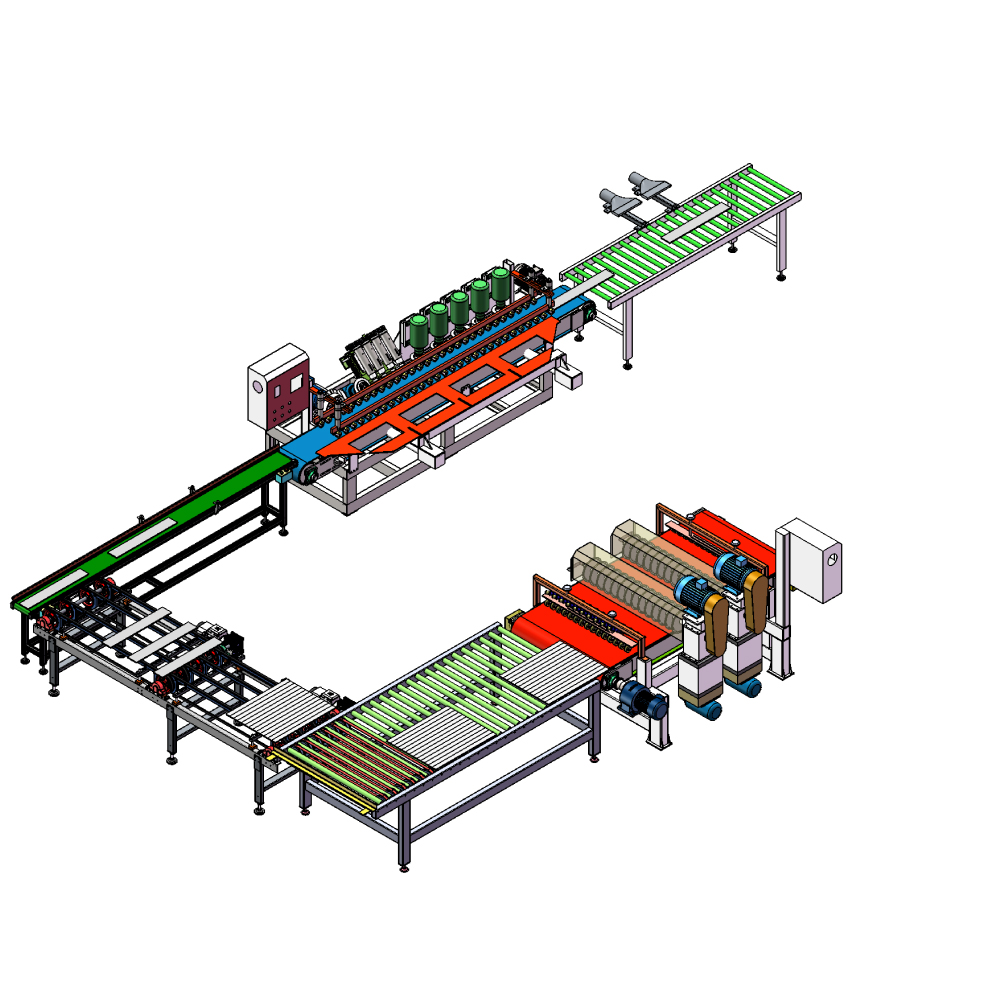
Some buyers assume a stone machinery automation project is “just add belts.” In continuous tile or stone processing, each piece must arrive at the next station in the correct position and orientation.
A real line may need:
convey → position → align → rotate → change direction → reposition → next process
Pieces do not always travel straight. Some products need a 90° o 180° rotation before the next machine. The automatic conveyor system and handling stations must be designed around the full process—not bolted on after the fact.
VERIFY: Automation ≠ just conveyors. Positioning, alignment, rotation and direction change are part of real line design.
3. Capacity Questions Beat “Which Machines Do You Want?”
For a small workshop with limited volume, separate machines stay practical. When the goal is higher daily output, continuous production, fewer operators, less dependence on skilled movers, shorter waiting time and better consistency, automation carries more weight.
The useful project question is not only “which machines?” It is: how much do you need to produce every day?
Soft note on capacity (keep this wording)
In some real projects, a properly designed automatic line can deliver significantly higher overall productivity than separate machines that rely on manual handling. Under certain product and process conditions, total output can be several times higher.
VERIFY: That is not a universal performance claim. Do not treat it as “this line is always 3× faster.” Actual capacity depends on material, product dimensions, machining process, equipment configuration, line speed and required finishing quality, and must be calculated per project. HOYUN will not invent ROI percentages for a public article—those belong in a project sheet with your products and cycle times.
A professional calculation should answer:
- How many square meters (or pieces) per hour?
- How many operators per shift?
- How much time is lost transferring between machines?
- Where is the bottleneck?
Only then can the investment decision be honest.
For individual cell pricing context (not a whole-line price promise): CNC bridge saw price guide · waterjet cutting machine price guide.
4. Machine Speed ≠ Factory Speed
A common mistake: assume spindle or cut speed equals plant output. It does not.
A machine may finish quickly while the operator is still moving another slab—so the machine waits. If the next station is not ready, the piece waits again. Seconds and minutes, hundreds of times a day, add up to lost capacity. One advantage of an automatic line is a coordinated production rhythm: when one stage finishes, the product can move to the next without waiting on a free pair of hands.
VERIFY: Machine speed ≠ factory speed.
That is also why bridge-saw / waterjet / Sawjet selection still needs a whole-plant rhythm view. See: bridge saw vs waterjet · 5-axis bridge saw & waterjet buying guide · CNC Sawjet 4-in-1 product overview.
5. Consistency Matters as Much as Speed
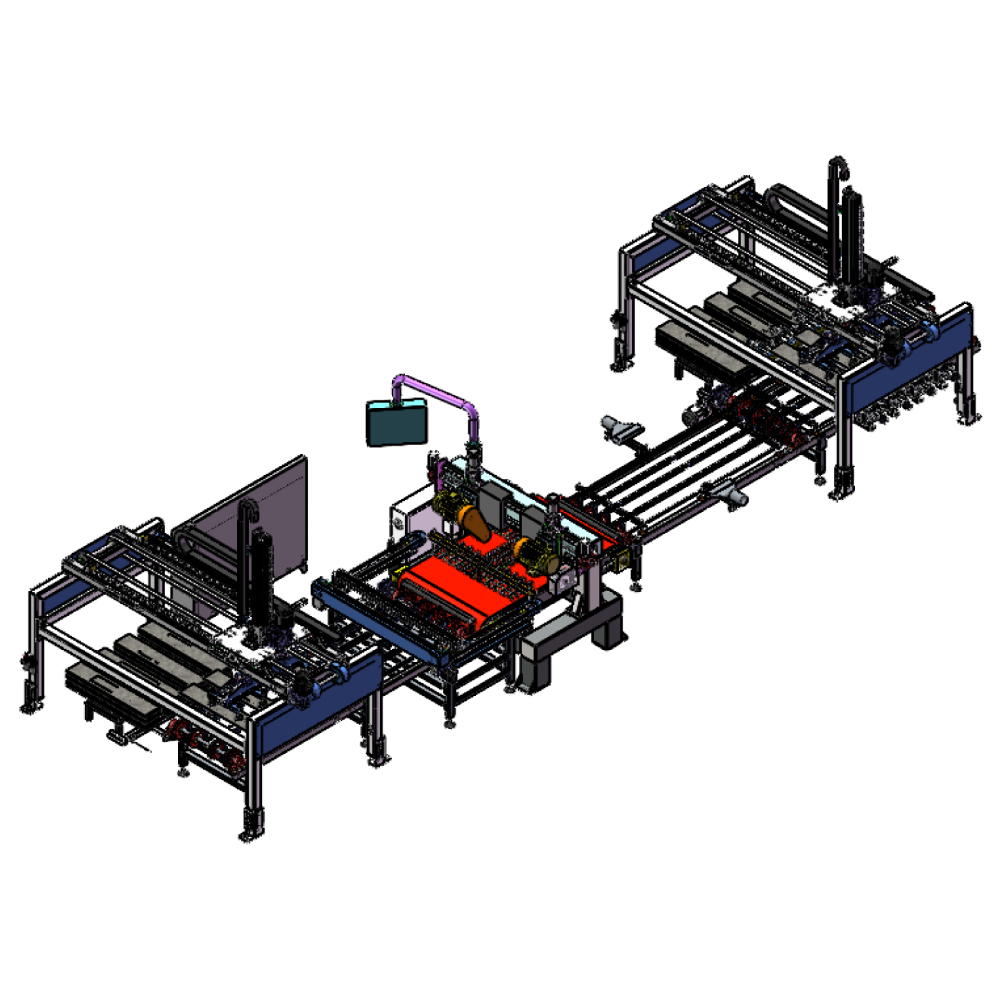
For tiles, sintered stone, countertops and other standardized products, the first piece and the hundredth should match. Manual positioning introduces variation. Automatic conveying, positioning and fixed machining references reduce that scatter. At volume, consistency is a commercial requirement—not a nice-to-have.
6. Compare Cost per Finished Product
| Item | Solution A (lean separate machines) | Solution B (lean automatic / semi-automatic line) |
|---|---|---|
| Machine purchase price | Lower | Higher |
| Operators | More | Fewer |
| Daily finished output | Lower | Higher |
| Useful metric | — | Cost per finished product |
Ask: what does the factory really spend to produce each square meter, each slab or each finished component? That number drives long-term competitiveness more than the day-one invoice.
7. Not Every Factory Needs a Fully Automatic Line
We do not tell every buyer to take a full auto line. Low volume, highly variable orders or a young business still finding its market often fit better with flexible standalone machines—or a semi-automatic step in between.
VERIFY: Not every factory needs full auto—low volume / variable orders → standalone or semi-automatic can be the better fit.
If capacity targets are already clear and production is expected to grow over the next few years, choosing a labor-heavy layout only to shrink the machine invoice can raise multi-year cost.
Checklist before you choose
- What products will the factory make?
- Which materials?
- What dimensions?
- Which processes (cut, edge, polish, drill, engrave…)?
- Target daily capacity?
- Local labor cost and availability?
- Expansion expected in the next 2–3 years?
Then decide among standalone machines, a semi-automatic line or a fully automatic production line.
Line / edging product pages: Processing Line — ceramic cutting & edging · CNC ceramic tile cutting · 45° chamfering · 610 edge polishing. Bridge saw / waterjet / Sawjet cells: CNC bridge saw category · bridgesaw · stone bridge saw machine · máquina de corte por chorro de agua · CNC Sawjet · Chorro de agua de 5 ejes · waterjet product.
8. Same Product-First Rule for Tombstones and Shaped Stone
Tombstones, monuments and shaped pieces follow the same logic. Lettering, engraved marks, logos, surface shapes, profiles and decorative patterns should define the process first. Then choose a CNC machining center, engraving machine or another cell that fits—product first, machine second. Do not force the product to adapt to whatever machine is already on the quote.
VERIFY: Tombstone / shaped stone: product first, machine second.
If you already run a bridge saw, waterjet or Sawjet cell, the same math applies when you bring them into a larger flow: start from the process route, not from a catalogue of belts. Related reading: 4-in-1 Sawjet workflow · CNC bridge saw price · waterjet cutting machine price.
Conclusion: Price Today vs Cost Over Several Years
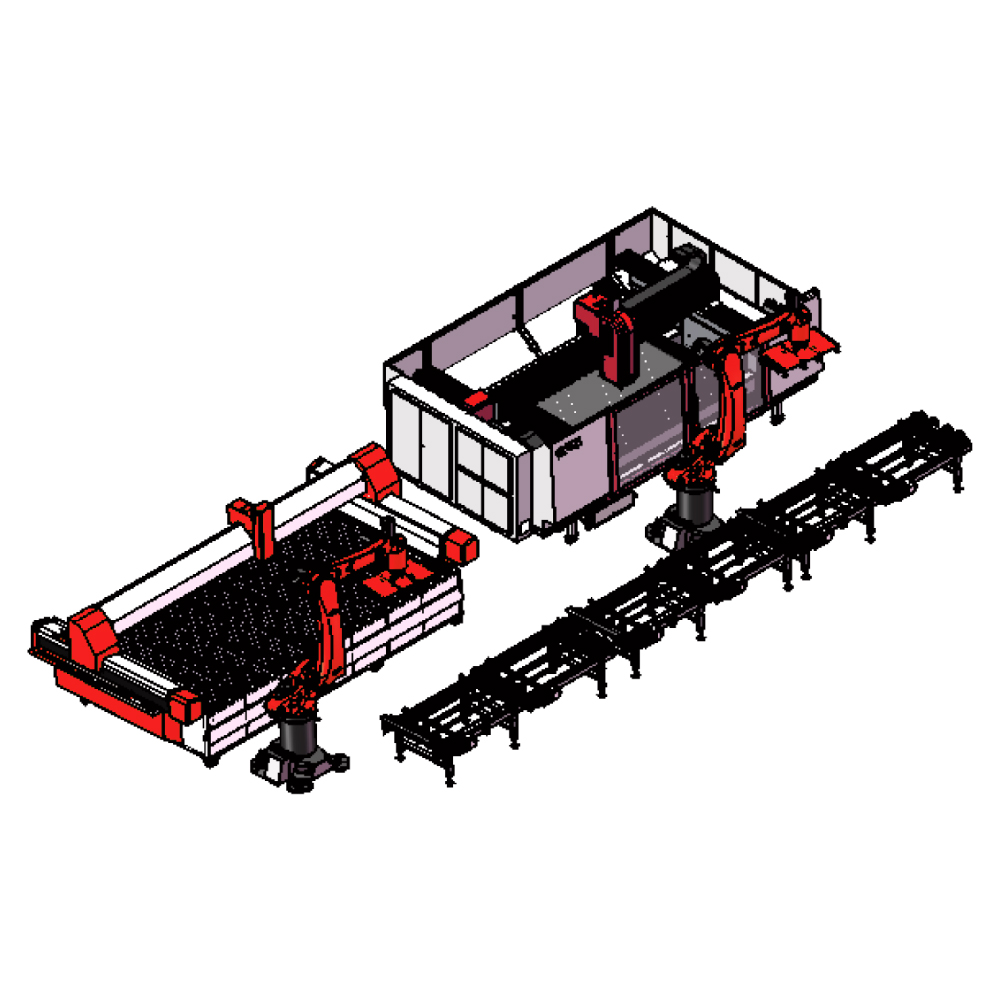
Automation in stone, tile and sintered-stone plants is rising—but its value is not only “how many workers it replaces.” Count capacity, labor, machine utilization, consistency, maintenance and cost per finished product.
Machine purchase price is one part of the investment. The sharper question:
How many qualified products can this equipment help your factory produce each year, and what will it really cost to produce them?
That calculation—not a brochure slogan—should decide separate machines versus an automatic production line.
Request a Project Capacity Calculation / Quote · Inicio · Póngase en contacto con · About HOYUN · Blog · Processing Line
Related reading (live on site)
- Stone fabrication workflow: 4-in-1 Sawjet (workflow angle; this article is total cost / capacity)
- Sawjet vs multi-machine solution
- CNC Sawjet 4-in-1 product overview
- Bridge saw vs waterjet
- 5-axis bridge saw & waterjet buying guide
- CNC bridge saw price guide
- Waterjet cutting machine price guide
About HOYUN MACHINERY
HOYUN MACHINERY manufactures stone, sintered stone and ceramic processing equipment and designs automatic and semi-automatic production lines around product, process and capacity targets.
PREGUNTAS FRECUENTES
Q1: Is an automatic stone production line always cheaper long term?
No. At low volume or with highly variable orders, separate machines can cost less overall. At sustained high capacity, labor and waiting time often flip the comparison toward a line—after a project calculation, not before.
Q2: Does “automatic” just mean conveyors?
No. Positioning, alignment, 90°/180° rotation and direction change are part of real stone machinery automation. Belts alone do not guarantee correct orientation at the next spindle.
Q3: Can an automatic line produce several times more than separate machines?
Under certain product and process conditions, total output can be several times higher. That is not a universal claim. Capacity depends on material, dimensions, process, configuration, line speed and finish quality, and must be calculated per project.
Q4: What should we compare instead of machine price alone?
Cost per finished product, operators per shift, daily / hourly output, transfer time between stations and bottleneck location.
Q5: Who should stay on standalone machines?
Workshops with limited daily volume, frequent product changes or an early-stage market often keep more flexibility with separate machines or a semi-automatic layout.
Q6: How does HOYUN start a line design?
Product and process first: materials, sizes, operations, target daily capacity, labor context and growth plans—then standalone, semi-auto or full auto.
Q7: Where do Sawjets, bridge saws and waterjets fit?
As process cells inside a larger flow. When cutting / waterjet is part of your route, read the Sawjet, bridge-saw and waterjet guides linked above, then discuss how conveying, positioning and rotation connect those cells.
Q8: Why can’t we decide from the day-one machine invoice alone?
Because labor, transfer waits, scrap and utilization accumulate over years of operation. For high-capacity plants, cost per finished product often decides competitiveness more than the first invoice.