


When a stone fabrication business invests in new machinery, the first question is often about price. Yet two machines that look similar can perform very differently in production.
This article is based on a factory-visit technical discussion at HOYUN MACHINERY with an overseas fabricator who has about 25 years of stone-processing experience—including Italian CNC, waterjet, and digital templating. The focus was engineering choices—spindle speed, motor layout, cutting accuracy, CNC options, and maintenance—not a quotation first. Those questions matter most when selecting a 5-axis bridge saw or a 水刀切割机.
HOYUN Machinery focuses on stone and building-material processing equipment—making building-material processing simpler. Site: https://hoyunmachinery.com/. Related: 数控桥锯, AB 5-axis waterjet, CNC Sawjet 5-axis.
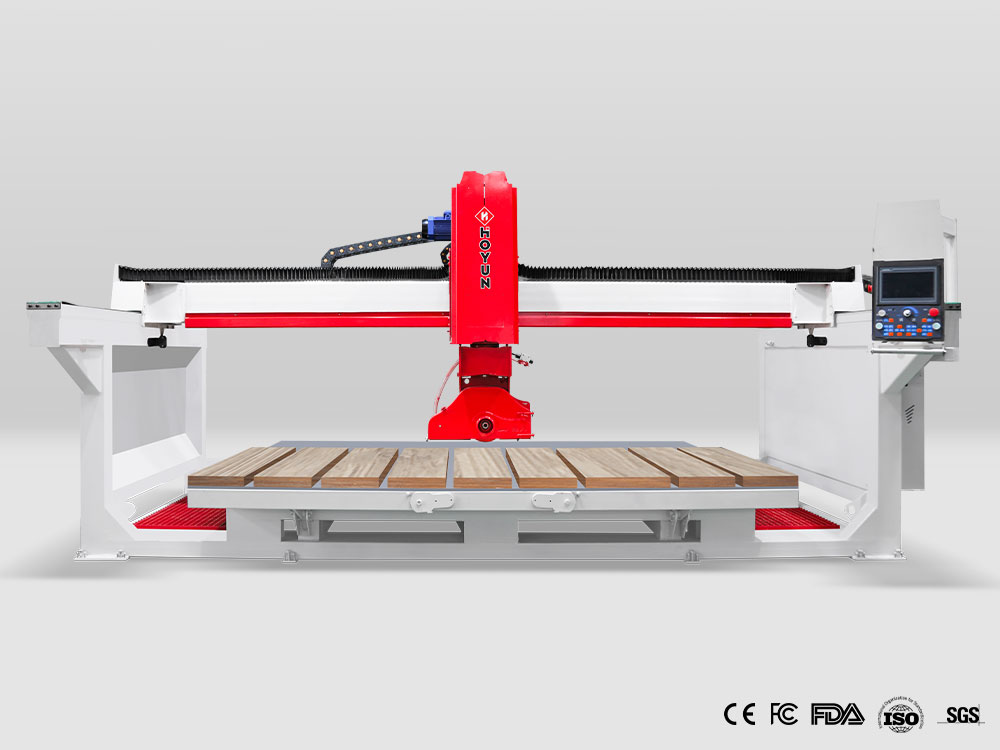
1. Does a Higher Spindle Speed Always Mean a Better Machine?
What is spindle speed? It is how many revolutions per minute (RPM) the saw spindle or milling spindle turns. Higher RPM does not automatically mean better cutting. Bearing specification, spindle rigidity, heat management, tool diameter, and the material being cut all need to be judged together.
A representative question from the visit: why do some machines list a maximum saw-spindle speed around 6,000 RPM, while others advertise 12,000 RPM? The answer sits in mechanical design and intended use. Spindle speed alone does not decide cutting performance.
As a design approach, HOYUN configurations are often built around a main saw spindle of about 6,000 RPM, with an independent milling spindle that can reach about 24,000 RPM—so sawing, profiling, routing, and hole work can use tools suited to each job. Splitting functions can help balance flexibility with mechanical requirements. Confirm exact RPM ratings and test data against the quoted model.
2. Why Does Cutting-Table Structure Matter So Much?
For stone and large-format porcelain (sintered slab) work, a 45° mitre cut needs more than accurate axis motion. The slab must stay stably supported for the whole cut.
The customer asked why a fixed welded support structure is used instead of removable support bars. Removable bars are easy to replace, but gaps, looseness, or shift can move the workpiece—especially critical on 45° mitres, where support affects edge flatness and consistency. Designs that prioritize rigidity (while still allowing designated sections to be replaced) aim at that stability. Final quality still depends on calibration, blade, parameters, and slab condition.
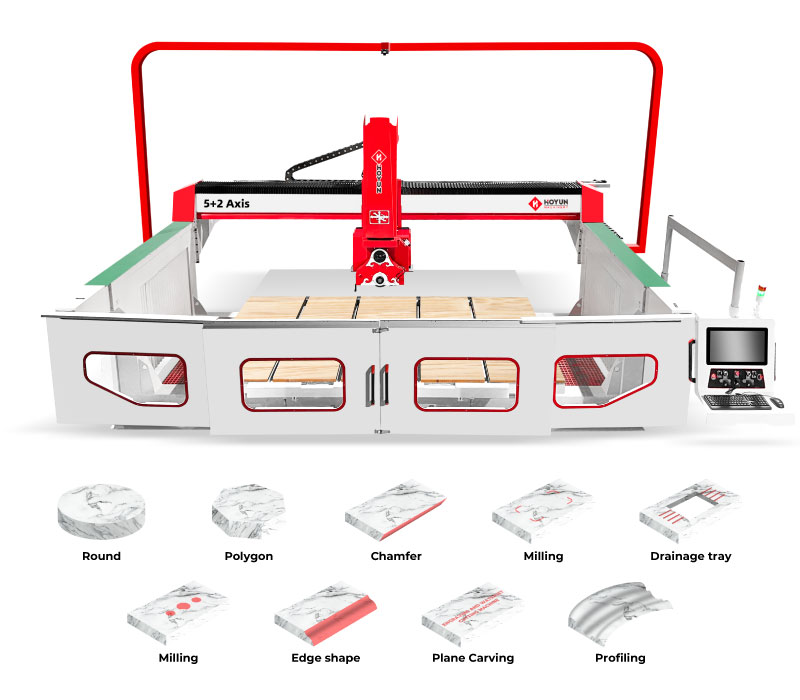
3. Italian CNC Systems vs Chinese / In-House CNC Options — How Should You Choose?
Many experienced fabricators already run European CNC brands. When they buy a new machine, they naturally ask whether to keep a familiar Italian control system or consider another configuration.
HOYUN MACHINERY can supply different CNC control-system options to match customer requirements—not a single forced choice:
- For shops long used to European equipment, a familiar interface and programming environment can be a real advantage.
- An in-house / proprietary control-system option offers another path: the engineering team can often support troubleshooting, software configuration, remote assistance, and later feature work more directly.
Choose based on workflow, programming needs, operator experience, budget, and long-term service expectations. Comparing brand names alone is less useful than running a practical machining test with your own drawings. This article does not claim HOYUN outperforms any named competitor, or that one CNC brand is always better.
4. Why Can Two Waterjet Cutting Machines Differ So Much in Price?
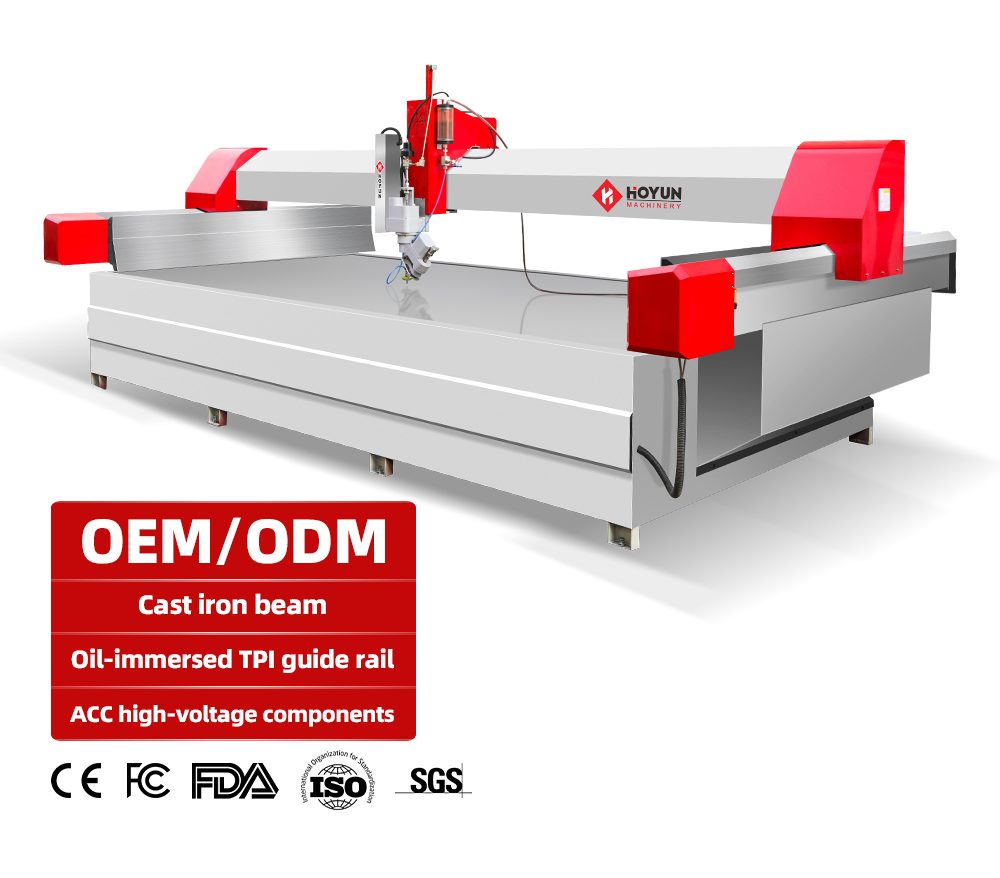
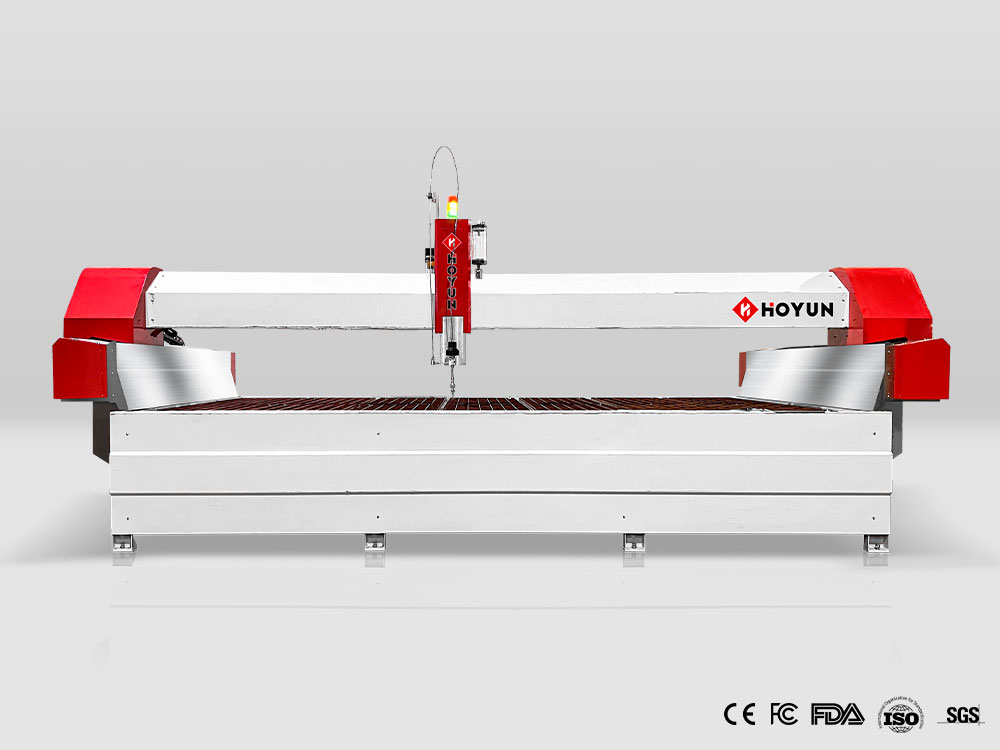
A 水刀切割机 should never be judged by table size alone. Configuration and cost are also driven by the high-pressure system and pump design, main motor power, cutting head, motion control, cooling, and machine structure.
HOYUN’s waterjet range covers multiple working-table sizes. For large-format work, a 4000 × 2000 mm table is often worth considering; a common large-slab size is about 3200 × 1600 mm. Caveat: nominal table size ≠ effective cutting envelope. Compare high-pressure systems, pumps, and components on real operating requirements—not brochure headlines. The goal is not the largest or most expensive model, but a match to your materials, thicknesses, volume, and processes.
5. What Practical Tests Should You Run Before You Buy?
We encourage buyers to evaluate machines through real machining demonstrations—and to insist on measurable results, not only “the machine seems to run smoothly.”
Suggested tests for a 5-axis bridge saw / CNC bridge saw: porcelain / sintered-slab cutting; 45° mitre cutting; profiling / shaping; hands-on review of the CNC operator interface.
Suggested tests for a waterjet cutting machine: cut quality; achievable accuracy; working pressure and cutting parameters; performance on your target materials.
Also ask what happens if power is lost or a job is interrupted: Is job data retained? What steps are required to resume safely after power returns?
Disclaimer (keep on publish): Power-loss data retention and safe resume behavior depend on the specific model, control-system features, and on-site verification. Do not attribute recovery capability solely to RTCP or any single named function.
6. Why Is After-Sales Support Part of the Buying Decision?
During the visit, the customer returned again and again to after-sales service. We agree it belongs on the CapEx checklist.
Solid specifications still fail shops if downtime, software issues, or hard-to-source repairs pile up. Before purchase, clarify:
- Operator training plan
- Spare-parts lead times and channels
- Remote technical support capability
- Day-to-day maintenance requirements and clear procedures
At HOYUN MACHINERY, we prefer customers to understand operation, process capability, and maintenance—rather than focusing only on the first quotation.
Final Thoughts: The Right Machine Is the One That Fits Your Factory
A 5-axis bridge saw or a waterjet is a long-term investment. The best machine is not necessarily the highest spindle speed, the most expensive CNC, or the lowest price—it is the one whose design, capability, performance, and service match your materials, capacity, and workflow.
HOYUN MACHINERY welcomes fabricators to bring drawings, materials, and process requirements for real cutting tests before finalizing configuration. Related reading: CNC Sawjet 4-in-1 overview.
FAQ: 5-Axis Bridge Saw & Waterjet Buying Guide
Is a 6,000 RPM main saw spindle “too slow”?
Not necessarily. RPM must match bearings, rigidity, cooling, tooling, and material. Many designs separate sawing from high-speed milling with a main saw spindle plus an independent milling spindle. Confirm exact RPM options against the quoted model and test reports.
Is a fixed welded support table always better than removable bars?
Each approach has trade-offs. Removable bars are easier to replace; fixed welded structures emphasize rigidity and slab stability during 45° mitres. End results still depend on calibration, blade, parameters, and slab condition.
Which is better: Italian CNC or Chinese / in-house CNC?
There is no single answer. It depends on operator habits, programming needs, budget, and service expectations. Decide after on-site tests with your own drawings.
Is a bigger waterjet table always better?
Not always. First confirm that the effective cutting envelope covers your target slabs (for example, about 3200 × 1600 mm porcelain). Then compare high-pressure pump, motor, cutting head, and motion control against your capacity needs.
What should you watch most carefully during a factory cutting test?
On a bridge saw: sintered/porcelain cutting, 45° mitres, profiling, and the operator interface. On a waterjet: quality, accuracy, pressure, and performance on your materials. Also clarify power-loss / interrupt data retention and the safe resume procedure—without simplifying that behavior to a single function name.
Request a Cutting Test / Get a Customized Quotation
If you are selecting a 5-axis bridge saw, 数控桥锯, or 水刀切割机 for stone or large-format slab fabrication, bring your drawings and materials for a factory cutting test—or contact us for a configuration recommendation matched to your materials and capacity.
Request a Cutting Test / Get a Customized Quotation
Website: https://hoyunmachinery.com/
Bridge saw: CNC bridge saw category · Waterjet: AB 5-axis waterjet · Combined platform: CNC Sawjet